About the Journal
About the Journal
JSQ: Jurnal Studi Al-Qur’an
Jurnal Studi Al-Qur’an (JSQ) is an international, peer-reviewed, open-access journal dedicated to scholarly inquiry into the Qur’an and its relationship with education, interpretation, and the transmission of knowledge. It examines how the Qur’an is taught, interpreted, and applied, from classical learning traditions and pesantren to contemporary schools, universities, and digital environments.
Published in print since 2005, online since 2013, and on the UNJ journal portal since 2017 (Journal History).
Journal Information
| Journal title | Jurnal Studi Al-Qur’an (JSQ) |
| ISSN | P-ISSN 0216-1648 · E-ISSN 2339-2614 |
| DOI prefix | 10.21009 |
| Publisher | LPPM Universitas Negeri Jakarta, Indonesia |
| Editor-in-Chief | Rihlah Nur Aulia (Editorial Team) |
| Frequency | Twice a year, January and July |
| Language | English |
| Peer review | Double-blind, at least two reviewers |
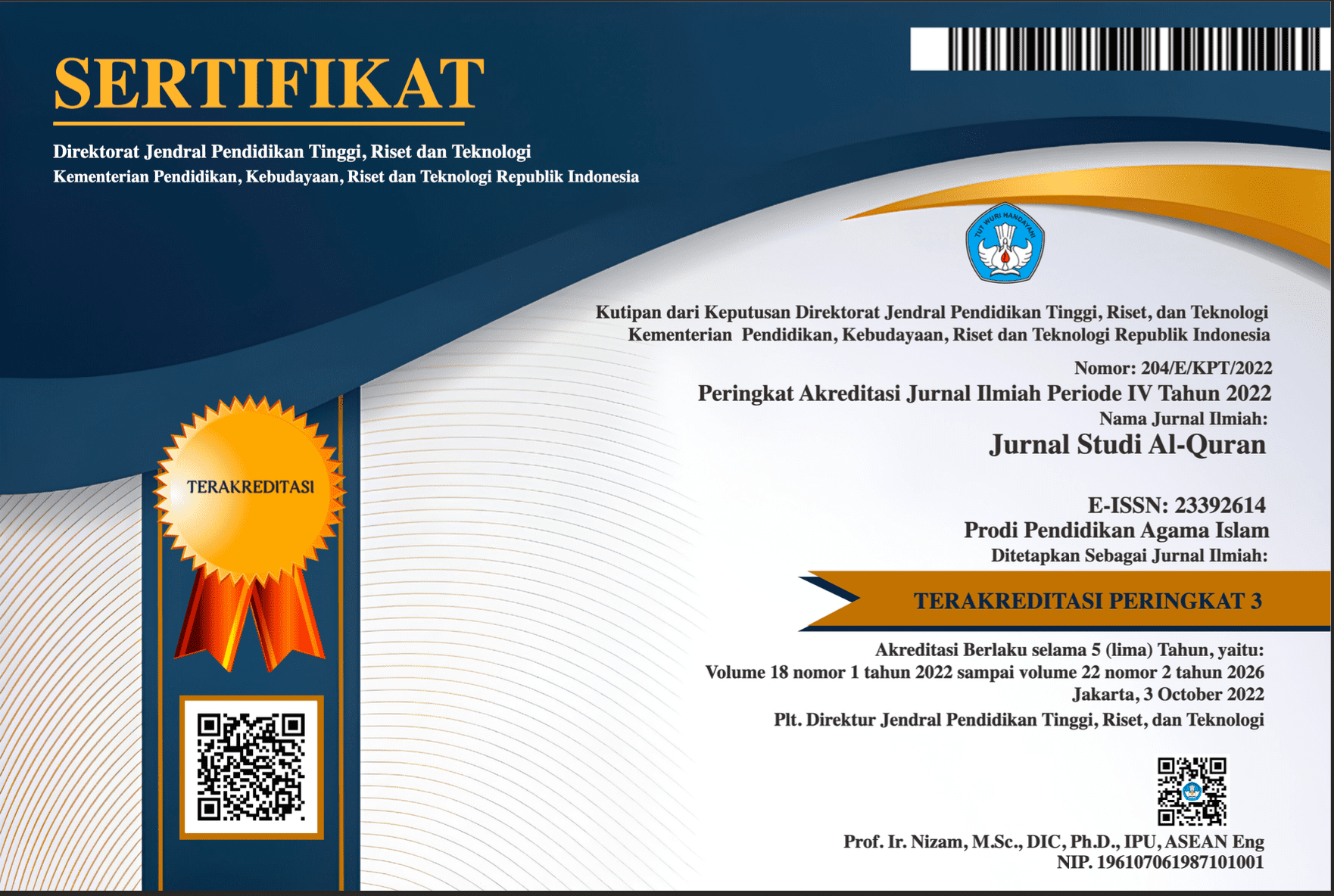
| Accreditation | SINTA 3 (Decree No. 204/E/KPT/2022) |
| Indexing | SINTA, DOAJ, Garuda, Google Scholar, Crossref, Dimensions (more) |
| Access | Open access, CC BY 4.0; authors retain copyright |
| Author fee | Free submission; APC IDR 1,000,000 after acceptance |
| Contact | jurnalstudialquran@unj.ac.id |
Aims
JSQ aims to advance scholarship on the Qur’an and its role in education, interpretation, and the transmission of knowledge. By connecting classical Qur’anic traditions with contemporary educational practice, the journal seeks to provide an international forum where researchers, educators, and practitioners can exchange ideas, and to make Qur’anic scholarship freely accessible to readers worldwide through open access.
Focus and Scope
Explores how the Qur’an shapes understanding, learning, educational philosophy, pedagogy, and curriculum.
Explores how the Qur’an forms virtue, character, ethical responsibility, and citizenship.
Explores how educators and leaders enact change, including science, technology, and AI in education.
Explores how Qur’anic education contributes to sustainability, justice, and human development.
Article Types
Manuscripts are written in English using the JSQ template. See Manuscript Type and Author Guidelines for details.
Peer Review
Journal Policies
JSQ follows the guidelines of the Committee on Publication Ethics (COPE). Click a policy to read it in full.