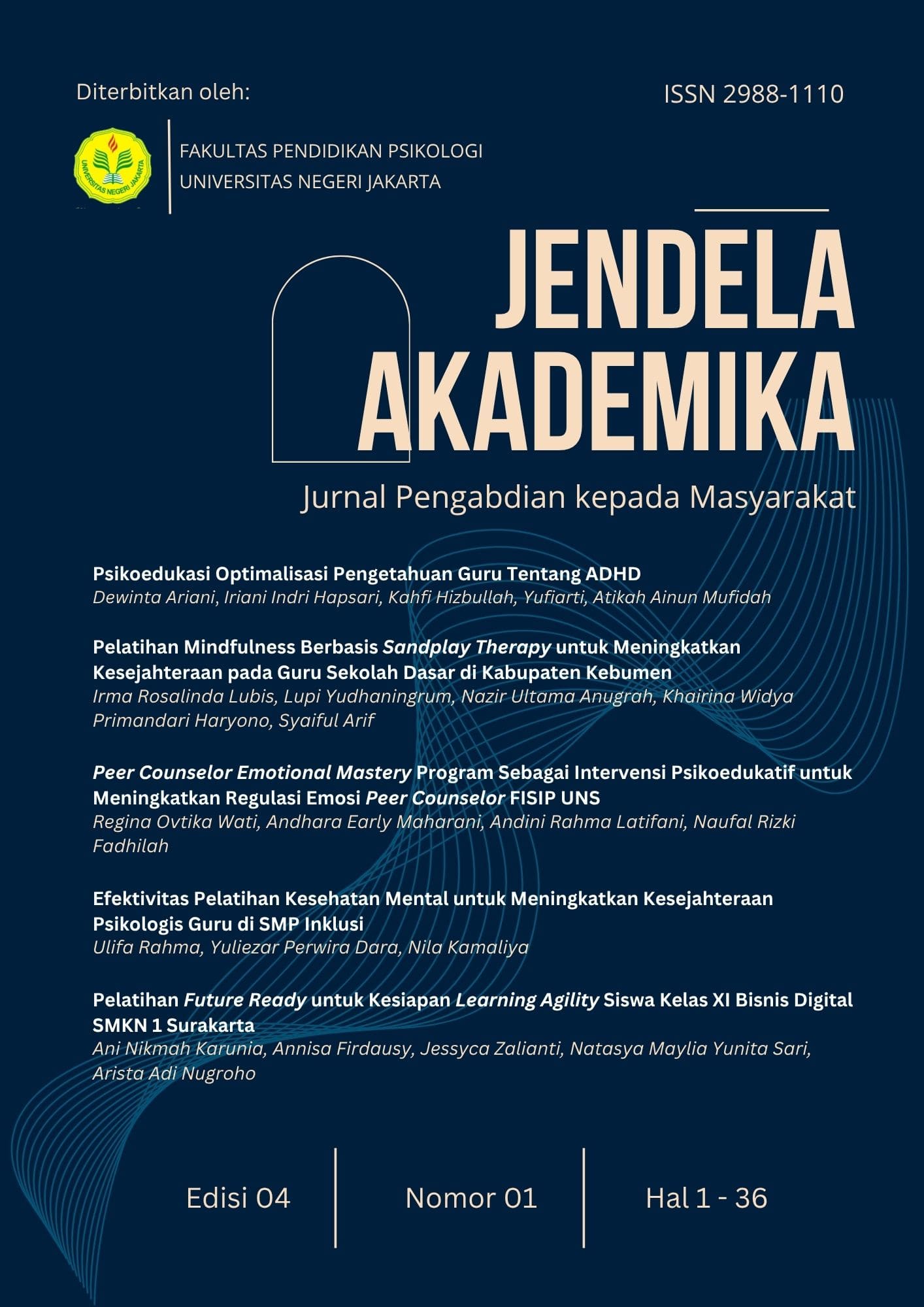
PELATIHAN FUTURE READY UNTUK KESIAPAN LEARNING AGILITY SISWA KELAS XI BISNIS DIGITAL SMKN 1 SURAKARTA
DOI:
https://doi.org/10.21009/JendelaAkademika.401.05Kata Kunci:
Learning Agility, Vocational Education, TrainingAbstrak
In the era of Industrial Revolution, industries require not only technical skills but also adaptive capabilities, flexible thinking, psychological resilience, and career direction awareness (Schwab, 2017). Indonesian Vocational High School (SMK) have a strategic role in preparing graduates to enter the workforce. Data from the Central Bureau of Statistics (BPS, 2023) show that SMK graduates still have the highest unemployment rate among all educational levels, reaching 9.42%. In Surakarta, Wibowo (2024) reports the unemployment rate of SMK graduates remains the highest compared to other education levels, at 1.85%. These conditions highlight the need to strengthen student’s learning agility to navigate a dynamic and unpredictable work environment. To address these challenges, the research team designed and implemented a learning agility training. The training included a conceptual introduction, reflective activities, and interactive sessions that operationalized the dimensions of learning agility. The study employed a quasi-experimental one group pretest-posttest design and was conducted at SMKN 1 Surakarta. Participants were selected from the class with the lowest average pretest score, resulting in a final sample of 28 students from Grade 11 Digital Business-1. After the training, participants required to complete the posttest. Descriptive and inferential analyses showed no significant difference between pretest (M = 142) and posttest (M = 139) scores, t(27) = 1.50, p = 0.144, with a small effect size (d = 0.284). These findings indicate that the short duration and compact schedule may have limited its statistical impact, suggesting the need for longer or multi-session interventions in future programs.
Keywords
Learning Agility, Vocational Education, Training
Unduhan
Diterbitkan
Cara Mengutip
Terbitan
Bagian
Lisensi
Hak Cipta (c) 2026 Ani Nikmah Karunia, Annisa Firdausy, Jessyca Zalianti, Natasya Maylia Yunita Sari, Arista Adi Nugroho

Artikel ini berlisensi Creative Commons Attribution-NonCommercial 4.0 International License.