MAIN MENU
SUBMISSIONS
PUBLICATIONS
INFORMATIONS
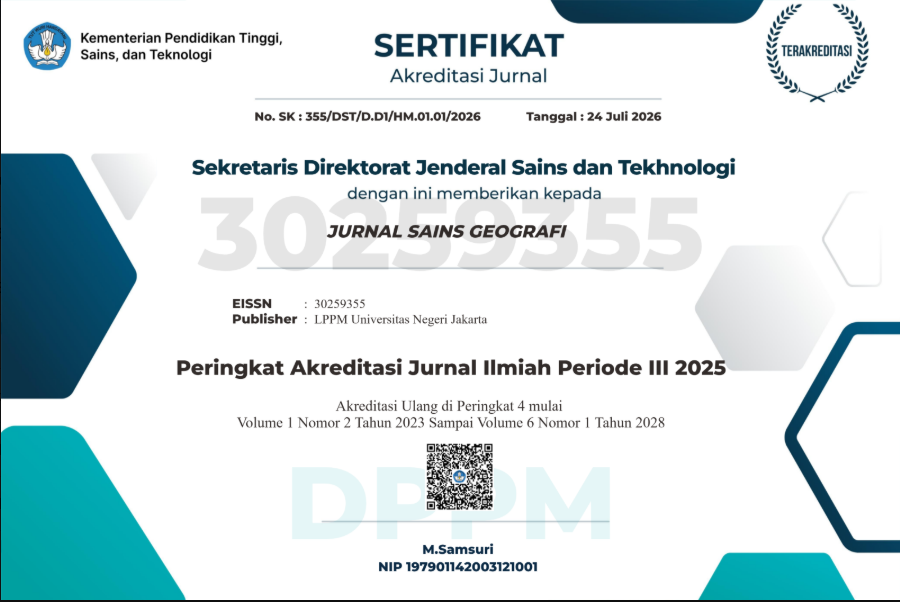
SINTA ACCREDITATION

ABSTRACTING & INDEXING


SUPPORTED BY

TOOLS



Volume 2, Issue 2 of the journal presents six scientific articles highlighting the role of geospatial technology in various strategic sectors in Indonesia. The opening study explores the potential for marine tourism development based on mangrove ecosystems in Pari Island, Thousand Islands, as a pathway to strengthen sustainable coastal economies. Critical environmental zones in Surabaya City are examined through NDVI and LST approaches to map degradation-prone areas. This is followed by a study of shoreline change in the coastal district of Banggae using the Digital Shoreline Analysis System, underlining the need for remote sensing-based environmental monitoring. Land use change is another major theme, explored through two separate studies. The first analyzes changes in Pekalongan City between 2013 and 2023 using Landsat 8 imagery, while the second uses the NDVI method to assess land cover dynamics in Sukoharjo Regency over the same period—offering insights for spatial planning policies. Lastly, the application of web-based Geographic Information Systems (GIS) is highlighted through flood vulnerability mapping in Kelapa Gading Timur, North Jakarta. This research demonstrates the relevance of GIS in delivering spatial information for disaster preparedness in densely populated urban settings. This issue underscores the contribution of Indonesian scholars in producing spatial data with direct relevance to development policy and risk mitigation, especially in regions facing environmental change.
MAIN MENU
SUBMISSIONS
PUBLICATIONS
INFORMATIONS
SINTA ACCREDITATION
ABSTRACTING & INDEXING
SUPPORTED BY
TOOLS
