MAIN MENU
SUBMISSIONS
PUBLICATIONS
INFORMATIONS
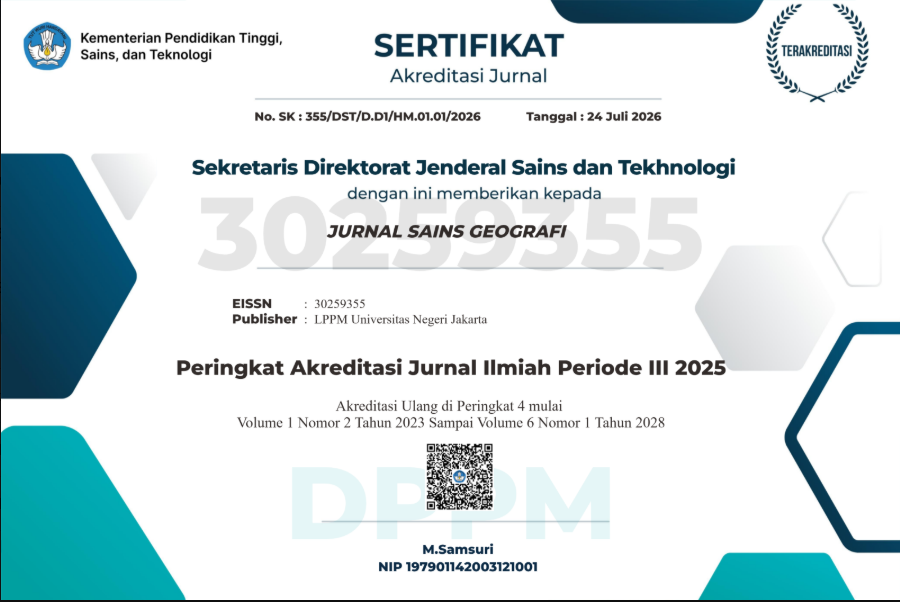
SINTA ACCREDITATION

ABSTRACTING & INDEXING


SUPPORTED BY

TOOLS




This edition of the Jurnal Sains Geografi, Volume 4, Number 1 (May 2026), presents nine articles addressing various strategic regional issues using a geospatial approach, spanning environmental, urban, socio-economic, and tourism sectors. From an environmental and disaster mitigation perspective, studies such as "Multi-Sensor NDVI Analysis of Eruption Impacts and Vegetation Recovery at Mount Kelud, East Java" and "Identification of Regional Vulnerability Levels in Facing Disasters in Cirebon City" highlight efforts to monitor ecological changes and reduce disaster risks. Additionally, the intersection of physical geography, tourism, and disaster preparedness is deeply examined in two related articles: "Geomorphological Instability and Socio-Economic Resilience of Goa Lowo Tourism, Trenggalek Post-Regional Access Change" and "Disaster Mitigation-Based Management Strategy for Gua Lowo Trenggalek Tourism Object."
The issue of socio-economic dynamics, tourism development, and spatial modeling is another important focus in this edition. The articles "The Role of Social Media in Increasing Tourism Visits: Analysis of Viral Destinations in Indonesia" and "Optimization of Urban Tourism Potential Through the Integration of Spatial Analysis and SWOT: A Case Study of Gambir District, Central Jakarta" discuss modern analytical approaches to boosting the tourism sector. Furthermore, "Spatial-Statistical Analysis of the Relationship Between Population Density and the Distribution of Active Cooperatives in Jember Regency, Indonesia" provides valuable insights into local economic distributions. This issue also features applied spatial and behavioral modeling, as seen in the "Spatio-Temporal Trend Analysis of Total Suspended Solids (TSS) for the 2018-2025 Period Using Sentinel-2 Near-Infrared Band 8 Regression Model (Case Study: Gajah Mungkur Reservoir, Wonogiri)" and "Analysis of Factors Affecting the Choice of Transportation Mode to Campus by Geography Students at Jakarta State University." Overall, the articles in this issue emphasize the important role of geographic science, remote sensing, and GIS in supporting spatial planning, disaster mitigation, and sustainable development in Indonesia.

This edition of the Jurnal Sains Geografi, Volume 3, Nomor 2 (2025), presents ten articles addressing various strategic regional issues using a geospatial approach, in coastal, urban, and rural areas. A study, "Availability of Senior High School Education Facilities and Estimated Number of Students for Projected Classroom Space Requirements in Wonosobo Regency in 2029," highlights planning for future high school classroom needs, while the article, "Sustainable Livelihoods of Heads of Families Receiving Land Redistribution in Getasan District, Semarang Regency," discusses the socio-economic dimensions of agrarian resource management. From a disaster mitigation perspective, two articles, "Tsunami Risk Mitigation Using Geographic Information Systems in Pesawaran Regency, Lampung Province," and "Tsunami Risk Mitigation Based on Regional Vulnerability and Evacuation Shelter Distribution in East Telukbetung," examine tsunami risk reduction efforts based on regional vulnerability and the availability of evacuation infrastructure.
The issue of environmental change and urban climate is another important focus in this edition. The articles Spatial Analysis of Vegetation Cover Change and Land Surface Temperature in Cirebon City Using Remote Sensing Data, Analysis of the multitemporal urban heat island (UHI) phenomenon in 2019–2024 with Google Earth Engine (GEE) in Semarang City, Spatio-Temporal Analysis of Land Cover and LST AST at the University of Indonesia and the University of Indonesia Library Area. On the other hand, the article the Development Pattern of Depok City Using the Landscape Expansion Index (LEI) in 2005–2025 maps the long-term urban expansion pattern. Overall, the articles in this issue emphasize the important role of geographic science, remote sensing, and GIS in supporting spatial planning, disaster mitigation, and sustainable development in Indonesia.

Volume 3, Issue 1 of this journal features eight scientific articles addressing strategic issues in spatial analysis, environmental management, and the application of geospatial technologies for sustainable development. The issue opens with a study on landslide vulnerability using the CMA method in Tana Toraja Regency, offering spatial insights for disaster risk reduction. Another article explores the spatial interaction between villages and urban areas in Medan City and Percut Sei Tuan District, highlighting patterns of urbanization and population mobility. A demographic study then examines population density distribution in North Sumatra Province using the 2020 census data to support regional planning. Environmental concerns are raised through two papers: one on land suitability analysis for final waste disposal (TPA) in South Manokwari Regency, and another on the groundwater quality around a landfill in Bekasi, revealing the impact of land use decisions on public health. Ecological research is represented by a study estimating carbon absorption in mangrove ecosystems on Tidung Kecil Island, emphasizing blue carbon conservation. The issue also includes an assessment of land carrying capacity for urban housing in Sentani and an evaluation of residential land suitability in Bandung Regency using Geographic Information Systems (GIS). All articles in this edition are contributed by Indonesian academics and researchers, showcasing a strong commitment to spatial data-based research. We extend our gratitude to the authors and the reviewers who ensured the scientific integrity of every article published.
Volume 2, Issue 2 of the journal presents six scientific articles highlighting the role of geospatial technology in various strategic sectors in Indonesia. The opening study explores the potential for marine tourism development based on mangrove ecosystems in Pari Island, Thousand Islands, as a pathway to strengthen sustainable coastal economies. Critical environmental zones in Surabaya City are examined through NDVI and LST approaches to map degradation-prone areas. This is followed by a study of shoreline change in the coastal district of Banggae using the Digital Shoreline Analysis System, underlining the need for remote sensing-based environmental monitoring. Land use change is another major theme, explored through two separate studies. The first analyzes changes in Pekalongan City between 2013 and 2023 using Landsat 8 imagery, while the second uses the NDVI method to assess land cover dynamics in Sukoharjo Regency over the same period—offering insights for spatial planning policies. Lastly, the application of web-based Geographic Information Systems (GIS) is highlighted through flood vulnerability mapping in Kelapa Gading Timur, North Jakarta. This research demonstrates the relevance of GIS in delivering spatial information for disaster preparedness in densely populated urban settings. This issue underscores the contribution of Indonesian scholars in producing spatial data with direct relevance to development policy and risk mitigation, especially in regions facing environmental change.
Volume 2, Issue 1 of the journal features six scientific articles discussing various strategic issues in the context of geospatial technology utilization, environmental management, and innovation in disaster mitigation and infrastructure development. This issue opens with a study on the use of Geographic Information Systems (GIS) to determine costs and assess the integration between two main modes of transportation in Jakarta, namely KRL and Transjakarta. This research aims to support the improvement of the effectiveness of public transportation systems in metropolitan areas through a spatial approach.
Next, there is a literature review discussing the phenomenon of mud volcanoes and the characteristics of mud that emerged in Bledug Kuwu, Central Java. This article reviews previous studies on geological processes, mud material content, and potential risks. From the marine and coastal environment sector, two articles focus on Pari Island, Thousand Islands. The first article assesses the health condition of coral reefs at a snorkeling tourist site using observation and spatial mapping methods, while the second article discusses changes in seawater quality and their impact on the sustainability of seaweed cultivation, which is a livelihood source for the local community.
One article in this edition also highlights the application of weather modification technology, specifically the optimization of cloud seeding methods to increase rainfall. This study demonstrates the role of atmospheric intervention in mitigating the impacts of extreme droughts in various regions of Indonesia. The final article addresses the mapping of changes in building density in the city of Sukabumi between 2018 and 2023 using the Normalized Difference Built-Up Index (NDBI) approach, which shows the growth of built-up areas and its implications for urban planning.
All articles in this edition are contributions from Indonesian academics and researchers, demonstrating a commitment to the development of research based on spatial and environmental data. We extend our gratitude to the authors for their contributions, as well as to the peer reviewers who ensured the scientific quality of each published article.
The Journal of Geography Science Volume 1 Issue 2 contains nine scientific articles that examine various spatial issues using a Geographic Information System (GIS) approach. The articles in this issue showcase diverse applications of GIS in the context of disaster risk mapping, land use change analysis, and the distribution of public facilities in urban and suburban areas. One article discusses landslide vulnerability mapping in Serang District, Banten, using scoring and overlay methods, aimed at identifying high-risk zones as an initial step in disaster mitigation.
Land use change analysis is a key focus in this edition, including an analysis of land use changes affecting green open spaces in Srengseng Sawah Village, South Jakarta, and a temporal study of land changes in Gunungpati District, Semarang, for the years 2002, 2012, and 2022. In the context of educational facilities, two articles highlight the distribution patterns of public elementary schools in Johar Baru District and high schools in Koja District, North Jakarta. Both use the Nearest Neighbor Analysis (NNA) approach to evaluate the accessibility and spatial distribution of educational facilities.
The issue of flood preparedness is also addressed in a study on elite residential areas in Mampang Prapatan District, South Jakarta, focusing on the relationship between flood-prone areas and community responses. Additionally, this edition features a spatial cluster analysis of the distribution of Integrated Child-Friendly Public Spaces (RPTRA) in Central Jakarta, as well as a study on the distribution of District General Hospitals (RSUD) in South Jakarta using the NNA method. The final article presents an analysis of the distribution of health facilities in Jakarta using the Geographically Weighted Regression approach, aiming to understand the spatial relationship between facility locations and socio-demographic variables.
All articles in this edition were written by researchers from Indonesia, demonstrating a strong commitment to integrating geospatial technology to support regional planning, public services, and disaster risk reduction. We extend our gratitude to the authors and peer reviewers for their contributions to the publication of this edition.

This first edition of Volume 1 of the Journal of Geography Science contains ten articles that explore the use of Geographic Information Systems (GIS) in various spatial contexts across Indonesia. Some studies focus on urban areas in Jakarta, such as an analysis of the distribution of Mixue ice cream shops in East Jakarta using the buffering method, an estimation of land value in Koja District, and a study on the distribution patterns of gas stations in East Jakarta. Additionally, there are articles discussing fire risks in densely populated residential areas of Penjaringan District, as well as mapping the distribution patterns of malls and the distribution of firefighting facilities (DAMKAR) in Central Jakarta using various spatial approaches.
This edition also includes studies outside Jakarta, such as the identification of forest fire hazards in Riau Province and an analysis of land use changes in the core area of the National Capital Region (IKN) in Penajam Paser Utara District, East Kalimantan, between 2019 and 2023. The use of GIS in the context of sustainability is also evident in a study on the mapping of urban parks in South Jakarta. Finally, there is also an analysis of the distribution patterns and accessibility of health facilities to settlements in Pulo Gadung Subdistrict using buffering and nearest neighbor analysis approaches.
The authors in this edition are from Indonesia, with contributions reflecting diverse technical approaches and methodological innovations in spatial studies. We extend our heartfelt gratitude to all authors and peer reviewers who have played a crucial role in the preparation of this edition.
MAIN MENU
SUBMISSIONS
PUBLICATIONS
INFORMATIONS
SINTA ACCREDITATION
ABSTRACTING & INDEXING
SUPPORTED BY
TOOLS
