
About the Journal
Hayula: Indonesian Journal of Multidisciplinary Islamic Studies is an international, peer-reviewed, open-access journal established in 2017 and published biannually in January and July. The journal advances multidisciplinary Islamic studies, with local wisdom and intangible cultural heritage serving as a defining lens through which it examines Islamic law, education, political life, and religious practice. This reflects the conviction that Islamic thought and practice are most meaningfully understood through the cultural and communal contexts in which they are lived, negotiated, and transmitted. This focus also affirms the value of cultural pluralism within the Muslim world, recognizing the diverse ways Islamic life is expressed and practiced across different societies as a legitimate and valuable source of scholarly knowledge.
This orientation is not confined to the Indonesian context: the journal welcomes studies of local wisdom, indigenous knowledge, and cultural heritage from Muslim societies worldwide. Committed to advancing internationally relevant scholarship, Hayula promotes research that bridges locally grounded knowledge with regional and global academic debates, contributing to the advancement of contemporary Islamic studies.
Building upon this distinctive orientation, Hayula explores how Islamic values, ideas, identities, knowledge traditions, and social practices are expressed, interpreted, negotiated, and transformed across five thematic areas: (1) intangible cultural heritage, local wisdom, and socio-cultural dynamics in Islamic identity and social resilience; (2) Islamic law, governance, and economic ethics in communal and institutional practice; (3) Islamic education and political thought in local and global contexts; (4) spirituality, religiosity, and evolving religious practice; and (5) gender, family, and everyday religious life in Muslim communities. By bridging Islamic studies with the social sciences, humanities, and cultural analysis, the journal treats locally situated knowledge as an important source of scholarly insight into contemporary Muslim experiences.
Contributions engaging any of the journal's five thematic areas are equally welcome from any national or regional context, whether or not they are framed explicitly through local wisdom or cultural heritage, provided they demonstrate clear relevance to the human and social dimensions of Islamic life.
The journal welcomes original research articles and scholarly review papers from a broad range of disciplinary perspectives, including Islamic studies, education, sociology, anthropology, law, economics, political science, communication, and cultural studies. All submissions undergo a rigorous double-blind peer-review process and are evaluated based on originality, methodological rigor, theoretical contribution, engagement with global scholarly debates, ethical integrity, and scholarly significance. To ensure transparency, accountability, consistency, and quality assurance, the journal implements a formal Standard Operating Procedure (SOP) throughout the editorial and publication process.
Hayula is published by the Institute for Research and Community Service (LPPM), Universitas Negeri Jakarta, in collaboration with the Association of Indonesian Islamic Education Lecturers (ADPISI) and the Association of Islamic Higher Education Graduate Programs (APPKI). The journal is indexed and abstracted in major scholarly databases, including SINTA, DOAJ, Crossref, Dimensions, Google Scholar, and Garuda. Through its commitment to editorial excellence and international scholarly collaboration, Hayula continues to strengthen its global visibility and contribute to contemporary discussions on Islam and Muslim societies.
Current Issue
Geographical Diversity of Authors: 


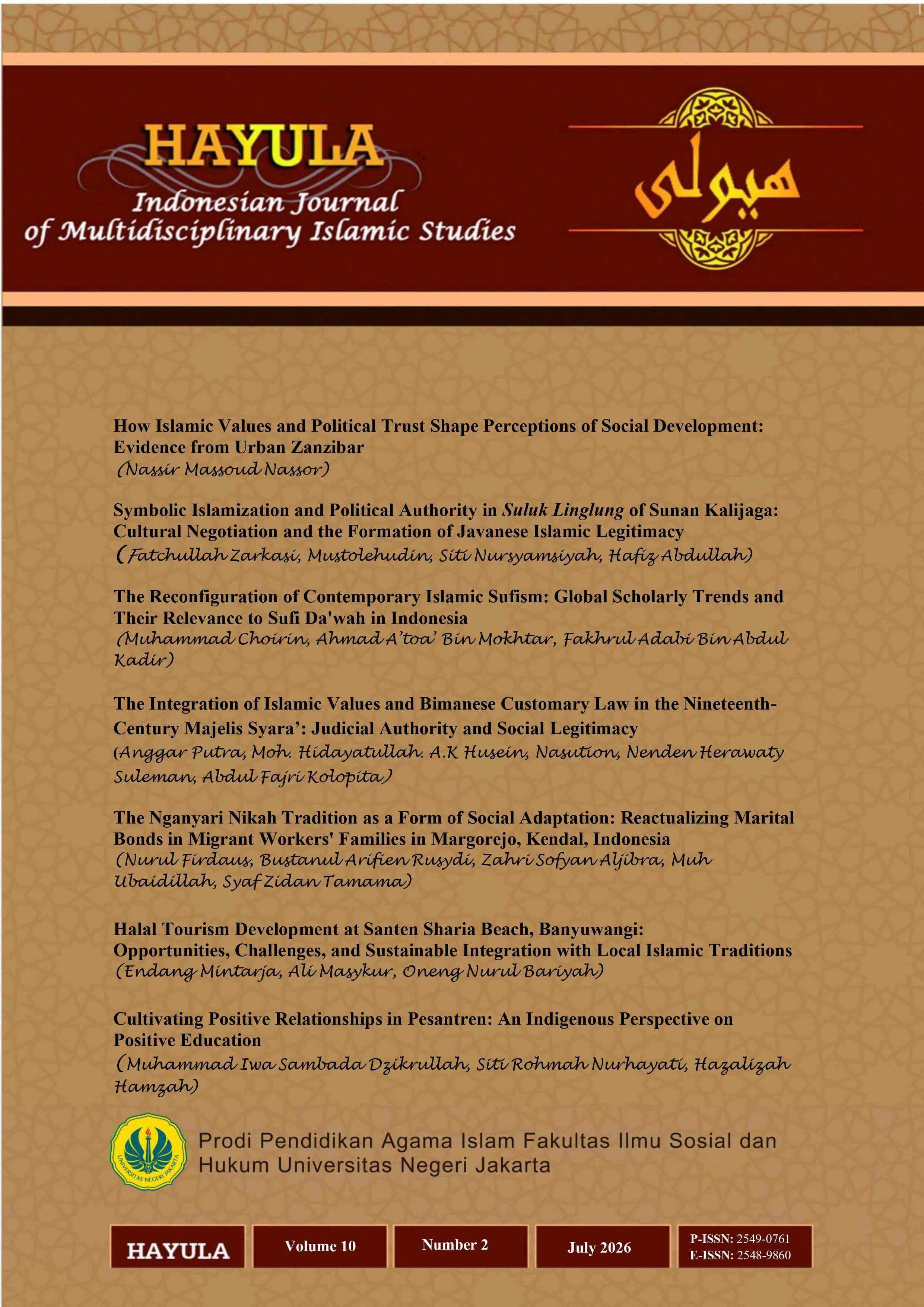
This issue explores a wide range of topics, including how Islamic values and political trust shape perceptions of social development in urban Zanzibar, symbolic Islamization and political authority in the Suluk Linglung of Sunan Kalijaga, and the reconfiguration of contemporary Islamic Sufism and its relevance to Sufi da'wah in Indonesia. Furthermore, this edition covers the historical integration of Islamic values and Bimanese customary law in the nineteenth-century Majelis Syara’, the Nganyari Nikah tradition as a form of social adaptation in migrant workers' families in Kendal, halal tourism development at Santen Sharia Beach in Banyuwangi, and cultivating positive relationships through an indigenous perspective in pesantren. In alignment with our global academic outreach, the contributing authors represent a diverse group of esteemed scholars affiliated with academic institutions from Indonesia, Tanzania, Egypt, Pakistan, Malaysia, and Saudi Arabia. This international representation reflects the richness of scholarly perspectives and the global relevance of the themes discussed in contemporary Islamic studies.


