The Impact of Varying Water Turbine Blade on Performance of Pico Hydro Power Plants
DOI:
https://doi.org/10.21009/JKEM.10.2.2Keywords:
prototype, kaplan, pelton, voltage, current, power generatorAbstract
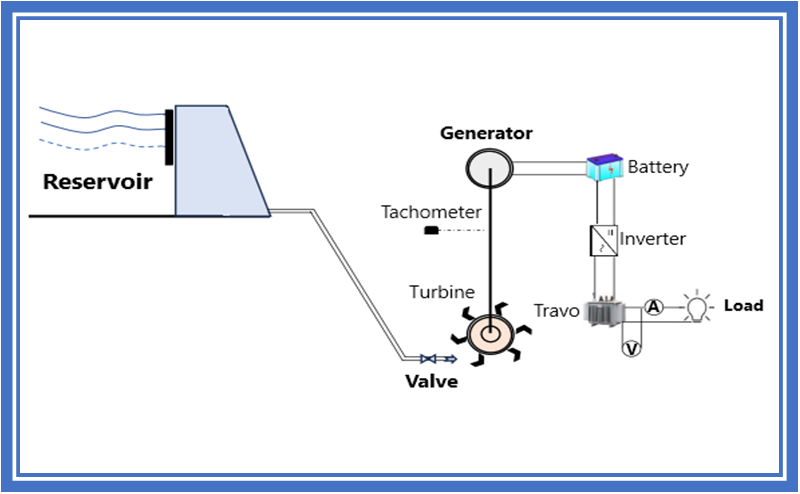
This study has a purpose to determine the number of blades effect on a water turbine regarding flow rate and turbine rotation. The turbine utilized in this study is a Pelton-type impulse turbine, which harnesses potential energy and water pressure to enhance its rotational speed. Additionally, it examines how turbine rotation affects voltage, current, and electric power generated. This research is an experimental study focusing on a prototype mini-micro hydro water turbine. The testing involved varying the valve openings at angles of 36°, 54°, 72°, and 90°, as well as the number of blades, which were set to 6, 8, and 10. The output parameters were measured using instruments that met the specifications for the test equipment. The results indicated that the minimum water discharge required to drive the turbine prototype was 30 cm³/s at a valve opening of 36°. The minimum power generated for each variation in the number of blades was as follows: 0.114 W for 6 blades, 1.426 W for 8 blades, and 1.672 W for 10 blades. At the maximum valve opening of 90°, a flow rate of 67 cm³/s was achieved. Under these conditions, the turbine generated powers of 1.5 W for 6 blades, 7.593 W for 8 blades, and 8.16 W for 10 blades. These findings demonstrate that the performance of the micro-hydro power generation system is significantly influenced by water discharge, turbine rotation speed, and the specifications of the power generator used. This study provides valuable insights for developing renewable energy sources to supply electricity in remote areas with limited access to conventional energy. Furthermore, the results can serve as a foundation for designing more efficient and sustainable micro-hydro systems in the future. The results indicate that an increase in the number of turbine blades leads to greater kinetic energy in the water, which in turn raises the rotational speed of the turbine. This increase in kinetic energy enhances the conversion of water energy into mechanical energy, resulting in improved efficiency of the turbine.
References
[1] Hendrayansyah, “Pengembangan potensi energi hidro guna meningkatkan perekonomian nasional,” Lembaga Ketahanan Nasional Republik Indonesia, Jakarta, 2024, p. 93, [Online]. Available: http://lib.lemhannas.go.id/public/media/catalog/0010-092400000000057/swf/7829/44%20-%20Hendrayansyah.pdf.
[2] I. B. G. W. Negara, I. G. N. Janardana, and I. W. A. Wijaya, “Studi potensi pembangkit listrik tenaga piko-hydro di aliran sungai irigasi subak werdi putra sedana kabupaten badung,” J. Spektrum, vol. 9, no. 2, pp. 148-157, 2022, doi: 10.24843/SPEKTRUM.2022.v09.i02.p17.
[3] A. M. A. Bawani and Sudarti, “Analisis kelemahan dan kelebihan pembangkit listrik tenaga mikrohidro (PLTMH) sebagai alternatif sumber energi listrik,” JKF, vol. 5 no. 2, pp. 99-104, 2022, doi: 10.33369/jkf.5.2.99-104.
[4] A. N. Sonjaya, F. S. Nugroho, and M. V. Vindiawan, “Perencanaan turbin pelton untuk pembangkit listrik tenaga mikrohidro kapasitas 100 watt,” J. Tek, vol. 11, no. 1, pp. 100-109, 2023, doi: 10.31479/jtek.v11i1.266.
[5] A. H. Valuby, Y. Shalahudidin, F. Yumono, and R. F. Rizal, ”Rancang bangun PLTMH menggunakan turbin pelton,” JURTIE, vol. 4, no. 2, pp. 100-111, 2022, doi: 10.55542/jurtie.v4i2.352.
[6] M. Rumbayan and R. Rumbayan, “Feasibility study of a micro hydro power plant for rural electrification in lalumpe village, north sulawesi, indonesia,” Sustainability, vol. 15, no. 19, p. 14285, 2023, doi: 10.3390/su151914285.
[7] S. Allifah and P. Wijayanti, “Potensi reduksi emisi gas rumah kaca dan kelayakan finansial dari pembangkit listrik tenaga mikro hidro cisalimar, jawa barat,” JIL, vol. 20, no. 4, pp. 900-911, 2022, doi: 10.14710/jil.20.4.900-911.
[8] M. Harahap, M. F. Zambak, and M. Yusfiani, “Analisa potensial debit air pada bendungan bandar sei jepang sebagai pemanfaatan pembangkit listrik,” RMME, vol. 4, no. 2, pp. 150-159, 2021, doi: 10.30596/rmme.v4i2.8076.
[9] G. A. Trianto, “Wujud negara hadir, pemerintah dan PLN berhasil listriki 99,92 persen desa di seluruh indonesia,” PT. PLN, 2025, [Online]. Available: https://web.pln.co.id/cms/media/siaran-pers/2025/01/wujud-negara-hadir-pemerintah-dan-pln-berhasil-listriki-9992-persen-desa-di-seluruh-indonesia/.
[10] R. F. Muzakki, “Studi potensi pembangkit listrik tenaga mikrohidro (PLTMH) di pulau timor, nusa tenggara timur,” JRES, vol. 4, no. 2, pp. 52-56, 2023, doi: 10.36706/jres.v4i2.81.
[11] H. Sudibyo, G. Pikra, and A. Fudholi, “The potential of hydro renewable energy technology to electricity remote villages in papua and maluku islands, indonesia,” IOP Conf. Ser.: Earth Environ. Sci., vol. 927, p. 012002, 2021, doi: 1755-1315/927/1/012002.
[12] Yulia, Akmal, M. Yeni, and A. F. Akram, “River hydrology analysis for micro hydro power plant,” JIDT, vol. 6, no. 1, pp. 118-124, 2024, doi: 10.60083/jidt.v6i1.484.
[13] N. Hasanzadeh, A. F. Najafi, and A. Riasi, “Study of blade type effect on the performance of drag-based in-pipe hydro-turbines for improving energy harvesting,” J. enconman, vol. 315, p. 118722, 2024, doi: j.enconman.2024.118722.
[14] G. Budiarsyah and M. A. Putra, “Pengaruh jumlah sudu turbin air crossflow terhadap kinerja pembangkit mini hidro,” G-Tech, vol. 7, no. 1, pp. 109-118, 2023, doi: 10.33379/gtech.v7i1.1932.
[15] A. Hasibuan, A. Asran, S. Yanti, M. Jannah, A. Bintoro, and A. Nrartha, “Effect of variation in the number of blades on turbine rotation and output power at PLTPH (picohydro power plant) using a kaplan turbine,” Bulletin of Comp. Sci. Electr. Eng., vol. 4, no. 1, pp. 49-56, 2023, doi: 10.25008/bcsee.v4i1.1170.
[16] P. Sritram and R. Suntivarakorn, “The effects of blade number and turbine baffle plates on the efficiency of free-vortex water turbines,” IOP Conf. Ser.: Earth Environ. Sci., vol. 257, p. 012040, 2019, doi:10.1088/1755-1315/257/1/012040.
Downloads
Published
How to Cite
Issue
Section
License
Copyright (c) 2025 Jurnal Konversi Energi dan Manufaktur

This work is licensed under a Creative Commons Attribution 4.0 International License.