Heat Pump Drying of Arabica Coffee Beans: Influence of Inlet Air Conditions on Drying Rate Constant
DOI:
https://doi.org/10.21009/JKEM.10.2.5Keywords:
arabica coffee, drying, drying constant, heat pump dryingAbstract
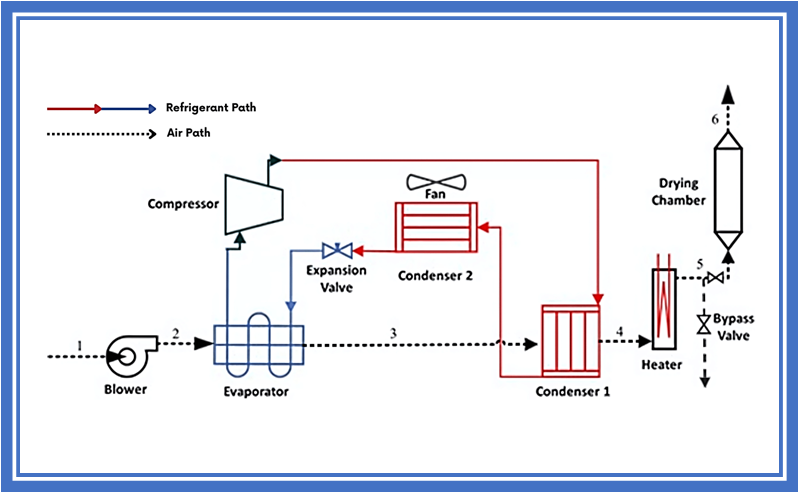
Drying is a crucial step in agricultural processing as it reduces moisture content, extends shelf life, and preserves product quality. For heat-sensitive Arabica coffee beans, heat pump drying (HPD) is an efficient and energy-saving method. This study investigates the drying characteristics of wet Arabica coffee beans using an HPD system, focusing on determining the drying rate constant (k) at various inlet air temperatures and humidity conditions. The drying process was conducted for 30 minutes at a constant air mass flux rate of 0.69 kg/m²-s at temperatures of 45, 50, 55, 60, and 65°C. Inlet air conditions were controlled with a cooling system at 10, 15, and 20°C, compared to ambient air without cooling. The results showed that increasing drying temperature and decreasing inlet air humidity significantly enhanced the drying rate. Additionally, the study explored the relationship between the constant air mass flux and variable parameters, including air temperature and humidity, which directly affected the drying rate constant (k). The highest k value (17.66 × 10⁻⁵ s⁻¹) was observed at 65°C with air from the cooling system at 10°C, indicating that combining high temperature and dry air improves drying efficiency.
References
[1] M. K. Rizalman, E. G. Moung, J. A. Dargham, Z. Jamain, N. M. Yaakub, and A. Farzamnia, "A review of solar drying technology for agricultural produce," IJEECS, vol. 30, no. 3, pp. 1407-1419, 2023, doi: 10.11591/ijeecs.v30.i3.pp1407-1419.
[2] Ľ. Šooš et al., "Analysis of thermodynamic events taking place during vacuum drying of corn," Sustainability, vol. 16, no. 2, p. 879, 2024, doi: 10.3390/su16020879.
[3] T. Yang, X. Zheng, H. Xiao, C. Shan, and J. Zhang, "Moisture Content online detection system based on multi-sensor fusion and convolutional neural network," Front. Plant Sci., vol. 15, 2024, doi: 10.3389/fpls.2024.1289783.
[4] A. M. O. A. Babiker, U. E. H. M. Khiar, M. H. A. Elhesain, S. E. Idriss, S. O. A Figeada and M. Abdalla, "Comparative study between open-direct sun and solar drying of onion slices (allium cepa L.)," OPSearch, vol. 2, no. 6, pp. 226-234, 2023, doi: 10.58811/opsearch.v2i6.16.
[5] S. N. Fadilah, A. I. Khamil, M. Muharja, R. F. Darmayanti, and V. Aswie, "Enhancement of the quality of onion drying using tray dryer," Cheesa, vol. 5, no. 2, pp. 74-81, 2022, doi: 10.25273/cheesa.v5i2.13968.74-81.
[6] E. A. Kosasih, A. Zikri, and M. I. Dzaky, "Effects of drying temperature, airflow, and cut segment on drying rate and activation energy of elephant cassava," Case Stud. Therm. Eng., Article vol. 19, p. 100633, 2020, doi: 10.1016/j.csite.2020.100633.
[7] M. Yulia, A. Analianasari, S. Widodo, K. Kusumiyati, H. Naito, and D. Suhandy, "The authentication of gayo arabica green coffee beans with different cherry processing methods using portable LED-based fluorescence spectroscopy and chemometrics analysis," Foods, vol. 12, no. 23, p. 4302, 2023, doi: 10.3390/foods12234302.
[8] H. D. Belitz, W. Grosch, and P. Schieberle, "Food chemistry," Springer Berlin Heidelberg, 2009.
[9] G. V. de M. Pereira et al., "Exploring the impacts of postharvest processing on the aroma formation of coffee beans–a review," Food Chem., vol. 272, pp. 441-452, 2019, doi: 10.1016/j.foodchem.2018.08.061.
[10] W. Dong, R. Hu, Z. Chu, J. Zhao, and L. Tan, "Effect of different drying techniques on bioactive components, fatty acid composition, and volatile profile of robusta coffee beans," Food Chem., vol. 234, pp. 121-130, 2017, doi: 10.1016/j.foodchem.2017.04.156.
[11] I. Flament and Y. B. Thomas, "Coffee flavor chemistry", Jhon Wiley & Son Ltd., 2001.
[12] F. Kulapichitr, C. Borompichaichartkul, I. Suppavorasatit, and K. R. Cadwallader, "Impact of drying process on chemical composition and key aroma components of arabica coffee," Food Chem., vol. 291, pp. 49-58, 2019, doi: 10.1016/j.foodchem.2019.03.152.
[13] T. Wahyudi, "Kopi: sejarah, botani, proses produksi, pengolahan, produk hilir, dan sistem kemitraan," Gadjah Mada University Press, 2016.
[14] M. U. H. Suzihaque and R. Driscoll, "Effects of solar radiation, buoyancy of air flow and optimization study of coffee drying in a heat recovery dryer," Procedia Eng., vol. 148, pp. 812-822, 2016, doi: 10.1016/j.proeng.2016.06.617.
[15] V. F. Ferreira, M. A. Ricaldoni, S. D. V. F. d. Rosa, M. A. d. Figueiredo, S. V. B. Coelho, and T. B. Fantazzini, "Endo--mannanase enzyme activity in the structures of coffea arabica L. seeds under different types of processing and drying," Ciênc. rural, vol. 48, no. 12, p. e20170839, 2018, doi: 10.1590/0103-8478cr20170839.
[16] N. K. Firdaus, A. Aunillah, D. Pranowo, D. Listyati, and M. Herman, "The effect of various harvesting techniques and drying methods on the yield and quality of liberoid coffee," in IOP Conf. Ser.: Earth Environ. Sci., vol. 1246, p. 012046, 2023, doi: 10.1088/1755-1315/1246/1/012046.
[17] S. S. Rizkiyani and Y. E. R. Unzilatirrizqi, "Postharvest handling of coffee in small medium enterprises (SMEs) tugu juang coffee, pulosari village, pemalang regency," JTFP, vol. 1, no. 01, pp. 7-16, 2021, doi: 10.46772/jtfp.v1i01.337.
[18] T. N. Sandeep, B. B. Channabasamma, T. N. Gopinandhan, and J. S. Nagaraja, "The effect of drying temperature on cup quality of coffee subjected to mechanical drying," JPC, vol. 49, no. 1, pp. 35-41, 2021, doi: 10.25081/jpc.2021.v49.i1.7059.
[19] M. B. Fauzi, E. A. Kosasih, and M. I. Dzaky, "Influence of drying condition on the drying constants and activation energy for robusta coffee using heat pump drying," in IOP Conf. Ser.: Earth Environ. Sci., vol. 1372, p. 012105, 2024, doi: 10.1088/1755-1315/1372/1/012105.
[20] A. B. T. Loemba, B. Kichonge, and T. Kivevele, "Comprehensive assessment of heat pump dryers for drying agricultural products," Energy Sci. Eng., vol. 11, no. 8, pp. 2985-3014, 2022, doi: 10.1002/ese3.1326.
[21] S. M. Ngalonkulu and Z. Huan, "Viability of an open-loop heat pump drying system in south african climatic conditions," Energies, vol. 17, no. 10, p. 2432, 2024, doi: 10.3390/en17102432.
[22] M. I. Dzaky, E. A. Kosasih, I. I. Hakim, and A. Zikri, "Investigation of thin-layer drying of coffee beans using a double-condenser compression refrigeration system: effects of air mass flux, specific humidity and drying temperature," ARFMTS, vol. 106, no. 1, pp. 90-103, 2023, doi: 10.37934/arfmts.106.1.90103.
[23] E. A. Kosasih, A. Zikri, and M. I. Dzaky, "Water vapor desorption from silica gel in a combined drying and double-condenser compression refrigeration system," Heliyon, vol. 8, no. 6, 2022, p. e09757, doi: 10.1016/j.heliyon.2022.e09757.
Downloads
Published
How to Cite
Issue
Section
License
Copyright (c) 2025 Jurnal Konversi Energi dan Manufaktur

This work is licensed under a Creative Commons Attribution 4.0 International License.