Finite Element-Based Structural Evaluation of a Rescue Boat Crane Mount on LCT 153 Vessel
DOI:
https://doi.org/10.21009/JKEM.10.2.3Keywords:
finite element analysis, crane foundation, landing craft tank, rescue boat mechanismAbstract
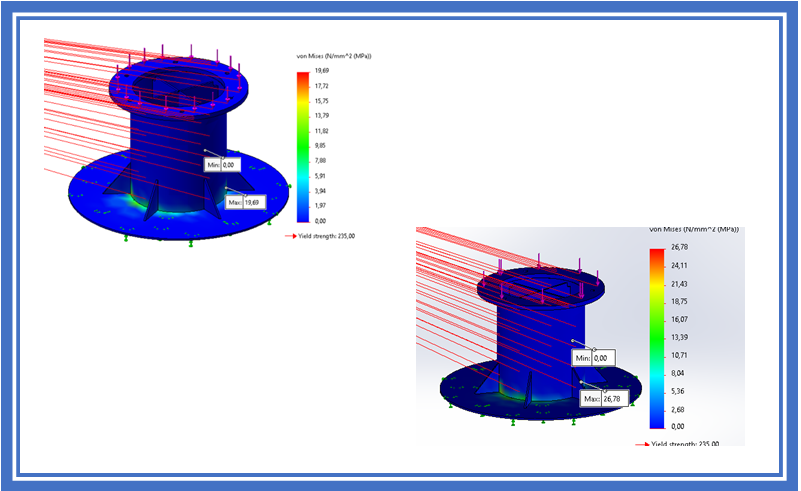
Rescue operations onboard marine vessels rely on effective and reliable deployment mechanisms for rescue boats, particularly in emergency scenarios. Cranes are commonly installed to assist in lowering rescue boats, but their performance depends greatly on the strength and reliability of their mounting systems. This study investigates the structural performance of a rescue boat crane mounting system on an LCT 153 vessel using finite element analysis. The problem addressed in this research is the lack of quantitative data on how different crane configurations affect the structural integrity of their mounting base under operational loads. Two crane models with different outreach and load specifications were assessed to identify the most structurally efficient option. Stress distribution and deformation were simulated using 3D models and meshed at various sizes to ensure convergence accuracy. The results revealed that the configuration with a 6-meter outreach generated lower stress (19.69 MPa) and deformation (0.004 mm), while the 7-meter alternative showed higher values. The findings contribute to safer and more efficient crane mounting designs and serve as a reference for shipyards in selecting appropriate equipment based on load performance and structural reliability.
References
[1] E. Gultom, “Pelabuhan indonesia sebagai penyumbang devisa negara dalam perspektif hukum bisnis,” Kanun, vol. 19, no. 3, pp. 419–444, 2017.
[2] V. F. Andromeda and D. W. Pratama, “Penanganan bongkar muat dengan crane kapal di MV. oriental jade,” Jurnal Dinamika Bahari, vol. 8, no. 2, pp. 2011-2028, 2018, doi: 10.46484/db.v8i2.73.
[3] A. Trihantoro, I. P. Mulyatno, and W. Amiruddin, “Analisa kekuatan struktur deck crane kapal tanker 6500 DWT menggunakan metode elemen hingga,” Jurnal Teknik Perkapalan, vol. 10, no. 2, pp. 52-59, 2022.
[4] A. Viviany, I. Rochani, and W. Wardhana, “Evaluasi unjuk kerja crane barge KGM-23 pada saat operasi pengangkatan dan pemasangan boom burner di Lokasi peciko field platform MWP-B total E&P indonesié,” Jurnal Teknik ITS, vol. 1, no.1, pp. G118-G123, 2012, doi: 10.12962/j23373539.v1i1.1617.
[5] Ridwan, M. A. Luhur and M. Elnath, “Pengaruh performa quay container crane dan penerapan system single cycle dan dual cycle terhadap bongkar muat peti kemas di KSO peti kemas koja jakarta,” Jurnal Maritim Polimarin, vol. 9, no. 1, 2023, doi: 10.52492/jmp.v9i1.102.
[6] W. Afrizal, M. S. Siregar, and Sabaruddin, “Pengoperasian rescue boat saat drill keselamatan di SPOB (self propelled oil barge) julvinda,” JOE, vol. 06, no. 01, pp. 5776–5783, 2023, doi: 10.31004/joe.v6i1.3578.
[7] C. Fratila, T. Axinte, R. C. Cojocaru, C. Berescu, and I. C. Scurtu, “The study of the lifting mechanism of the crane arm to a barge,” Technium, vol. 2, no. 1, pp. 91–96, 2020, doi: 10.47577/technium.v2i1.47.
[8] Q. Shao-yang, R. Hong-xiang, Z. Xiu-feng, W. De-long, S. Jian, and X. Fang-bing “Modeling and simulation of rescue boat’s launching from a ship,” Journal of Traffic and Transportation Engineering, vol 22, no. 2, pp. 233-245, 2022, doi: 10.19818/j.cnki.1671-1637.2022.02.018.
[9] Y. Zhao, “A crane trolley structure design and finite element analysis,” in International Conference on Mechanical Design and Simulation (MDS 2022), vol. 12261, pp. 772-778, 2022. doi: 10.1117/12.2638560.
[10] P. S. Fard, H. Tohidi, and H. Moayeri, “Boom structural design and static finite element analysis for a 1000tons sheerleg offshore crane,” IRJET, vol. 03, no. 01, pp. 485-498, 2016.
[11] I. Gerdemeli and S. Kurt, “Design and finite element analysis of gantry crane,” Key Eng Mater, vol. 572, pp. 517–520, 2013, doi: 10.4028/www.scientific.net/KEM.572.517.
[12] S. A. Wardana, H. Yudo, and I. P. Mulyanto, “Analisa kekuatan struktur pondasi crane pada kapal kontainer 100 TEUS dengan metode elemen hingga,” Jurnal Teknik Perkapalan, vol. 6, no. 4, 2018.
[13] S. Borodulina, A. Kulachenko, S. Galland, and M. Nygårds, “Stress-strain curve of paper revisited,” Nord Pulp Paper Res J, vol. 27, no. 2, pp. 318–328, 2012, doi: 10.3183/npprj-2012-27-02-p318-328.
[14] I. K. A. P. Utama, M. H. N. Aliffrananda, A. Sulisetyono, D. Setyawan, I. K. Suastika, D. Utama, W. D. Aryawan, and Y. A. Hermawan., “Performance of rescue boat operation when operated in waves,” in IOP Conf Ser Mater Sci Eng, vol. 1052, no. 1, p. 012059, 2021, doi: 10.1088/1757-899X/1052/1/012059.
[15] R. Sandström, “Stress strain curves,” in Basic Modeling and Theory of Creep of Metallic Materials, pp. 39–58, 2024, doi: 10.1007/978-3-031-49507-6_3.
[16] P. Feltham, “Deformation and Strength of Materials, 1st edition,” New York, NY: Springer, 1966.
[17] J. Ambrose, “Simplified Mechanics and Strength of Materials, 6th edition,” New York: John Wiley & Sons, Inc, 2002.
[18] I. A. Chaves, R. E. Melchers, Z. Sterjovski, and J. Rosen, “Long-term marine immersion corrosion of welded ABS grade steels,” Corrosion Engineering, Science and Technology, vol. 57, no. 3, pp. 195–203, 2022, doi: 10.1080/1478422X.2021.2015823.
Downloads
Published
How to Cite
Issue
Section
License
Copyright (c) 2025 Jurnal Konversi Energi dan Manufaktur

This work is licensed under a Creative Commons Attribution 4.0 International License.