Performance and Efficiency Comparison of Human Waste Biogas and LPG Production in Modified Water Pump Engines
DOI:
https://doi.org/10.21009/JKEM.10.2.7Keywords:
human waste, LPG, modified water pump engines, biogasAbstract
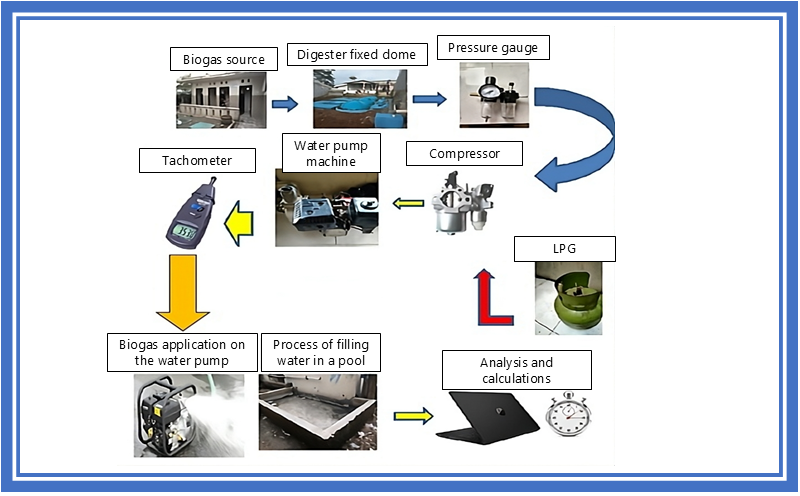
As daily needs and fuel prices continue to rise and non-renewable natural resources diminish, alternatives are needed to replace these energy sources with renewable energy. Data from the National Energy Council shows that in Indonesia, only 16.358 household biogas digester units have been installed, or about 1.6% of the total potential that can be utilized. This research aims to compare the performance of biogas from human feces with liquefied petroleum gas (LPG) as fuel for water pump engines. The method used is experimental, involving the modification of the carburetor on the water pump engine, followed by direct measurement and analysis of the water pump results using variations of biogas and LPG fuels. A literature review indicates that biogas has great potential as a renewable energy source, but its utilization in Indonesia remains very limited. In this study, the test variables include variations in pump speed at 3800, 5300, and 6600 rpm. The test results show that the mass flow rate of biogas compared to LPG yields the highest discharge at 6600 rpm (0.118: 0.150 m³/s). For both biogas and LPG fuels, the maximum shaft power of the water pump engine reaches 3.9 kW at 6600 rpm. The maximum waterpower generated by the water pump engine using biogas and LPG is 1.26 kW and 1.6 kW at 6600 rpm, respectively, while the maximum efficiency reaches 32% with biogas and 41% with LPG. Therefore, the higher the water pump engine speed, the higher the values of shaft power, engine power, discharge, and efficiency. The efficiency ratio comparison between biogas and LPG at 6600 rpm is 3:4.
References
[1] K. Rajendran, S. Aslanzadeh, and M. J. Taherzadeh, “Household biogas digesters-a review,” Energies, vol. 5, no.8, pp. 2911-2942, 2012,. doi: 10.3390/en5082911.
[2] A. Asankulova and A. Obozov, “Biogas in kyrgyzstan,” Appl. Sol. Energy, vol. 43, no. 4, pp. 262–265, 2007, doi: 10.3103/S0003701X07040172.
[3] T. W. Widodo and A. Hendriadi, “Development of biogas processing for small scale cattle farm in indonesia,” in International seminar on biogas technology for poverty reduction and sustainable development, pp. 255-261, 2005.
[4] S. Wahyuni and A. Yuanita, "Menghasilkan biogas dari aneka limbah," AgroMedia Pustaka, 2011.
[5] B. Abderezzak, B. Khelidj, A. Kellaci, and M. T. Abbes, “The smart use of biogas: decision support tool,” AASRI Procedia, vol. 2, pp. 156–162, 2012, doi: 10.1016/j.aasri.2012.09.028.
[6] E. Ryckebosch, M. Drouillon, and H. Vervaeren, “Techniques for transformation of biogas to biomethane,” Biomass and Bioenergy, vol. 35, no. 5, pp. 1633–1645, 2011, doi: 10.1016/j.biombioe.2011.02.033.
[7] C. Mao, Y. Feng, X. Wang, and G. Ren, “Review on research achievements of biogas from anaerobic digestion,” Renew. Sustain. Energy Rev., vol. 45, pp. 540–555, 2015, doi: 10.1016/j.rser.2015.02.032.
[8] N. Wieczorek, M. A. Kucuker, and K. Kuchta, “Microalgae-bacteria flocs (MaB-Flocs) as a substrate for fermentative biogas production,” Bioresour. Technol., vol. 194, pp. 130–136, 2015, doi: 10.1016/j.biortech.2015.06.104.
[9] M. Dȩbowski, M. Zieliński, A. Grala, and M. Dudek, “Algae biomass as an alternative substrate in biogas production technologies—review,” Renew. Sustain. Energy Rev., vol. 27, pp. 596–604, 2013, doi: 10.1016/j.rser.2013.07.029.
[10] Y. Shen, J. L. Linville, M. Urgun-Demirtas, M. M. Mintz, and S. W. Snyder, “An overview of biogas production and utilization at full-scale wastewater treatment plants (WWTPs) in the united states: challenges and opportunities towards energy-neutral WWTPs,” Renew. Sustain. Energy Rev., vol. 50, pp. 346–362, 2015, doi: 10.1016/j.rser.2015.04.129.
[11] W. Gazda and W. Stanek, “Energy and environmental assessment of integrated biogas trigeneration and photovoltaic plant as more sustainable industrial system,” Appl. Energy, vol. 169, pp. 138–149, 2016, doi: 10.1016/j.apenergy.2016.02.037.
[12] N. H. S. Ray, M. K. Mohanty, and R. C. Mohanty, “Biogas as alternate fuel in diesel engines: a literature review,” IOSR-JMCE, vol. 9, no.1, pp. 23-28, 2013.
[13] K. A. Subramanian, V. C. Mathad, V. K. Vijay, and P. M. V. Subbarao, “Comparative evaluation of emission and fuel economy of an automotive spark ignition vehicle fuelled with methane enriched biogas and CNG using chassis dynamometer,” Appl. Energy, vol. 105, pp. 17–29, 2013, doi: 10.1016/j.apenergy.2012.12.011.
[14] D. Goulding and N. Power, “Which is the preferable biogas utilisation technology for anaerobic digestion of agricultural crops in Ireland: biogas to CHP or biomethane as a transport fuel?,” Renew. Energy, vol. 53, pp. 121–131, 2013, doi: 10.1016/j.renene.2012.11.001.
[15] A. Lanzini et al., “Dealing with fuel contaminants in biogas-fed solid oxide fuel cell (SOFC) and molten carbonate fuel cell (MCFC) plants: degradation of catalytic and electro-catalytic active surfaces and related gas purification methods,” Prog. Energy Combust. Sci., vol. 61, pp. 150–188, 2017, doi: 10.1016/j.pecs.2017.04.002.
[16] D. Papurello, A. Lanzini, L. Tognana, S. Silvestri, and M. Santarelli, “Waste to energy: exploitation of biogas from organic waste in a 500 wel solid oxide fuel cell (SOFC) stack,” Energy, vol. 85, pp. 145–158, Jun. 2015, doi: 10.1016/j.energy.2015.03.093.
[17] V. Rathod and P. V. Bhale, “Experimental investigation on biogas reforming for syngas production over an alumina based nickel catalyst,” Energy Procedia, vol. 54, pp. 236–245, 2014, doi: 10.1016/j.egypro.2014.07.267.
[18] A. Vita, L. Pino, F. Cipitì, M. Laganà, and V. Recupero, “Biogas as renewable raw material for syngas production by tri-reforming process over NiCeO2 catalysts: optimal operative condition and effect of nickel content,” Fuel Process. Technol., vol. 127, pp. 47–58, 2014, doi: 10.1016/j.fuproc.2014.06.014.
[19] M. Krupa, M. Moskalewicz, A. P. Sikora, and A. Szurlej, “Dimethyl ether. Properties, production technologies and the market,” Przem. Chem., vol. 93, no. 9, pp. 1621–1627, 2014.
[20] A. C. C. Chang and K. Y. Lee, “Biogas reforming by the honeycomb reactor for hydrogen production,” Int. J. Hydrogen Energy, vol. 41, no. 7, pp. 4358–4365, 2016, doi: 10.1016/j.ijhydene.2015.09.018.
[21] E. C. Faria, R. C. R. Neto, R. C. Colman, and F. B. Noronha, “Hydrogen production through CO2 reforming of methane over Ni/CeZrO2/Al2O3 catalysts,” Catal. Today, vol. 228, pp. 138–144, 2014, doi: 10.1016/j.cattod.2013.10.058.
[22] V. Chintala, “Influence of flame quenching and crevice gas on hydrocarbon emission formation in an enriched biogas dual-fuel engine – An experimental and theoretical investigation,” Fuel, vol. 277, p. 118084, 2020, doi: 10.1016/j.fuel.2020.118084.
[23] S. Samnur and A. M. Irfan, “Analisis kesetaraan nilai kalor LPG dengan biogas dari biodigester skala rumah tangga,” J. Tek. Mesin Teknol., vol. 14, no. 2, pp. 103-110, 2011.
[24] O. Norouzi, F. Di Maria, and M. El-Hoz, “A short review of comparative energy, economic and environmental assessment of different biogas-based power generation technologies,” Energy Procedia, vol. 148, pp. 846–851, 2018, doi: 10.1016/j.egypro.2018.08.111.
[25] A. Abdel-Galil, M. M. Mostafa, M. A. Elnono, and M. F. Mohamed, “Biogas utilization for powering water irrigation pump,” Misr J. Agric. Eng., vol. 25, no. 4, pp. 1438-1453, 2008, doi: 10.21608/mjae.2008.190278.
[26] C. E. Manyi-Loh, S. N. Mamphweli, E. L. Meyer, A. I. Okoh, G. Makaka, and M. Simon, “Microbial anaerobic digestion (bio-digesters) as an approach to the decontamination of animal wastes in pollution control and the generation of renewable energy,” Int. J. Environ. Res. Public Health, vol. 10, no. 9, pp. 4390-4417, 2013, doi: 10.3390/ijerph10094390.
[27] B. E. Rittmann and P. L. McCarty, “Environmental biotechnology: principles and applications,” McGraw-Hill, 2020.
[28] G. M. Bragg and W. L. Schmidt, “Performance matching and optimization of wind powered water pumping systems,” Energy Convers., vol. 19, no. 1, pp. 33–39, 1979, doi: 10.1016/0013-7480(79)90014-7.
[29] I. R. Kusuma, S. Sarwito, and R. A. W. A. Irawati, “Analysis of electric propulsion performance on submersible with motor DC, supply power 10260AH at voltage 115VDC,” Int. J. Mar. Eng. Innov. Res., vol. 1, no. 2, 2017, doi: 10.12962%2Fj25481479.v1i2.1941.
[30] B. C. Purnomo, A. Widiyanto, S. Munahar, A. H. Purwantini, L. Muliawanti, and M. I. Rosyidi, "Implementasi energi biogas sebagai energi alternatif pembangkit listrik di kabupaten boyolali,“ CARADDE, vol. 3, no. 2, pp. 219-228, 2020, doi: 10.31960/caradde. v3i2.549.
[31] A. Aksan, S. Said, R. L. and W. S. Alfira, “Pengembangan pemanfaatan biogas untuk sumber listrik pompa penampung air di kelurahan tatae kabupaten pinrang,” in Seminar Nasional Hasil Penelitian & Pengabdian Kepada Masyarakat (SNP2M), vol. 8, pp. 13-18, 2024.
[32] A. W. Perdana, S. Wahyuni, and Rifky, “Penggunaan bahan bakar biogas sebagai energi penggerak mula pompa air model CCWP-30,” Rekayasa Teknol., vol. 4, no. 2, pp. 40–50, 2012.
[33] K. C. B. Artayana, I. G. B. W. Kusuma, and I. W. B. Adnyana, “Pengaruh variasi konverter biogas terhadap unjuk kerja pada mesin genset berkapasitas 1200 watt,” Logic, vol. 14, no. 3, pp. 119-206, 2014.
[34] S. Sunaryo, “Uji eksperimen pemurnian biogas sebagai pengganti bahan bakar motor bensin,” J. PPKM, vol. 1, no. 2, pp. 123–130, 2014, doi: 10.32699/ppkm.v1i2.246.
Downloads
Published
How to Cite
Issue
Section
License
Copyright (c) 2025 Jurnal Konversi Energi dan Manufaktur

This work is licensed under a Creative Commons Attribution 4.0 International License.