The Effect of Hardening Process on SKD 61 Material using Single Quenching and Double Quenching Techniques on Its Mechanical Properties
DOI:
https://doi.org/10.21009/JKEM.10.2.8Keywords:
bending test, brinell hardness, cooling media, double quenching, single quenchingAbstract
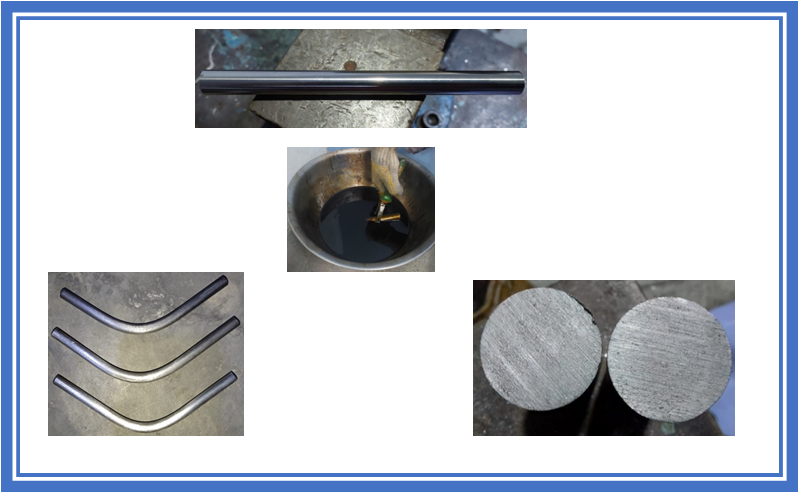
This study focuses on investigating the effects of Single quenching and double quenching techniques on the mechanical properties of SKD 61 material, particularly in the context of bending strength and hardness measured using the Brinell hardness test. The research method involved heating SKD 61 specimens to 1000°C for 15 minutes, followed by cooling using oil and air as quenching media. The results showed that the single quenching technique with oil medium increased the bending strength from 406.89 to 435.84 N/mm² and the hardness from 255 to 315 HB. The single quenching technique using air increased the bending strength to 410.88 N/mm² and the hardness to 290 HB. Meanwhile, the double quenching technique using a combination of oil and air produced a bending strength of 430.08 N/mm² and a hardness of 305 HB. These improvements are based on average values, and no statistical significance testing was conducted. These findings suggest that the appropriate selection of quenching media can optimize the mechanical properties of SKD 61, which is crucial for industrial applications requiring a combination of high toughness and strength.
References
[1] S. Kumar, S. Ranjan Maity, and L. Patnaik, “A comparative study on wear behaviors of hot work and cold work tool steel with same hardness under dry sliding tribological test,” Mater. Today Proc., vol. 44, pp. 949–954, 2021, doi: 10.1016/j.matpr.2020.11.004.
[2] L. A. Duc, P. M. Hieu, and N. M. Quang, “Development of OCMNO algorithm applied to optimize surface quality when ultra-precise machining of SKD 61 coated Ni-P materials,” Manuf. Rev., vol. 10, no. 7, pp. 1–16, 2023, doi: 10.1051/mfreview/2023006.
[3] L. F. Hou, Y. H. Wei, Y. G. Li, B. S. Liu, H. Y. Du, and C. L. Guo, “Erosion process analysis of die-casting inserts for magnesium alloy components,” Eng. Fail. Anal., vol. 33, pp. 457–464, 2013, doi: 10.1016/j.engfailanal.2013.06.018.
[4] C. S. Chang, K. S. Yang, C. K. Chung, and J. F. Lin, “Surface quality, microstructure, and mechanical properties of the SKD 61 tool steel with prior heat treatment affected by single- and double-pass continuous wave laser polishing,” Int. J. Adv. Manuf. Technol., vol. 92, no. 5–8, pp. 1643–1658, 2017, doi: 10.1007/s00170-017-0264-7.
[5] S. Luthfiyah, A. Faridh, and B. Soegijono, “The effect of vacuum quenching on corrosion and hardness of the surface of SKD61 steel,” in IOP Conf. Ser. Mater. Sci. Eng., vol. 694, p. 012033, 2019, doi: 10.1088/1757-899X/694/1/012033.
[6] Z. xing Li, B. qian Tong, Q. li Zhang, J. hua Yao, and V. Kovalenko, “Microstructure refinement and properties of 1.0C-1.5Cr steel in a duplex treatment combining double quenching and laser surface quenching,” Mater. Sci. Eng. A, vol. 776, p. 138994, 2020, doi: 10.1016/j.msea.2020.138994.
[7] A. Ozer, M. Ozer, Ç. Atak, and G. Altuntas, “The effect of quenching/double quenching and tempering heat treatment cycles on the microstructure, impact energy and hardness of AISI H13 tool steel,” Can. Metall. Q., vol. 63, no. 4, pp. 1138–1149, 2024, doi: 10.1080/00084433.2023.2286144.
[8] M. Ali, D. Porter, J. Kömi, M. Eissa, H. El faramawy, and T. Mattar, “The effect of double austenitization and quenching on the microstructure and mechanical properties of CrNiMoWMnV ultrahigh-strength steels after low-temperature tempering,” Mater. Sci. Eng. A, vol. 763, p. 138169, 2019, doi: 10.1016/j.msea.2019.138169.
[9] S. Herbirowo and B. Adjiantoro, “Pengaruh Perlakuan panas terhadap struktur mikro dan kekuatan mekanik baja nikel laterit,” Widyariset, vol. 2, no. 2, pp. 153–160, 2016, doi: 10.14203/widyariset.2.2.2016.153-160.
[10] M. Graf, M. Kuntz, H. Autenrieth, and R. Müller, “Investigation of size effects due to different cooling rates of as-quenched martensite microstructures in a low-alloy steel,” Appl. Sci., vol. 10, no. 15, pp. 1–15, 2020, doi: 10.3390/APP10155395.
[11] Y. Wang, Y. Xu, T. Zhang, J. Li, X. Hou, and W. Sun, “Effects of quenching temperature on bainite transformation, retained austenite and mechanical properties of hot-galvanized Q&P steel,” Mater. Sci. Eng. A, vol. 822, p. 141643, 2021, doi: 10.1016/j.msea.2021.141643.
[12] X. Lu, Z. Yang, D. Qian, J. Lan, and L. Hua, “Effect of martensite pre-quenching on bainite transformation kinetics, martensite/bainite duplex microstructures, mechanical properties and retained austenite stability of GCr15 bearing steel,” J. Mater. Res. Technol., vol. 15, pp. 2429–2438, 2021, doi: 10.1016/j.jmrt.2021.09.070.
[13] G. Jeon, D. Ha, Y. Park, and C. Jeong, “Three-point bending properties of hybrid multi-materials using adhesive bonding dependent on strength difference between steel and aluminum,” Materials (Basel)., vol. 15, no. 9, pp. 1–17, 2022, doi: 10.3390/ma15093328.
[14] M. Übeyli et al., “The ballistic performance of SiC-AA7075 functionally graded composite produced by powder metallurgy,” Mater. Des., vol. 56, pp. 31–36, 2014, doi: 10.1016/j.matdes.2013.10.092.
[15] K. Waas and V. D. Waas, “Pengaruh holding time (waktu tahan) dan variasi media quenching (pendinginan) terhadap nilai kekerasan baja karbon rendah ST 42 pada proses pengkarbonan padat menggunakan arang batok biji pala (myristica fagrans),” J. Simetrik, vol. 10, no. 1, pp. 269–278, 2020, doi: 10.31959/js.v10i1.361.
[16] M. Nofri and A. Taryana, “Analisis sifat mekanik baja SKD 61 dengan baja ST 41 dilakukan hardening dengan variasi temperatur,” Bina Tek., vol. 13, no. 2, p. 189, 2017, doi: 10.54378/bt.v13i2.218.
[17] T. A. Wiradinata, A. Daryus, D. Sugiyanto, Nopryandi, and M. Ikhsan, “Analysis of corrosion rate in low-carbon steel ASTM A36 and AISI 1020 in sulfuric acid solution using heat treatment temperature and immersion time variations,” J. Konversi Energi dan Manufaktur, vol. 10, no. 1, pp. 44–52, 2025, doi: 10.21009/jkem.10.1.5.
[18] G. R. Furqon, M. Firman, and M. A. Sugeng, “Analisa uji kekerasan pada poros baja ST 60 dengan media pendingin yang berbeda,” Al-Jazari J. Ilm. Tek. Mesin, vol. 01, no. 02, pp. 21–26, 2016.
[19] Y. Zheng, F. Wang, C. Li, Y. Lin, and R. Cao, “Effect of martensite structure and carbide precipitates on mechanical properties of Cr-Mo Alloy steel with different cooling rate,” High Temp. Mater. Process., vol. 38, pp. 113–124, 2019, doi: 10.1515/htmp-2018-0018.
Downloads
Published
How to Cite
Issue
Section
License
Copyright (c) 2025 Jurnal Konversi Energi dan Manufaktur

This work is licensed under a Creative Commons Attribution 4.0 International License.