Tracking Carbon in Executive Trains: A Study of Non-Traction Electricity and CO₂ Emissions in the Bima Train, Indonesia
DOI:
https://doi.org/10.21009/JKEM.11.2.2Keywords:
non-traction electricity, CO2 emissions, executive class trainsAbstract
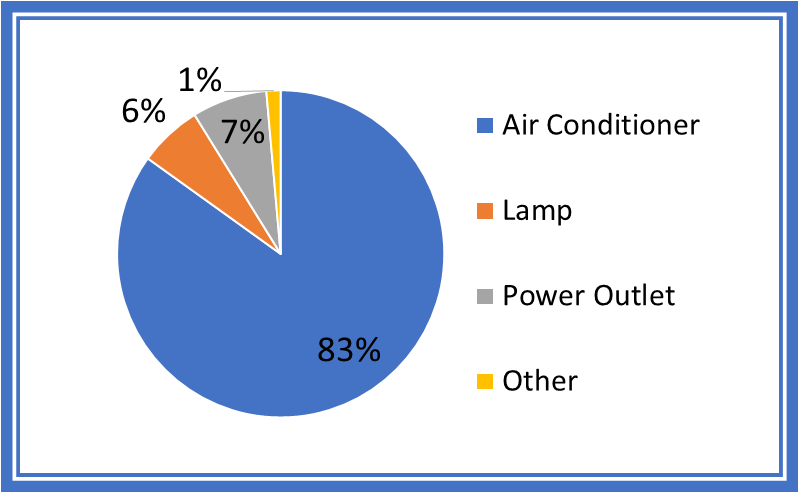
Non-traction electricity consumption in train operations includes auxiliary loads such as lighting, air conditioning (AC), power outlets, and other electronic devices are essential for passenger comfort and safety. Although smaller than traction energy, the carbon emissions from non-traction electricity consumption remain significant, particularly when electricity is supplied by fossil-fueled diesel generators. This study quantifies the total annual CO₂ emissions generated from non-traction electricity used in executive-class train cars applying a quantitative approach based on measured energy consumption and emission factors. Data analyzed include electrical energy consumption (kWh), daily operating duration and frequency, and the annual operating period of a single train set as the unit of analysis. Emission calculations were performed using an emission factor of 0.64–0.74 kg CO₂/kWh for diesel generator-based systems, incorporating operational assumptions such as constant AC usage and auxiliary load patterns. Sensitivity analyses to evaluate the effect of variations in operating patterns. Results indicate that total annual CO₂ emissions range from 511 to 591 Tons per train, with AC identified as the dominant contributor to non-traction energy use. Scenario simulations suggest that integrating renewable energy sources, particularly solar panels, combined with targeted energy efficiency improvements, can reduce non-traction emissions by approximately 25–40% compared to current operational conditions. Thus, effective management of non-traction energy is a critical component of railway decarbonization, and implementing renewable energy solutions alongside efficiency-based strategies offers a substantial opportunity to reduce operational emissions, supporting sustainable railway operations and contributing to Indonesia’s net zero emissions target by 2060.
References
[1] C. Ling, J. Tang, P. Zhao, L. Xu, Q. Lu, L. Yang, F. Huang, W. Lyu, and J. Yang “Unraveling the relation between carbon emission and carbon footprint: a literature review and framework for sustainable transportation,” npj Sustainable Mobility and Transport, vol. 1, p. 13, 2024, doi: 10.1038/s44333-024-00013-5.
[2] H. Zhang, L. Jia, L. Wang, and X. Xu, “Energy consumption optimization of train operation for railway systems: algorithm development and real-world case study,” Journal of Cleaner Production, vol. 214, pp. 1024-1037, 2019, doi: 10.1016/j.jclepro.2019.01.023.
[3] M. S. M. Fatoni and Y. A. Handoko, “Overview of energy efficiency in urban electric railways,” Jurnal Perkeretaapian Indonesia (Indonesian Railway Journal), vol. 8, no. 1, pp. 8–20, 2024, doi: 10.37367/jpi.v8i1.296.
[4] B. Tostes, S. T. Henriques, P. E. Brockway, M. K. Heun, T. Domingos, and T. Sousa, “On the right track? energy use, carbon emissions, and intensities of world rail transportation, 1840–2020,” Applied Energy, vol. 367, p. 123344, 2024, doi: 10.1016/j.apenergy.2024.123344.
[5] E. V. E. Nurjana, H. Akhsan, and N. Fajriah, “Energy efficiency strategies in electric railway traction systems: a systematic review with implications for developing countries,” Jurnal Riset Sains dan Teknologi, vol. 10, no. 1, pp. B.31–B.42, 2026, doi: 10.30595/jrst.v10i1.28997.
[6] L. D. Hersaputri, R. Yeganyan, C. Cannone, F. P-. Niño, S. O-. Owusu, Y. Kountouris, and M. Howells, “Reducing fossil fuel dependence and exploring just energy transition pathways in Indonesia using OSeMOSYS (open-source energy modelling system),” Climate, vol. 12, no. 3, p. 37, 2024, 10.3390/cli12030037.
[7] J. A. Ordonez, M. Fritz, and J. Eckstein, “Coal vs. renewables: least-cost optimization of the Indonesian power sector,” Energy for Sustainable Development, vol. 68, pp. 350-363, 2022, doi: 10.1016/j.esd.2022.04.017.
[8] D. D. F-. Soares, S. A. Eliziário, J. D. Galvincio, and A. F. R-. Ridao, “Greenhouse gas emissions in railways: systematic review of research progress,” Buildings, vol. 14, no. 2, p. 539, 2024, doi: 10.3390/buildings14020539.
[9] C. Hart, L. Lopez, J. Warichet, R. Kristiansen and P. Vithayasrichareon, “Enhancing indonesia’s power system pathways to meet the renewables targets in 2025 and beyond,” International Energy Agency, 2022.
[10] B. Guan, X. Liu, T. Zhang, and X. Wang, “Hourly energy consumption characteristics of metro rail transit: train traction versus station operation,” Energy and Built Environment, vol. 4, no. 5, pp. 568–575, 2023, doi: 10.1016/j.enbenv.2022.05.001.
[11] M. Lawrence and R. Bullock, “The role of rail in decarbonizing transport in developing countries,” World Bank Publications, 2022.
[12] K. Alshoufi, K. A‑. Nagar, and S. Fischer, “Integrating renewable energy into railway systems: a path to sustainable transportation – a review,” Chemical Engineering Transactions, vol. 114, pp. 817–822, 2024, doi: 10.3303/CET24114137.
[13] S. Sharma, V. Kandpal, T. Choudhury, E. D. R. S. Gonzalez, and N. Agarwal, “Assessment of the implications of energy‑efficient technologies on the environmental sustainability of rail operation,” AIMS Environment Science, vol. 10, no. 5, pp. 709–731, 2023, doi: 10.3934/environsci.2023039.
[14] T. Ercan, N. C. Onat, N. Keya, O. Tatari, N. Eluru, and M. Kucukvar, “Autonomous electric vehicles can reduce carbon emissions and air pollution in cities,” Transportation Research Part D: Transport and Environment, vol. 112, p. 103472, 2022, doi: 10.1016/j.trd.2022.103472.
[15] M. Davoodi, H. J. Kaleybar, M. Brenna, and D. Zaninelli, “energy management systems for smart electric railway networks: a methodological review,” Sustainability, vol. 15, no. 16, p. 12204, 2023, doi: 10.3390/su151612204.
[16] S. Babamohammadi, A. R. Birss, H. Pouran, J. Pandhal, and T. N. Borhani, “Emission control and carbon capture from diesel generators and engines: a decade‑long perspective,” Carbon Capture Science & Technology, vol. 154, p. 100379, 2025, doi: 10.1016/j.ccst.2025.100379.
[17] A. Bezdudnaya, O. Kol, R. Smirnov, and M. Treyman, “Methodological approaches to the CO2 emissions estimation in rail transport,” E3S Web of Conferences, vol. 535, p. 04010, 2024, doi: 10.1051/e3sconf/202453504010.
[18] D. Samara, “Design and performance evaluation of hybrid solar-wind energy systems with battery storage for sustainable community power supply,” SOLAV Journal, vol. 1, pp. 74-91, 2025.
[19] M. Bertolini, P. Duttilo, and F. Lisi, “Accounting carbon emissions from electricity generation: A review and comparison of emission factor‑based methods,” Applied Energy, vol. 392, no. 125992, doi: 10.1016/j.apenergy.2025.125992.
[20] A. Gabaldón, A. G-. Garre, M. C. R-. Abellón, A. Guillamón, R. Molina, and J. Medina, "Management of railway power system peaks with demand-side resources: an application to periodic timetables," Sustainability, vol. 15, no. 3, p. 2746, 2023. doi: 10.3390/su15032746.
[21] A. G-. Garre and A. Gabaldón, "Analysis, evaluation and simulation of railway diesel-electric and hybrid units as distributed energy resources," Applied Sciences, vol. 9, no. 17, p. 3605, 2019. doi: 10.3390/app9173605.
[22] A. Buonomano, C. Forzano, G. F. Giuzio, A. Palombo, and G. Russo, “Energy efficiency and indoor thermal comfort of railway carriages: development of an innovative passenger-centric-control framework for HVAC systems,” Energy, vol. 307, no. 132440, 2024, doi: 10.1016/j.energy.2024.132440.
[23] Z. Xiao, Q. Wang, P. Sun, B. You and X. Feng, "Modeling and energy-optimal control for high-speed trains," IEEE Transactions on Transportation Electrification, vol. 6, no. 2, pp. 797-807, 2020, doi: 10.1109/TTE.2020.2983855.
Downloads
Published
How to Cite
Issue
Section
License
Copyright (c) 2026 Yudi Utomo Putra, Dwinugroho Putro Utomo

This work is licensed under a Creative Commons Attribution 4.0 International License.