
Pelatihan Produksi Biomaterial Berbasis Serat Komposit Gulma Invasif sebagai Bahan Baku Produk Aplikatif Berkelanjutan
DOI:
https://doi.org/10.21009/sarwahita.232/06Keywords:
biomaterial, gulma invasif, pemberdayaan masyarakat, produk aplikatif, serat kompositAbstract
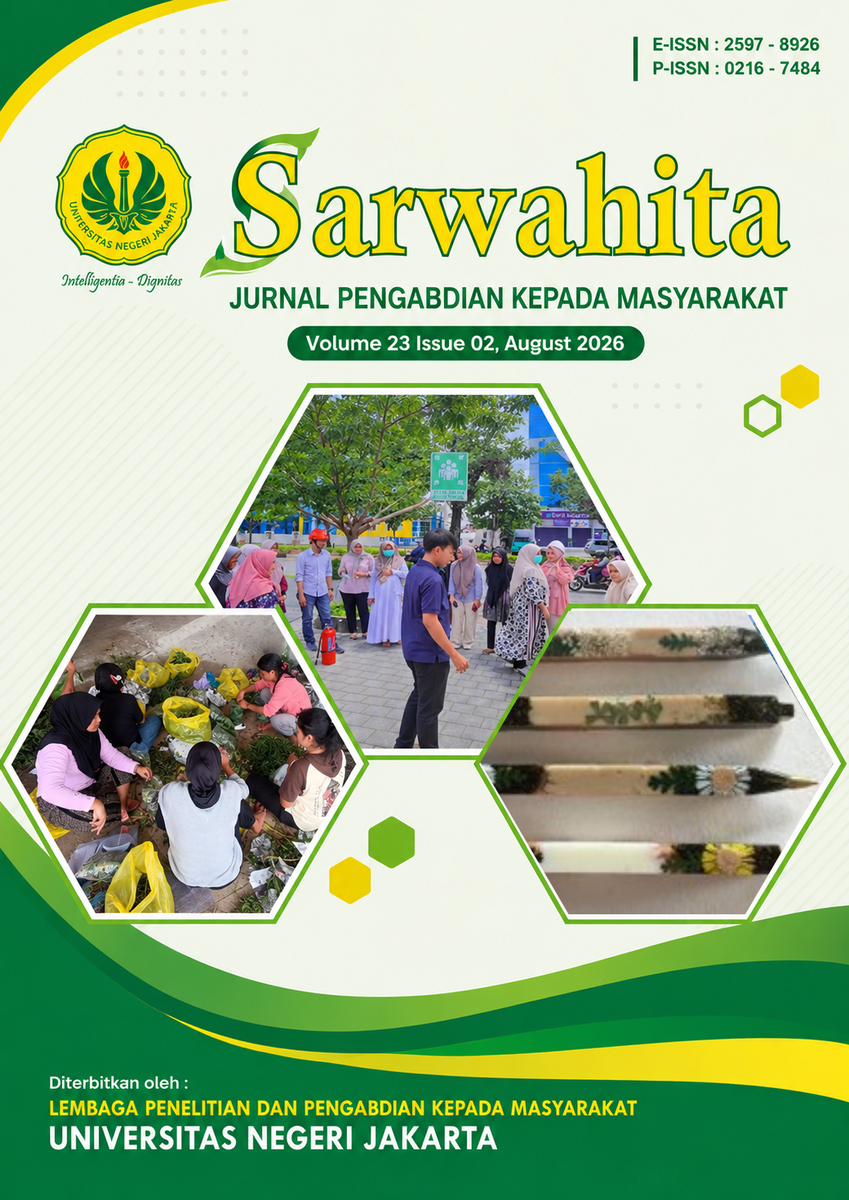
Invasive weeds are generally regarded as nuisance plants that reduce land productivity and remain underutilized. However, they contain lignocellulosic fibers with the potential to be processed into environmentally friendly biomaterials with higher economic value. This community service program aimed to enhance community knowledge and skills in producing composite fiber-based biomaterials from invasive weeds and developing them into sustainable applied products, such as reusable pens, keychains, bookmarks, coasters, ashtrays, and binder. The implementation methods included socialization and training on biomaterial production, training on the manufacture of sustainable applied products, and monitoring and evaluation through pre-tests and post-tests. Biomaterials were produced by processing invasive weeds into dry pulp through a delignification process using a 10% NaOH solution with the WAW-25 Pulp Machine, followed by mixing with resin as a binder, molding using silicone molds, and incorporating pressed flowers to enhance the aesthetic value of the products. The results showed that participants were able to produce biomaterials and various environmentally friendly applied products. The average participant score increased from 54.5 in the pre-test to 87.7 in the post-test, representing an improvement of 60.92%. These findings indicate that the learning by doing approach effectively improved participants' capacity to utilize invasive weeds as value-added biomaterials, thereby supporting the development of sustainable creative products based on local resources.
Abstrak
Gulma invasif umumnya dianggap sebagai tanaman pengganggu yang menurunkan produktivitas lahan dan belum dimanfaatkan secara optimal. Padahal, gulma invasif memiliki kandungan serat lignoselulosa yang berpotensi diolah menjadi biomaterial ramah lingkungan dengan nilai ekonomi yang lebih tinggi. Kegiatan pengabdian kepada masyarakat ini bertujuan meningkatkan pengetahuan dan keterampilan masyarakat dalam memproduksi biomaterial berbasis serat komposit gulma invasif serta mengembangkannya menjadi produk aplikatif berkelanjutan, seperti reusable pen, gantungan kunci, pembatas buku, tatakan gelas, asbak, dan binder. Metode pelaksanaan meliputi sosialisasi dan pelatihan produksi biomaterial, pelatihan pembuatan produk aplikatif, serta monitoring dan evaluasi melalui pre-test dan post-test. Biomaterial diproduksi melalui proses delignifikasi menggunakan larutan NaOH 10% dengan WAW-25 Pulp Machine, dilanjutkan dengan pembuatan dry pulp, pencampuran resin sebagai bahan pengikat, pencetakan menggunakan silicone mold, serta penambahan pressed flower untuk meningkatkan nilai estetika produk. Hasil kegiatan menunjukkan bahwa peserta mampu memproduksi biomaterial dan menghasilkan berbagai produk aplikatif ramah lingkungan. Nilai rata-rata peserta meningkat dari 54,5 pada pre-test menjadi 87,7 pada post-test atau sebesar 60,92%. Hasil tersebut menunjukkan bahwa kegiatan pengabdian yang dilaksanakan efektif dalam meningkatkan kapasitas masyarakat dengan memanfaatkan gulma invasif menjadi biomaterial bernilai tambah yang mendukung pengembangan produk kreatif berbasis sumber daya lokal.
References
Adhitya, B., Zumaeroh, Z., & Winarto, H. (2022). Diversifikasi Produk Dan Ekspansi Pemasaran Melalui Media Sosial. WIKUACITYA: Jurnal Pengabdian Kepada Masyarakat, 1(1), 75–79. https://doi.org/10.56681/wikuacitya.v1i1.19
Aldywaridha, Nasution, U., Asmanizar, Sumantri, S. E., Anwar, A., & Irfa, T. A. D. (2021). Pengujian Efikasi Alelopati Cyperus rotundus L. terhadap Gulma Asystasia gangetica (L.) T. Anderson di Perkebunan. Jurnal Ilmu Pertanian, 9(2), 76–82.
Arthur et al: Exploring green product attributes and their effect on consumer behaviour: A systematic review https://doi.org/10.1016/j.spc.2022.04.012
Azahra, S. D., Kartikawati, S. M., & Lestariningsih, S. P. (2023). Optimasi sumber daya tumbuhan lokal menjadi produk daur ulang yang bernilai ekonomi dan ramah lingkungan. 7(6), 6474–6482.
Bagastira, Y. T., Produk, D., Arsitektur, F., Kristen, U., Wacana, D., Harjani, C., Produk, D., Arsitektur, F., Kristen, U., & Wacana, D. (2021). Pengembangan Anyaman Serat Resam Menjadi Wadah Simpan Bumbu Dapur. 1.
Jepinus, & Fitrian, Y. (2024). DIANMAS BHAKTI : Jurnal Pengabdian pada Masyarakat. DIANMAS BHAKTI: Jurnal Pengabdian Pada Masyaraka, 1(1), 1–6.
Karim, F. E., Islam, M. R., Ahmed, R., Siddique, A. B., & Begum, H. A. (2023). Extraction and characterization of a newly developed cellulose enriched sustainable natural fiber from the epidermis of Mikania micrantha. Heliyon, 9(9), e19360. https://doi.org/10.1016/j.heliyon.2023.e19360
Klavins, M., Purmalis, O., Klavina, L., Niedrite, E., & Ansone-Bertina, L. (2024). Biomass of Invasive Plants as a Resource for the Development of the Bioeconomy. In BioResources (Vol. 19, Issue 4). https://doi.org/10.15376/biores.19.4.Klavins
Ketelsen, M., Janssen, M., & Hamm, U. (2020). Consumers’ response to environmentally-friendly food packaging – A systematic review. Journal of Cleaner Production, 254, 120123. DOI: 10.1016/j.jclepro.2020.120123.
Nurjanah, N., Rohayati, A., & Wibisono, Y. (2019). Program pelatihan media pembelajaran berbasis computer-based learning untuk guru-guru MGMP Matematika SMP di Kabupaten Bandung Barat. Jurnal Abmas, 19(1). https://doi.org/10.17509/abmas.v19i1.36465
Nurim, Y., & Harjanto, N. (2026). Pendekatan Learning By Doing Dalam Peningkatan Kewirausahaan : Studi Pada Kelompok Wanita Teratai. Jurnal ADARMA, 13(1), 38–46.
Puspita Sari, F., Ghozali, M., Damayanti, R., Fatriasari, W., & Euis Hermiati, D. (2018). Peranan Serat Alang-alang (Imperata cylindrica) sebagai Penguat Kertas Daur Ulang. Majalah Polimer Indonesia, 21(1), 1–19.
Ramadhan, M. A. (2026). Desain Berkelanjutan dan Tren Eco-Friendly pada Produk Kreatif Muhammad. Jurnal Seni Dan Desain Kreatif, 1(2), 44–51.
Ratnasari, I. F. D., & Febriansyah, I. (2025). Effect of NaOH Concentration and Soaking Duration on the Delignification Process of Oil Palm Plantation Weeds as an Alternative Raw Material for Pulp and Paper. Berkala Sainstek, 13(4), 171–177. https://doi.org/10.19184/bst.v13i4.53704
Ratnasari, I. F. D., Tinduh, Y. K., & Nisfimawardah, L. (2025). Pembuatan Kertas Seni Berbahan Baku Kertas Bekas , Gulma Perkebunan dan Limbah Pertanian Melalui Proses Delignifikasi Sederhana. BERNAS: Jurnal Pengabdian Kepada Masyarakat, 6(3), 1837–1844.
Rizal, A., & Azmi, A. (2021). Identifikasi Gulma Pada Tanaman Kelapa Sawit Menghasilkan Setelah Aplikasi Kompos dan Tandan Kosong di PT Bangun Tata Lampung Asri (Sungai Budi Group). Jurnal Pengelolaan Perkebunan, 2(1), 30–37.
Saparita, R., Nanang Surachman, D., M. Astro, H., Sukirno, S., & Karsani Apriliyadi, E. (2020). Sustainable Community Development for Developing of Coastal Areas in Alor Regency, East Nusa Tenggara, Indonesia. Jurnal Pemberdayaan Masyarakat: Media Pemikiran Dan Dakwah Pembangunan, 4(2), 323–344. https://doi.org/10.14421/jpm.2020.04-05
Setyaningsih, A. (2026). Pengembangan Busana Casual Dengan Teknik Ecoprint Menggunakan Tumbuhan Gulma Development of Casual Fashion with Ecoprint Technique Using Weed Plants. 43(1), 141–156. https://doi.org/10.22322/dkb.v43i1.8761
Thamrin, M., Asikin, S., & Willis, M. (2013). Tumbuhan Kirinyu Chromolaena Odorata (L) (Asteraceae: Asterales) Sebagai Insektisida Nabati Untuk Mengendalikan Ulat Grayak Spodoptera litura. J. Litbang Pertanian, 32(2), 112–121.
Wibisono, I., Leonardo, H., & others. (2013). Pembuatan pulp dari alang-alang. Widya Teknik, 10(1), 11–20.
Downloads
Published
Issue
Section
License
Copyright (c) 2026 Ika Fitriana Dyah Ratnasari, Firdaus Husein, Ihda Andrey Yanuar Setiawan, Lailatun Nisfimawardah, Ilham Febriansyah

This work is licensed under a Creative Commons Attribution 4.0 International License.
Copyright Notice
Sarwahita allow the author(s) to hold the copyright without restrictions and allow the author(s) to retain publishing rights without restrictions. Sarwahita CC-BY or an equivalent license as the optimal license for the publication, distribution, use, and reuse of scholarly work. In developing strategy and setting priorities, Sarwahita recognize that free access is better than priced access, libre access is better than free access, and libre under CC-BY or the equivalent is better than libre under more restrictive open licenses. We should achieve what we can when we can. We should not delay achieving free in order to achieve libre, and we should not stop with free when we can achieve libre.
Sarwahita is licensed under a Creative Commons Attribution 4.0 International License.
You are free to:
Share - copy and redistribute the material in any medium or format
Adapt - remix, transform, and build upon the material for any purpose, even commercially.
The licensor cannot revoke these freedoms as long as you follow the license terms.
