
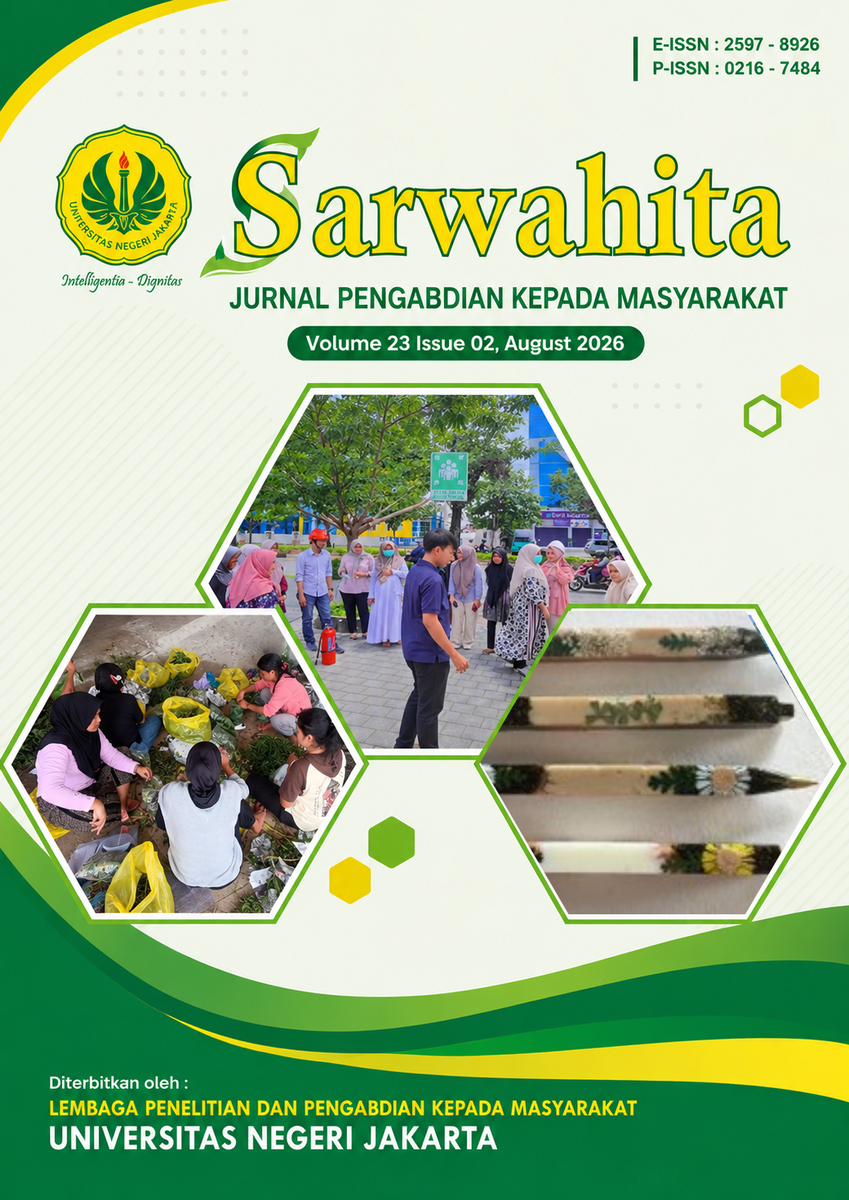
Edukasi K3 bagi Pekebun Kelapa Sawit Bersertifikasi Indonesian Sustainable Palm Oil (ISPO) dan Roundtable on Sustainable Palm Oil (RSPO) di Kabupaten Lamandau
DOI:
https://doi.org/10.21009/sarwahita.232.01Keywords:
keselamatan dan kesehatan kerja, petani kelapa sawit swadaya, ISPO–RSPO, alat pelindung diri, pembelajaran partisipatifAbstract
The use of Personal Protective Equipment (PPE) and safe pesticide spraying skills are integral to Occupational Safety and Health (OSH), which constitutes an important component of the Indonesian Sustainable Palm Oil (ISPO) and Roundtable on Sustainable Palm Oil (RSPO) standards. However, their implementation among independent smallholder oil palm farmers remains inconsistent. This community service program aimed to improve participants’ theoretical and practical OSH knowledge and assess their level of satisfaction throughout the program. The program was conducted in December 2025 at BUM Desa Berkah Mulya Jaya, Wonorejo Village, Sematu Jaya District, Lamandau Regency, involving 26 independent oil palm farmers certified under ISPO and RSPO. A participatory learning approach was employed, comprising partner coordination, educational sessions, field demonstrations and practical training, participatory discussions, and pre-tests and post-tests for evaluation. The results showed an increase in theoretical understanding from 57.7% to 100% and practical skills from 50.0% to 92.3%, with a participant satisfaction rate of 91.33%. These findings indicate that ISPO–RSPO-based OSH education effectively improves farmers’ competencies and supports the implementation of OSH practices in independent oil palm plantations.
Abstrak
Penggunaan Alat Pelindung Diri (APD) dan keterampilan penyemprotan pestisida yang aman merupakan bagian dari Keselamatan dan Kesehatan Kerja (K3) sebagai komponen penting dalam standar Indonesian Sustainable Palm Oil (ISPO) dan Roundtable on Sustainable Palm Oil (RSPO) yang pelaksanaannya belum konsisten diterapkan di kalangan petani kelapa sawit swadaya. Program pengabdian kepada masyarakat ini bertujuan untuk meningkatkan pengetahuan K3 secara teori dan praktik serta mengetahui tingkat kepuasan peserta selama kegiatan berlangsung. Program dilaksanakan pada Desember 2025 di BUM Desa Berkah Mulya Jaya, Desa Wonorejo, Kecamatan Sematu Jaya, Kabupaten Lamandau, dengan melibatkan 26 petani kelapa sawit swadaya yang telah tersertifikasi ISPO dan RSPO. Metode yang digunakan berbasis pembelajaran partisipatif meliputi koordinasi dengan mitra, penyampaian materi edukasi, demonstrasi lapangan dan pelatihan praktik, diskusi partisipatif, serta pre-test dan post-test sebagai evaluasi. Hasil program pengabdian menunjukkan peningkatan pemahaman teori dari 57,7% menjadi 100% dan kemampuan praktik dari 50,0% menjadi 92,3%, dengan tingkat kepuasan peserta sebesar 91,33%. Hal ini menunjukkan bahwa edukasi K3 berbasis ISPO–RSPO efektif meningkatkan kompetensi petani serta mendukung penerapan K3 pada perkebunan kelapa sawit swadaya.
References
Alfarezy, M., Andrikasmi, S., Simarmata, L. Q., et al. (2025). Urgensi Peningkatan Kesadaran Keselamatan dan Kesehatan Kerja (K3) bagi Buruh Tani Kelapa Sawit di Kampung Teluk Merempan. Unri Conference Series: Community Engagement 7, 305-310, https://doi.org/10.31258/unricsce.7.305-310
Anindya, A., Lestantyo, D., & Setyaningsih, Y. (2026). Literature Review of Occupational Health and Safety in Oil Palm Plantations. KESANS : International Journal of Health and Science, 5(8), 1506–1515. https://doi.org/10.54543/kesans.v5i8.643
Apriyanto, M., Fikri, KMS. N. S., Siregar, V. A., Jamri, & Azhar, A. (2020). Penyuluhan Tentang Peremajaan Kelapa Sawit Dan Legalitas Lahan Di Kecamatan Kempas Kabupaten Indragiri Hilir. JPM : Jurnal Pengabdian Masyarakat, 1(1), 1–6.
Astutik, S., et al. (2025). Medicinal Plant Production System Management in Rural Java, Indonesia: Views of Local Actors from a Participatory Rural Appraisal Approach. (2025). Forest and Society, 9(1), 20-47. https://doi.org/10.24259/fs.v9i1.31352
Badan Pusat Statistik Kabupaten Lamandau. (2026). KABUPATEN LAMANDAU DALAM ANGKA 2026 (Vol. 22). Badan Pusat Statistik Kabupaten Lamandau.
Efriani, Utami, D., & Dewantara, J. A. (2020). Sosialiasi Sustainable Palm Oil Pada Petani Sawit Mandiri. JCES (Journal of Character Education Society), 3(2), 246–257. https://doi.org/10.31764/jces.v3i1.2309
Febriansyah, Y., Bangsu, T., & Bengkulu, U. (2026). Peran Inspektur Tenaga Kerja Dalam Pengawasan Keselamatan Dan Kesehatan Kerja (K3): Ada Namun Belum Optimal (Bukti Dari Perusahaan Perkebunan Dan Pengolahan Kelapa Sawit Di Kabupaten Seluma, Provinsi Bengkulu). Inovasi Pembangunan – Jurnal Kelitbangan, 14(1), 1–11. jurnal.balitbangda.lampungprov.go.id/
Friansa, K., Natsir, I., Kundori, Anisah, H. U., Arisanti, D., Suhartini, Supangat, Kumala, C. M., & A, A. R. (2025). BUDAYA K3: Membangun Lingkungan Kerja Aman Dan Sehat. Akiopedia Press.
Husna, A. M., Setyawan, H., & Nurriwanti, N. S. S. (2025). Enhancing PPE Awareness through SAFE Education among Manufacturing Workers in Sleman, Indonesia. The Indonesian Journal of Occupational Safety and Health 14(3), 305-316. http://doi.org10.20473/ijosh.v14i3.2025.305-316
Hidayati, F., Syahni, R., Suliansyah, I., & Tanjung, H. B. (2025). Model Teoritis Adopsi Inovasi Pertanian: Integrasi Pendekatan Perilaku Petani. Rawa Sains: Jurnal Sains STIPER Amuntai, 15(1), 70–79. https://rawasains.stiperamuntai.ac.id/rs/index.php/rs
Ikhsan, N., Ismoyojati, R., Tinduh, Y. K., & Setiawan, I. A. Y. (2025). Sosialisasi Best Management Practice (BMP) Kelapa Sawit di BUMDes Berkah Mulya Jaya Kabupaten Lamandau. JURNAL PENGABDIAN MASYARAKAT BANGSA, 3(2), 455–460. https://doi.org/10.59837/jpmba.v3i2.2215
Innocenti, E. D., & Oosterveer, P. (2020). Opportunities and bottlenecks for upstream learning within RSPO certified palm oil value chains: A comparative analysis between Indonesia and Thailand. Journal of Rural Studies, 78, 426–437. https://doi.org/10.1016/j.jrurstud.2020.07.004
Lubis, D. Y., Rahayu, P., Nasutin, Y. S., & Hasibuan, A. (2025). Peningkatan Perilaku Pengunaan Alat Pelindung Diri Pada Pekerja Perkebunan Kelapa Sawit. Elastisitas, 1(1), 1-9.
Majid, N. A., Ramli, Z., Sum, S. M., & Awang, A. H. (2021). Sustainable palm oil certification scheme frameworks and impacts: A systematic literature review. Sustainability (Switzerland), 13(6). https://doi.org/10.3390/su13063263
Myzabella, N., Fritschi, L., Merdith, N., El-Zaemey, S., Chih, H., & Reid, A. (2019). Occupational health and safety in the palm oil industry: A systematic review. In International Journal of Occupational and Environmental Medicine (Vol. 10, Number 4, pp. 159–173). NIOC Health Organization. https://doi.org/10.15171/ijoem.2019.1576
Nainggolan, H. L., Kasih, M. B.-B., Lawolo, O., Sitompul, J. B. M., & Nainggolan, L. H. (2024). Strategi Peningkatan Pemahaman Petani terhadap Sertifikasi ISPO-RSPO untuk Mendukung Sawit Rakyat Berkelanjutan. Jurnal Agrikultura, 35(3), 517–528.
Putri, E. P., Kurnia, H., Saryono, & Jayawardana, H. B. A. (2025). Merajut Harmoni Sosial Dalam Masyarakat Melalui Pendekatan Participatory Rural Appraisal (PRA). Kurnia Mengabdi: Jurnal Pengabdian Kepada Masyarakat, 2(2), 80-88. https://doi.org/10.61476/9v19tj77
Ramadhani, T. N., & Hasibuan, A. (2024). Pengaruh Pelatihan Keselamatan Dan Kesehatan Kerja Terhadap Pengurangan Tingkat Kecelakaan Di Tempat Kerja. Gudang Jurnal Multidisiplin Ilmu, 2(6), 550–555. https://doi.org/10.59435/gjmi.v2i6.610
Setiawan, I. A. Y. (2026). Peningkatan kapasitas kalangan muda melalui edukasi pengukuran lahan berbasis GPS di BUM Desa Berkah Mulya Jaya Kabupaten Lamandau. SELAPARANG: Jurnal Pengabdian Masyarakat Berkemajuan, 10, 2117–2127. https://doi.org/10.31764/jpmb.v10i2.38827
Setiawan, I. A. Y., Ikhsan, N., Tinduh, Y. K., & Yiska, T. (2026). Dampak Sosial Ekonomi Perkebunan Kelapa Sawit Terhadap Masyarakat Pedesaan Di Desa Nanga Palikodan Kabupaten Lamandau. Innofarm: Jurnal Inovasi Pertanian, 28(1), 105–117. https://doi.org/10.33061/7r718p60
Setiawan, I. A. Y., Tinduh, Y. K., & Ikhsan, N. (2025). Optimalisasi pemupukan: sosialisasi best management practice bagi petani binaan RSPO BUM Desa Berkah Mulya Jaya, Kabupaten Lamandau. SELAPARANG: Jurnal Pengabdian Masyarakat Berkemajuan, 9(3), 1434–1441. https://doi.org/10.31764/jpmb.v9i3.30842
Sinaga, N. E., Sintia, T. R., Aulia, R., & Purba, S. H. (2024). Analisis Penerapan K3 di Pabrik Perkebunan Sawit. Jurnal Anestesi, 2(3), 132–145. https://doi.org/10.59680/anestesi.v2i3.1203
Sumartono, E., Sukiyono, K., Romdhon, M. M., & Andani, A. (2026). Sustainable Behaviour in Palm Oil Certification: A Systematic Review of ISPO and RSPO Adoption. Research on World Agricultural Economy, 813–846. https://doi.org/10.36956/rwae.v7i2.2747
Triwati, I., Nuhardi, I., & Baco, D. A. (2024). Edukasi dan Praktik Penggunaan APD untuk Meningkatkan Penerapan K3 pada Pekerja Konstruksi Sektor Informal CV. Arumi Design Kota Palopo. Abdimas Singkerru, 4(1), 24–34. https://jurnal.atidewantara.ac.id/index.php/singkerru
Downloads
Published
Issue
Section
License
Copyright (c) 2026 Ihda Andrey Yanuar Setiawan, Ika Fitriana Dyah Ratnasari, Choirul Fuadi, Nur Ikhsan, Yulio Kristian Tinduh

This work is licensed under a Creative Commons Attribution 4.0 International License.
Copyright Notice
Sarwahita allow the author(s) to hold the copyright without restrictions and allow the author(s) to retain publishing rights without restrictions. Sarwahita CC-BY or an equivalent license as the optimal license for the publication, distribution, use, and reuse of scholarly work. In developing strategy and setting priorities, Sarwahita recognize that free access is better than priced access, libre access is better than free access, and libre under CC-BY or the equivalent is better than libre under more restrictive open licenses. We should achieve what we can when we can. We should not delay achieving free in order to achieve libre, and we should not stop with free when we can achieve libre.
Sarwahita is licensed under a Creative Commons Attribution 4.0 International License.
You are free to:
Share - copy and redistribute the material in any medium or format
Adapt - remix, transform, and build upon the material for any purpose, even commercially.
The licensor cannot revoke these freedoms as long as you follow the license terms.
