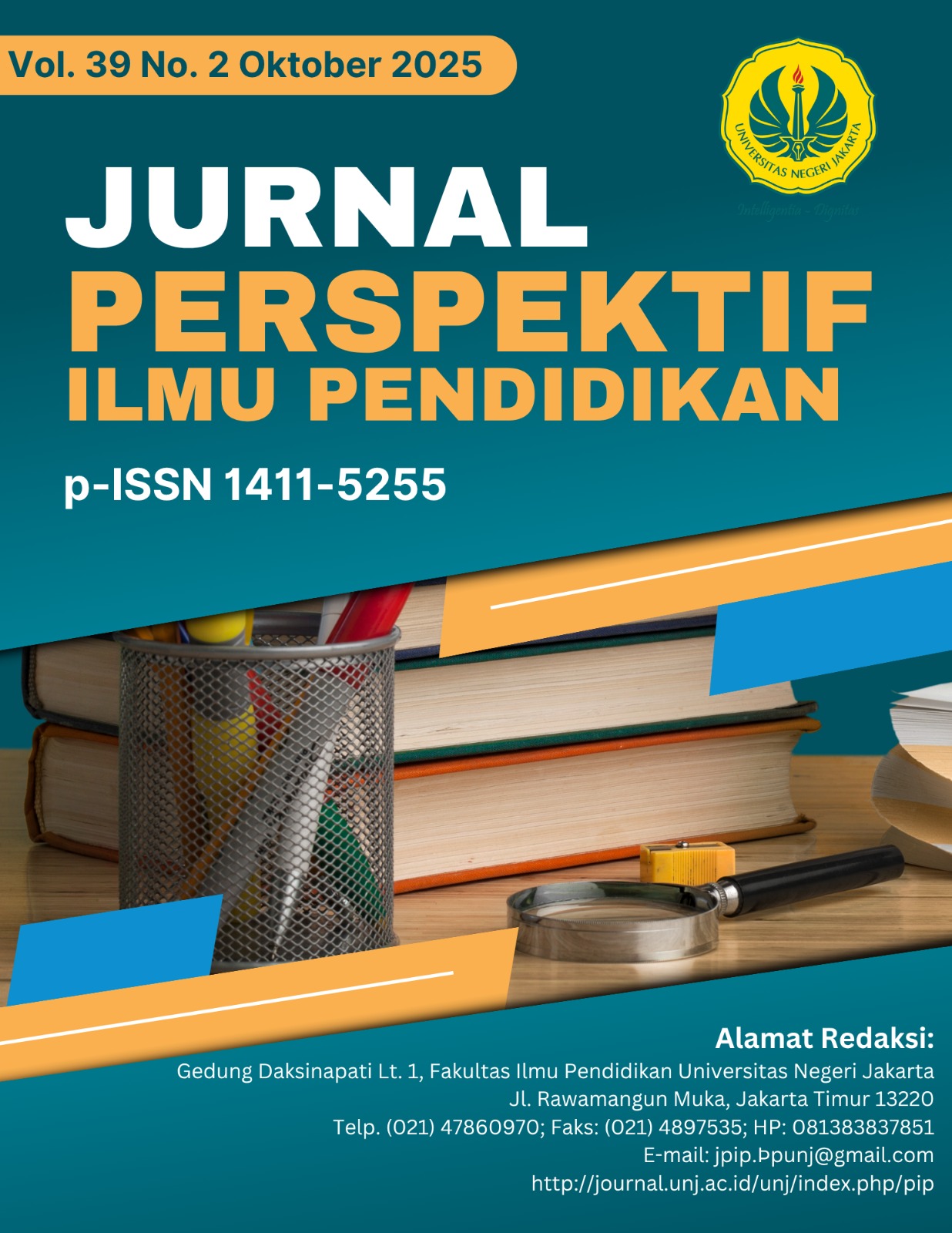
The Effect of Stem-Based Mathematics Learning on Students’ Critical and Creative Thinking Skills at SMA It Yarsi Mataram
DOI:
https://doi.org/10.21009/PIP.392.8Keywords:
Creative Thinking, Critical Thinking, STEM-Based Mathematics LearningAbstract
Abstract: This study aims to: (1) explain the significant effect of STEM-based mathematics learning on students’ critical thinking skills; (2) explain the significant effect of STEM-based mathematics learning on students’ creative thinking skills; and (3) explain the significant effect of STEM-based mathematics learning on students’ critical and creative thinking skills at SMA IT Yarsi Mataram. The research employed a quantitative approach with a survey research design, which was selected to obtain systematic and structured data regarding students’ characteristics. The study was conducted at SMA IT Yarsi Mataram, with the population consisting of all eleventh-grade students, while the research sample comprised 53 students. The data collection instrument was a questionnaire distributed manually. The collected data were analyzed using multivariate regression analysis. The results indicate that: (1) STEM-based mathematics learning does not have a significant effect on students’ critical thinking skills, as shown by a univariate test significance value of 0.971, which is greater than the 0.05 significance level; (2) the STEM approach does not have a significant effect on students’ creative thinking skills, with a univariate test significance value of 0.147, exceeding 0.05; and (3) STEM-based mathematics learning does not show a significant effect on students’ critical and creative thinking skills simultaneously, as indicated by a Wilks’ Lambda significance value of 0.276, greater than 0.05. The implications of this study suggest that STEM-based mathematics learning cannot yet be considered an effective alternative learning strategy for developing higher-order thinking skills, particularly critical and creative thinking, highlighting the need for further research to explore learning models better suited to the characteristics of high school students.
Keywords: STEM-Based Mathematics Learning, Critical Thinking, Creative Thinking
Downloads
Published
How to Cite
Issue
Section
License
Copyright (c) 2026 Haerorroni Haerorroni, Alfira Mulya Astuti, Nur Hardiani

This work is licensed under a Creative Commons Attribution-NonCommercial-ShareAlike 4.0 International License.
Authors who publish with this Journal agree to the following terms:
- Author retain copyright and grant the journal right of first publication with the work simultaneously licensed under a creative commons attribution licensethat allow others to share the work within an acknowledgement of the work’s authorship and initial publication of this journal.
- Authors are able to enter into separate, additional contractual arrangementfor the non-exclusive distribution of the journal’s published version of the work (e.g. acknowledgement of its initial publication in this journal).
- Authors are permitted and encouraged to post their work online(e.g. in institutional repositories or on their websites) prior to and during the submission process, as it can lead to productive exchanges, as well as earlier and greater citation of published works.
-
Users/public use of this website will be licensed to CC BY-NC-SA Creative Commons Attribution-NonCommercial-ShareAlike 4.0 International License