
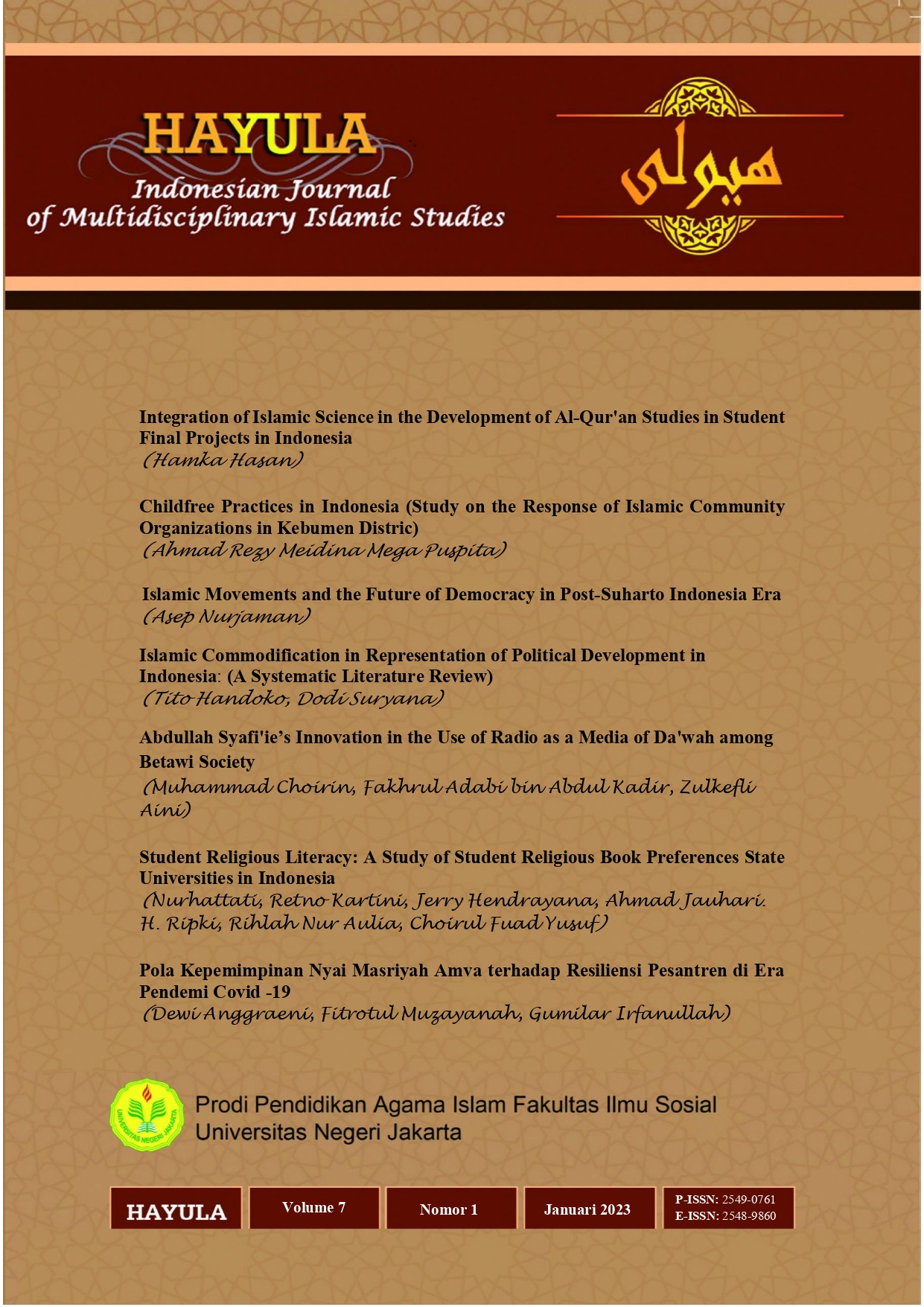
Childfree Practices in Indonesia
(Study on the Response of Islamic Community Organizations in Kebumen Distric)
DOI:
https://doi.org/10.21009/hayula.007.01.02Keywords:
childfree, Radical Feminism, Islamic Community OrganizationsAbstract
This article discusses child-free practices in Indonesia. Childfree means an agreement made by husband and wife not to have children during the marriage period. Practices in society are still taboo when you hear the term childfree itself. There is also a small portion of society that is no longer a taboo and has even practiced it, especially among the upper elite. This research is interesting to study because childfree itself is contrary to the purpose of marriage, namely having children and reproductive rights in Islam to enjoy biological relations. This article aims to explore the views and responses of several Islamic organizations in Kebumen regarding childfree.
This research uses qualitative methods (field research). The main object of this research is child-free practices and the views and responses of Islamic organizations in Kebumen. Data collection techniques were carried out by interviewing several Islamic organizations in Kebumen. Then the data analysis technique is descriptive analysis. The results of the study identified: (1) childfree as a phenomenon of current issues that reap various opinions, some support it and some don’t (2) childfree as a radical feminism. (3) childfree in the opinion of Islamic organizations in Kebumen regency such as (Nahdlatul Ulama, Muhamadiyah, Indonesian Islamic Da'wah Institute, and Hidayatullah) is that childfree has gone against nature, because it has deviated from the Qur’an, Hadis and the purpose of marriage.
References
Alimni, A., Amin, A., & Agus Kurniawan, D. (2022). The role of Islamic education teachers in fostering students' emotional intelligence. International Journal of Evaluation and Research In Education (IJERE), 11 (4), 224.
Asrohah, H., & Idayatni, S. (2020). In search for gender equality in rural madrasas of Malang Raya. Journal of Indonesian Islam, 14 (2), 387–406.
Azizi, A. Q., Imron, A., & Heradhyaksa, B. (2020). Fulfillment of civil rights of extramarital children and its effect on social dimensions. Ijtihad: Jurnal Wacana Hukum Islam dan Kemanusiaan, 20(2), 235–252.
Azwar, S. (2010). Metode Penelitian Muamalah. STAIN Po Press.
Blackstone, A., & Stewart, M. D. (2012). Choosing to be childfree: Research on the decision not to parent. Sociology Compass, 6(9), 718–727.
BOGOCH, M. (2021). Andrea Dworkin, Last Days at Hot Slit: The Radical Feminism of Andrea Dworkin. SYNOPTIC, 325.
Carmichael, GA, & Whittaker, A. (2007). Choice and circumstance: Qualitative insights into contemporary childlessness in Australia. European Journal of Population/Revue europeenne de demographie, 23 (2), 111–143.
Chrastil, R. (2019). How to be childless: A history and philosophy of life without children. Oxford UniversityPress.
D. (2022, June 8). Results of interviews with Kebumen Muhammadiyah Regional Leaders [Personal communication].
Dawamudin. (2022, July 6). Results of Interview with Mr. Dawamudin Head of PCNU [Personal communication].
Dr, P. (2008). Sugiyono, Quantitative Qualitative Research Methods, and R&D. CV. Alfabeta, Bandung, 25.
Duberman, M. (2020). Andrea Dworkin: The feminist as revolutionary. The NewPress.
Dworkin, A. (1974). Woman Heating. Penguin Books.
Echols, JM, & Shadily, H. (1992). Indonesian-English dictionary.
Etno Widyastuti, P. (2022, November 19). Https://www.tribunnews.com/lifestyle/2021/08/20/apa-itu-childfree-ramai discussed-after-gita-savitri-bahas-lections-tak-punyak . What is Childfree? Lots of talk after Gita Savitri discusses her choice not to have children.
Fadhilah, E. (2021). Childfree in Islamic Perspective. Al-Mawarid: JSYH, 3 (2), 71–80.
Faqihuddin. (2022, July 14). Interview results with the Head of Hidayatullah Kebumen [Personal communication].
Fauzan, A. (2022). CHILDFREE PERSPECTIVE OF ISLAMIC LAW. As-Salam: Journal of Islamic Law Studies & Education, 11 (1), 1–10.
Fauzi, F., Ashilah, AA, & Maisaroh, M. (2020). The polemic of the controversial articles on the Family Resilience bill from the perspective of Islamic law, psychology, and social communication. Ijtihad: Journal of Discourse on Islamic Law and Humanity, 20 (1), 115–146.
Frejka, T. (2017). Childlessness in the United States. In Childlessness in Europe: Contexts, causes, and consequences (pp. 159–179). Springer, Cham.
Gunardi, H. (2022, July 6). Results of interviews with the Head of Regional Leadership LDII Kebumen [Personal communication].
Hadi, A., & Khotiimah, H. (2022). CHILDFREE AND CHILDLESS REVIEWED IN FIQIH SCIENCE AND ISLAMIC EDUCATION PERSPECTIVE. JOEL: Journal of Educational and Language Research, 1 (6), 647–652.
Haecal, MIF, Fikra, H., & Darmalaksana, W. (2022). Analysis of the Childfree Phenomenon in Society: Study of Takhrij and Syarah Hadith with an Islamic Law Approach. Gunung Djati Conference Series, 8, 219–233.
Hamid Al-Ghazali, A. (tt). Ihyâ' 'Ulûmiddîn (Juz II). Beirut, Darul Ma'rifah.
Hariyanto, H. (2016). Dehumanization of women In the praxis of polygamy: Dialectics between normativity and historicity. PALASTREN Journal of Gender Studies, 8 (1), 79–102.
Hello doctor. (2022, November 19). Https://www.alodokter.com/changes-body-women-post-delivery. Postpartum Women's Body Changes.
Hird, MJ, & Abshoff, K. (2000). Women without children: A contradiction in terms? Journal of comparative family studies, 31 (3), 347–366.
Humanities. (2022, November 19). Https://epaper.mediaindonesia.com/detail/phenomena-childfree-di-indonesia.
Khasanah, U., & Ridho, MR (2021). Childfree Perspective of Women's Reproductive Rights in Islam. Al-Syakhsiyyah: Journal of Law & Family Studies, 3 (2), 104–128.
Kwon, S. A. (2005). Childfree by choice: A qualitative exploration of Asian/White interracial couples in a childfree marriage. Alliant International University, San Diego.
Meidina, A. R. (2022). Meninjau Ulang Iwadl Khuluk Perspektif Keadilan Gender. Al-Manahij: Jurnal Kajian Hukum Islam, 16(1), 77–90.
Meier, C. (2014). Windows of opportunity: Early childhood development prospects in South Africa. Journal of Social Sciences, 40(2), 159–168.
Merriam-Webster, I. (1996). Merriam-Webster’s Dictionary of Law. Merriam-Webster.
Mollen, D. (2006). Voluntarily child-free women: Experiences and counseling considerations. Journal of Mental Health Counseling, 28 (3), 269–282.
Munshihah, A., & Hidayat, MR (2022). Childfree in the Qur'an: An Analysis of Tafsir Maqashidi. Student Scientific Journal Raushan Fikr, 11 (2), 211–222.
Patnani, M., Takwin, B., & Mansoer, WW (2021). Happy without children? The importance of children for involuntary childlessness. Scientific Journal of Applied Psychology, 9 (1), 117–129.
Pelu, IEA (2011). Similarity: Marital property within the marriage law is a debate on the legal position and actual applications.
Rahayu, NF (2022). Fertile Couples Decision Not To Have Children. Hermeneutics: Journal of Hermeneutics, 8 (1).
Rizka, SM, Yeniningsih, TK, Mutmainnah, M., & Yuhasriati, Y. (2021). Childfree Phenomenon in Indonesia. Proceedings of AICS-Social Sciences, 11, 336–341.
Sabri, FASFA (2011). ADOPTION (An Offer of Islamic Law towards the Good Future of Neglected Children). AL-IHKAM: Journal of Law & Social Institutions, 6 (2), 201–216.
Saputra, E., & Busyro, B. (2018). Kawin Maupah: An Obligation to Get Married After Talak Tiga in the Tradition of Binjai Village in Pasaman District: A Maqasid al-Shari'ah Review. QIJIS (Qudus International Journal of Islamic Studies), 6 (2), 181–220.
Sugiyono. (2008). Metode Penelitian Kuantitatif dan Kualitatif R&D. CV Alfabeta.
Sutherland, S. (1995). The Macmillan dictionary of psychology. Bloomsbury Publishing.
Tunggono, VM (2021). Childfree & Happy. EA Books.
Wahib, AB (2014). Family law reform in the Muslim world. Ijtihad: Journal of Discourse on Islamic Law and Humanity, 14 (1), 1–19
Wajdi, F. (2018). The Discourse of Muhammadiyah and Nahdlatul Ulama with Considerations of Geertz’ s Religion of Java. Hayula: Indonesian Journal of Multidisciplinary Islamic Studies, 2(1), 49-64.
Downloads
Published
How to Cite
Issue
Section
License
Authors who publish with this Journal agree to the following terms:
- Author retain copyright and grant the journal right of first publication with the work simultaneously licensed under a creative commons attribution licensethat allow others to share the work within an acknowledgement of the work’s authorship and initial publication of this journal.
- Authors are able to enter into separate, additional contractual arrangementfor the non-exclusive distribution of the journal’s published version of the work (e.g. acknowledgement of its initial publication in this journal).
- Authors are permitted and encouraged to post their work online(e.g. in institutional repositories or on their websites) prior to and during the submission process, as it can lead to productive exchanges, as well as earlier and greater citation of published works.
Users/public use of this website will be licensed to CC BY


