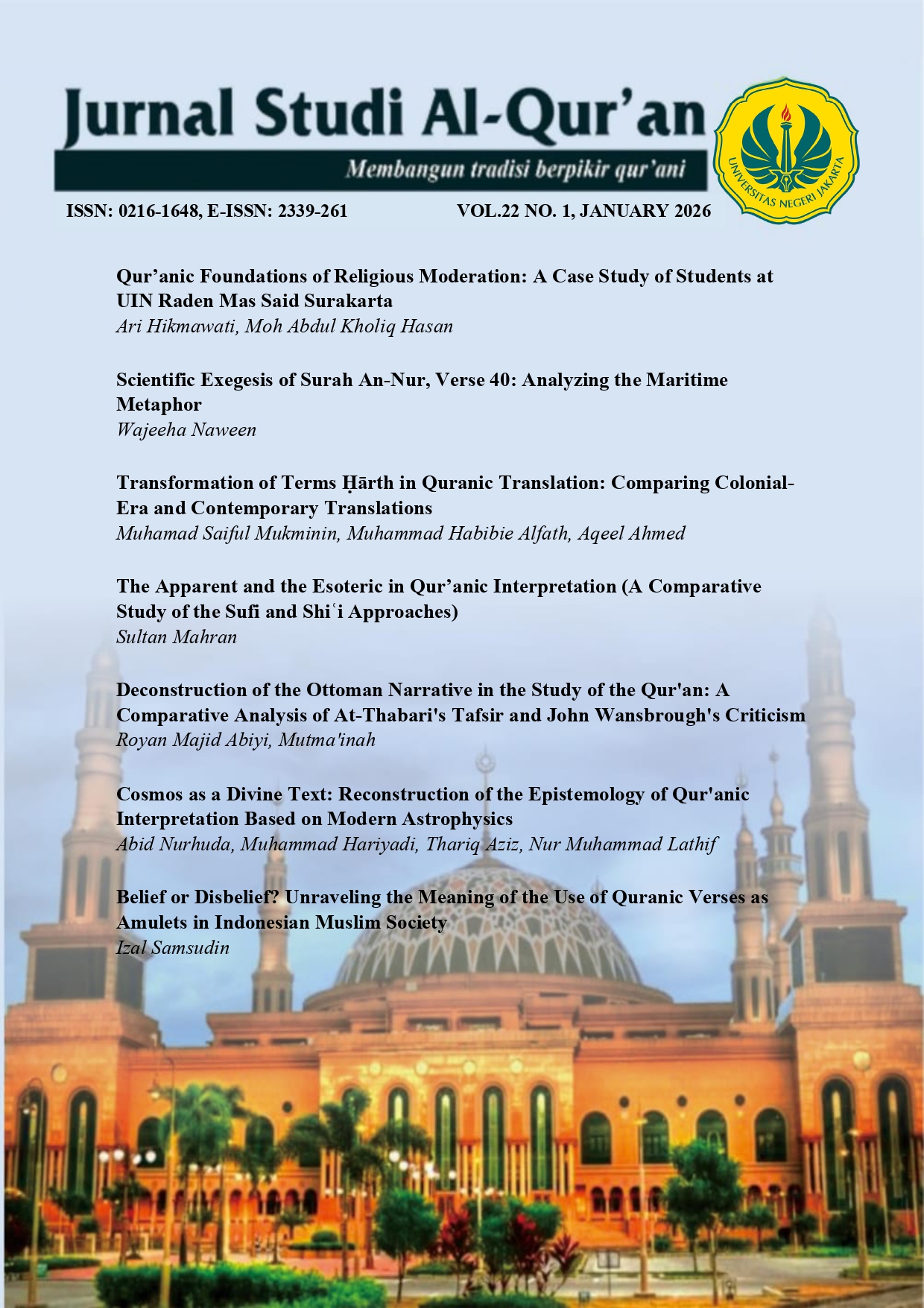
Belief or Disbelief? Unraveling the Meaning of the Use of Quranic Verses as Amulets in Indonesian Muslim Society
DOI:
https://doi.org/10.21009/JSQ.22.1.07Keywords:
Amullet, Islamic Theology, Local Traditions, Muslim Society, TawhidAbstract
The practice of using Quranic verses as amulets among Indonesian Muslims indicates complex issues related to religious understanding and the concept of monotheism. This study aims to examine this phenomenon and its implications. Using qualitative methods, data were collected through a literature review and field observations, and then analyzed from an Islamic theological perspective, specifically the concept of monotheism and the views of Islamic scholars. The results indicate that this practice persists, influenced by local traditions and mystical beliefs, and fueled by limited understanding. While some view it as a spiritual endeavor, Islamic scholarship warns that believing Quranic verses have independent power can deviate from the creed. The study recommends strengthening the understanding of the creed through more effective Islamic da'wah and education.
References
Al-Ghazali, A. H. M. (n.d.). Ihya Ulumuddin. Dar al-Fikr.
Al-Qaradawi, Y. (1997). At-Tauhid wa Atsaruhu fi Hayat al-Insan. Maktabah Wahbah.
Creswell, J. W. (2014). Research Design: Qualitative, Quantitative, and Mixed Methods Approaches. SAGE Publications.
Geertz, C. (1973). The Interpretation of Cultures: Selected Essays. Basic Books.
Hakim, G. (2025). Living Qur’an: A study of community religious practices in Indonesia. Melati Journal.
Ibn Taymiyah, T. a.-D. A. (2001). Majmoo’ al-Fatawa (Vol. 19). Dar Al-Wafa.
Mujahidin, A. (2015). The use of Qur’an verses as amulets in the Ponorogo community. E-Journal Raden Intan.
Nurullah, A., & Handasa, A. (2020). Living Qur’an: The manifestation of sacred texts in the cultural practices of Muslim communities. Ar-Raniry Journal.
Saiful Islam. (2021). Qur’an inspiration for literacy: The 2nd series of thematic tafsir stories.
Widiyanto, S. (2025). The amulet of the Qur’an in Barus: A study on spiritual and psychological protection. Unisma Research.
Downloads
Published
How to Cite
Issue
Section
License
Copyright (c) 2026 Izal Samsudin (Author)

This work is licensed under a Creative Commons Attribution 4.0 International License.
Authors who publish with this Journal agree to the following terms:
- Author retain copyright and grant the journal right of first publication with the work simultaneously licensed under a creative commons attribution licensethat allow others to share the work within an acknowledgement of the work’s authorship and initial publication of this journal.
- Authors are able to enter into separate, additional contractual arrangementfor the non-exclusive distribution of the journal’s published version of the work (e.g. acknowledgement of its initial publication in this journal).
- Authors are permitted and encouraged to post their work online(e.g. in institutional repositories or on their websites) prior to and during the submission process, as it can lead to productive exchanges, as well as earlier and greater citation of published works.
Users/public use of this website will be licensed to CC BY