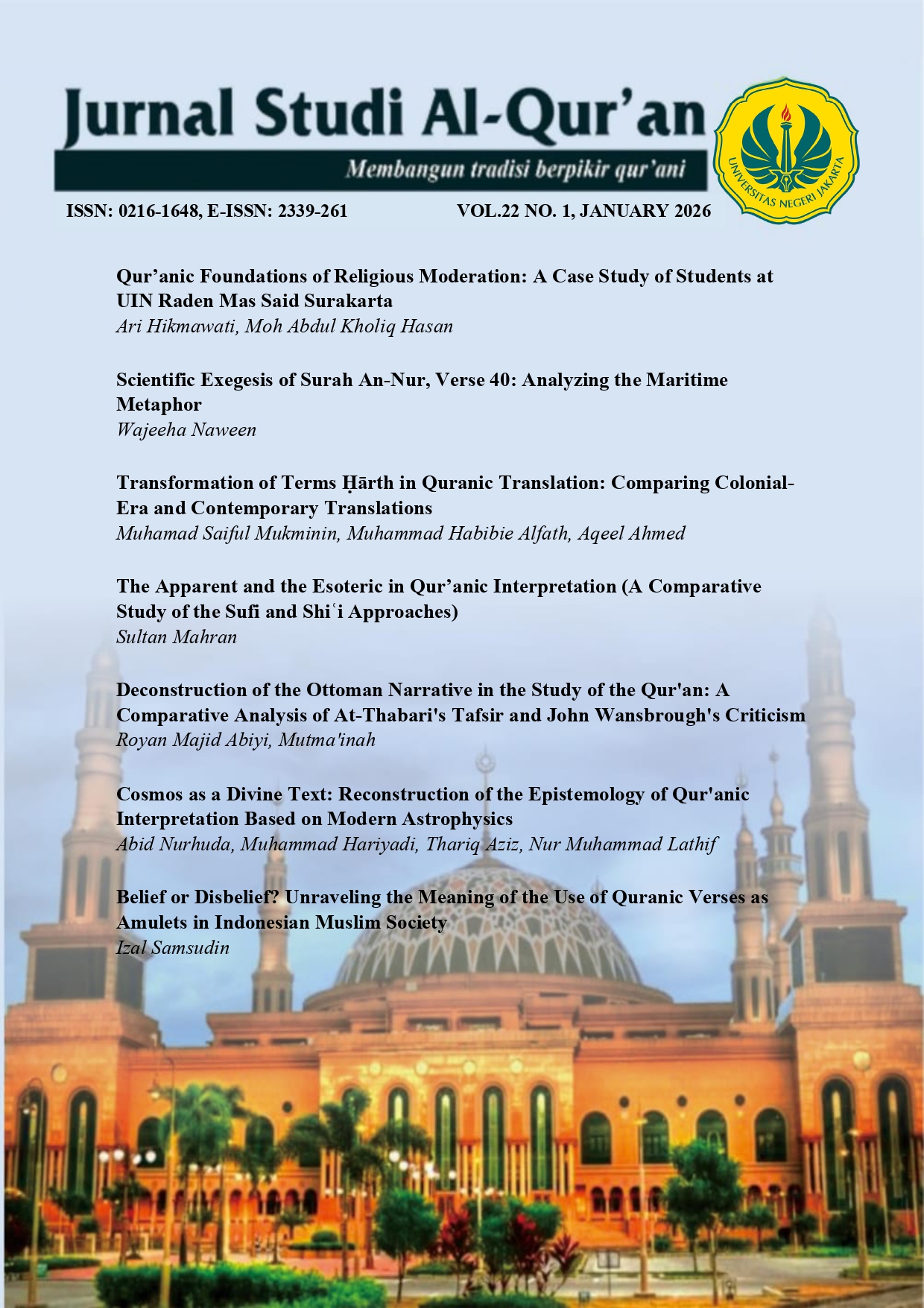
Transformation of Terms Ḥārth in Quranic Translation: Comparing Colonial-Era and Contemporary Translations
DOI:
https://doi.org/10.21009/JSQ.22.1.03Keywords:
Ḥārth, Comparison, Terminological Transformation, Translation of the Qur'an, Socio-culturalAbstract
Differences in translations across periods often lead to variations in meaning, making terminological transformation inevitable. This study aims to analyze in depth the transformation of the term Ḥārth in two versions of the Qur'an translation, namely during the colonial period and the present day. The methodology is a qualitative approach combining descriptive, comparative, and interpretive methods. The research data are drawn from all verses containing the element Ḥārth in the Tafsir Qur'an Karim by Mahmud Yunus, as well as the official version from the Indonesian Ministry of Religious Affairs. The results show that Ḥārth has a broad meaning, encompassing farming, land, and metaphorical uses. The identified transformation patterns include shifts from place to product, from product to place, from singular to plural, and from literal to metaphorical, influenced by socio-cultural context and reading styles over time. This study recommends that academics and translation institutions pay more attention to historical-linguistic aspects to maintain the relevance and accuracy of theological messages in changing times.
References
Al-Tarawneh, Alalddin. “The Role of Quran Translations in Radicalizing Muslims in the West and Misrepresenting Islam.” Journal of Religion and Violence 9, no. 1 (2021): 101–22. https://doi.org/10.5840/jrv202142587.
AlJahsh, Muhammad Ahmad Ibrahim. “Influence of Cultural Context on Qur’ānic Translation: Analyzing Social Justice Interpretations in Sura An-Nisā’Verse 58.” Maʿālim Al-Qurʾān Wa Al-Sunnah 19, no. 2 (2023): 366–387. https://doi.org/10.33102/jmqs.v19i2.446.
An, Andri Nirwana, Sufian Suri, Didi Junedi, Sayed Akhyar, Faisal Husen Ismail, Fuad Fansuri, Mohd Shafiq Bin Sahimi, Muhammad Zakir Bin Husain, Muhammad Amri, and Fahmi Arfan. “Exploration of Wasatiyah Diction to Realize Sustainable Tolerance between Religious Communities: A Study of the Translation of the Quran of the Ministry of Religious Affairs of the Republic of Indonesia.” Revista de Gestão Social e Ambiental 18, no. 6 (2024): 1–38. https://doi.org/10.24857/rgsa.vl8n6-012.
Boulaouali, Tijani. “Quran Translation: A Historical-Theological Exploration.” International Journal of Islamic Thought 19, no. 1 (2021): 120–32. https://doi.org/10.24035/ijit.19.2021.202.
Catford, J.C. A Linguistic Theory of Translation: An Essay in Applied Linguistics. Oxford: Oxford: Oxford University Press, 1978.
Djamdjuri, Dewi Suriyani, Zuriyati Zuriyati, and Siti Gomo Attas. “Metaphor in Parable from the Noble Qur’an: A Corpus Based Stylistic Approach.” Jurnal Studi Al-Qur’an 18, no. 1 (2022): 59–73. https://doi.org/10.21009/JSQ.018.1.03.
Faizin, Hamam. “Sejarah Dan Karakteristik Al‑Qur’an Dan Terjemahnya Kementerian Agama RI.” Suhuf 14, no. 2 (2021): 283–311. https://doi.org/10.22548/shf.v14i2.669.
Fajri, Ahmad, Nur Rofiah, and Azmi Ismail. “An Analysis of the Meaning of the Word Auliyā’in the 2019 Edition of the Indonesian Ministry of Religious Affairs’ Qur’anic Translation: A Critical Discourse Perspective.” Al Furqan: Jurnal Ilmu Al Quran Dan Tafsir 8, no. 1 (2025): 68–88. https://doi.org/10.58518/alfurqon.v8i1.3543.
Farhan, Rivki Lutfiya. “Adaptasi Bahasa Sunda Dalam Al-Amin Al-Qur’an Tarjamahan Sunda: Menelusuri Interaksi Budaya Dalam Proses Penerjemahan Al-Qur’an.” Contemporary Quran 4, no. 1 (2024): 51–64. https://doi.org/10.14421/cq.v4i1.5676.
Farisi, Mohamad Zaka Al. “Acceptability of the Quran Translation.” Al-Jami’ah: Journal of Islamic Studies 61, no. 2 (2023): 329–63. https://doi.org/10.14421/ajis.2023.612.329-363.
Gaanoun, Kamel, and Mohammed Alsuhaibani. “Sentiment Preservation in Quran Translation with Artificial Intelligence Approach: Study in Reputable English Translation of the Quran.” Humanities and Social Sciences Communications 12, no. 1 (2025): 1–15. https://doi.org/10.1057/s41599-024-04181-0.
Gunawan, Fahmi. “The Ideology of Translators in Quranic Translation: Lessons Learned from Indonesia.” Cogent Arts & Humanities 9, no. 1 (2022): 2088438. https://doi.org/10.1080/23311983.2022.2088438.
Hasbiyallah, Muhammad. “Paradigma Tafsir Kontekstual: Upaya Membumikan Nilai-Nilai Al-Qur’an.” Al-Dzikra: Jurnal Studi Ilmu Al-Qur’an Dan Al-Hadits 12, no. 1 (2018): 21–50. https://doi.org/10.24042/al-dzikra.v12i1.2924.
Khamis, Ibrahim Elshahat Mohamed, Abdollatif Ahmadi Ramchahi, and M Y Zulkifli Mohd Yusoff. “Permissibility of the Literal Translation of The Glorious Qur’an: A New Perspective.” QURANICA-International Journal of Quranic Research 15, no. 2 (2023): 25–57. https://doi.org/10.22452/quranica.vol15no2.2.
Maisya, Anis, and Nur Rohman. “Pentashihan Al‑Qur’an Digital Di Indonesia: Peran, Legitimasi Dan Otoritas LPMQ.” Academic Journal of Islamic Principles and Philosophy 2, no. 1 (2021): 25–42. https://doi.org/10.22515/ajipp.v2i1.3725.
Manzhur, Jamalu Ad-Din Ibnu. Lisan Al-’Arab. Beirut, 1994. Dar Shadir.
Miles, Matthew B., and A. Michael Huberman. Qualitative Data Analysis. California: California: Sage Publication, 1994.
Mubasyir, A Djawad. “Literal Equivalence In Meaning-Based Translation.” Deiksis 7, no. 03 (2015): 171–82. http://dx.doi.org/10.30998/deiksis.v7i03.547.
Mukminin, Muhamad Saiful, and Ahmad Abdul Muhhit. “Lexical Transformation of Blender Part Terms Translation in The User Manual.” ReALL-Research on Applied Linguistics and Literature 4, no. 1 (2025): 19–28. https://ejournal.unsap.ac.id/index.php/reall/article/view/1898.
Munawwir, Ahmad Warson. Al-Munawwir: Kamus Arab-Indonesia. Surabaya: Pustaka Progressif, 1997.
Newmark, Peter. A Text Book of Translation. Great Britain: Prentince International Ltd, 1988.
Nida, Eugene A. “The Nature of Dynamic Equivalence in Translating.” Babel: International Journal of Translation 22, no. 3 (1977): 99–103.
Nuraini, Nuraini, Waharjani Waharjani, and Mohammad Jailani. “From Textual to Contextual: Contemporary Islamic Thinker Abdullah Saeed on Qur’anic Exegesis.” Jurnal Ilmiah Al-Mu’ashirah: Media Kajian Al-Qur’an Dan Al-Hadits Multi Perspektif 21, no. 1 (2024): 32–49. https://doi.org/10.22373/jim.v21i1.19639.
Otay, Areej Ali, Mohd Azidan Abdul Jabar, and Muhd Zulkifli Islam. “Analyzing Mood Structures in the Quranic Stories of Nuh: A Comparative Study of Quranic Translations.” Theory and Practice in Language Studies 15, no. 1 (2025): 155–65. https://doi.org/10.17507/tpls.1501.18.
Pujianti, Kiki, and Sajarwa Sajarwa. “Transformasi Leksikal Penerjemahan Kata-Kata Budaya Jawa Ke Dalam Bahasa Inggris Pada Novel Bahasa Indonesia Anak Bajang Menggiring Angin.” Humanis 29, no. 3 (2025): 368–78. https://doi.org/10.24843/JH.2025.v29.i03.p09.
Rijal, Achmad Saifur, Fathor Rasyid, and Zainur Rofiq. “Metafora Dan Strategi Penerjemahannya Pada Surat Ali Imran Versi Indonesia Dan Inggris.” KODE: Jurnal Bahasa 11, no. 2 (2022): 89–104. https://doi.org/10.24114/kjb.v11i2.36131.
Rosi, Fauzi Fathur, Ahmad Nabilul Maram, Jullul Wara, and Nurul Qomariya. “Politics and Ideology in Qur’Anic Translation: A Comparative Analysis Between the Indonesian Ministry of Religious Affairs Translation and the Hilali-Khan Translation.” Jurnal Ilmiah Al-Mu’ashirah: Media Kajian Al-Qur’an Dan Al-Hadits Multi Perspektif 22, no. 1 (2025): 93–113. https://doi.org/10.22373/jim.v22i1.29862.
Statham, Nigel. “Dynamic Equivalence and Functional Equivalence: How Do They Differ?” The Bible Translator 54, no. 1 (2003): 102–11. https://doi.org/10.1177/026009350305400102.
Vermeer, Hans J. “Translation Today: Old and New Problems.” Translation Studies: An Interdiscipline 5 (1994): 3–16.
Yunus, Mahmud. Tafsir Qur’an Karim. Kementerian Agama Republik Indonesia, 1969.
Zafar, Amna, Muhammad Wasim, Shaista Zulfiqar, Talha Waheed, and Abubakar Siddique. “Transformer-Based Topic Modeling for Urdu Translations of the Holy Quran.” ACM Transactions on Asian and Low-Resource Language Information Processing 23, no. 10 (2024): 1–21. https://doi.org/10.1145/3694967.
Downloads
Published
How to Cite
Issue
Section
License
Copyright (c) 2026 Muhamad Saiful Mukminin, Muhammad Habibie Alfath, Aqeel Ahmed (Author)

This work is licensed under a Creative Commons Attribution 4.0 International License.
Authors who publish with this Journal agree to the following terms:
- Author retain copyright and grant the journal right of first publication with the work simultaneously licensed under a creative commons attribution licensethat allow others to share the work within an acknowledgement of the work’s authorship and initial publication of this journal.
- Authors are able to enter into separate, additional contractual arrangementfor the non-exclusive distribution of the journal’s published version of the work (e.g. acknowledgement of its initial publication in this journal).
- Authors are permitted and encouraged to post their work online(e.g. in institutional repositories or on their websites) prior to and during the submission process, as it can lead to productive exchanges, as well as earlier and greater citation of published works.
Users/public use of this website will be licensed to CC BY