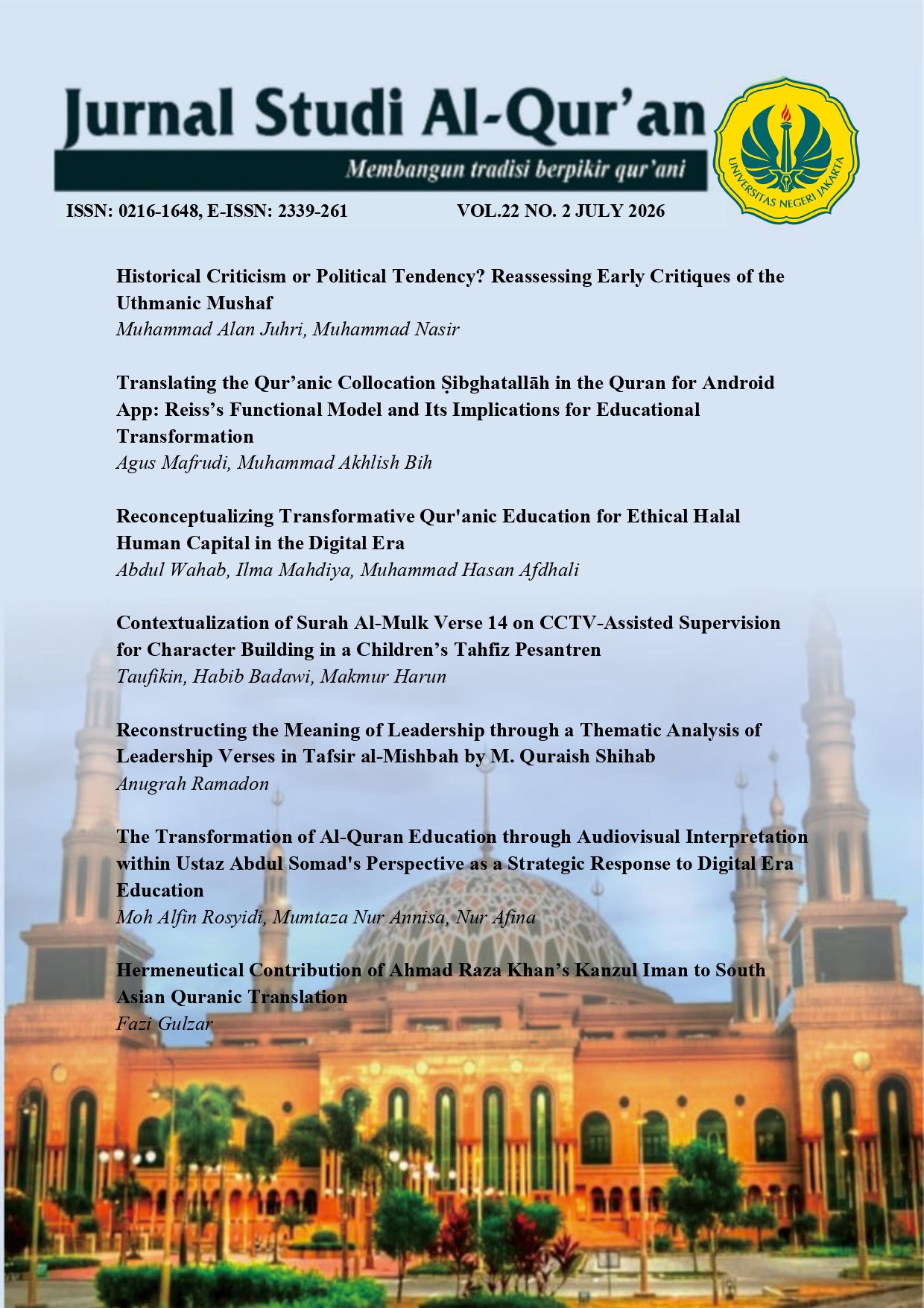
Historical Criticism or Political Tendency? Reassessing Early Critiques of the Uthmanic Mushaf
DOI:
https://doi.org/10.21009/JSQ.22.2.01Keywords:
Mushaf Utsmani, Kritik Tekstual Al-Qur'an, Tahrif, Sejarah Islam Awal, Identitas SektarianAbstract
Debates over the integrity and authenticity of the Uthmanic Mushaf have persisted since the early period of Islam. However, much of the existing scholarship tends to treat these critiques as a singular and uniform phenomenon, without adequately distinguishing the underlying ideological motives across different early Muslim communities. Purpose, to examine critiques of the Uthmanic Mushaf during the early period of Islam (1st–4th centuries AH/7th–10th centuries AD) by tracing the basis of arguments and the ideological tendencies underlying these critiques among early Muslim communities. Method, a historical-critical approach combined with comparative analysis of classical Sunni, Shia, and Islamic heresiographical sources. Result, critiques of the Uthmanic Mushaf stemmed from fundamentally different bases across groups. Among some of the Prophet's companions, critiques were primarily grounded in historical objections to the codification process and the validity of the Mushaf collectors. Among certain Khawarij groups, rejection of parts of the Uthmanic Mushaf was driven by ethical-dogmatic prejudices against verses considered incompatible with the sanctity of revelation. Meanwhile, among the early Imami Shia, rejection reflected strong political tendencies, particularly through narratives delegitimizing ruling authority and claims regarding the removal of verses affirming the superiority of Ali and Ahl al-Bayt. Contribution, this study offers a typology of early critiques, namely historical, ethical-dogmatic, and political, while affirming that discourse on the integrity of the Uthmanic Mushaf cannot be separated from the dynamics of power, religious authority, and sectarian identity in the formative period of Islam.
References
Al-Ash'arī, A. al-H. (1980). Maqālāt al-Islāmiyyīn. Al-Maktabah al-'Ashriyah.
Al-'Ayyāshī, M. bin M. (1421 AH). Tafsīr al-'Ayyāshī. Muassasah al-Bi'tsah.
Al-Kulaynī, A. J. M. bin Y. (2005). Ușūl al-Kāfī. Muassasah Ansariyan.
Al Maawali, A. M. S. S. (2019). A multidisciplinary approach to the distinguishing features
between Ibāḍīs and Khārijītes. Journal of Islamic Thought and Civilization, 9(2), 116–133.
Al-Qummī, A. al-H. 'A. bin I. (n.d.). Tafsīr al-Qummi. Muassasah Dar Al-Kitab li Al-Taba'ah wa Al-Nasyr.
Al-Qurṭubī. (1964). Al-Jāmi' li ahkām al-Qur'ān (Vol. 1). Dar el-Kutub Al-Mishriyyah.
Al-Ṣafadī. (2000). Al-Wāfi bil wafiyāt. Dār ihyā al-Turāts.
Al-Shahrastānī. (n.d.). Al-Milal wa al-nihal. Muassasah Al-Halbi.
Al-Suyuti, J. al-D. (2008). Al-Itqān fī 'ulūm al-Qur'ān. Ar-Risalah.
Al-Zarkasyi, B. al-D. (2006). Al-Burhān fī 'ulūm al-Qur'ān. Dār el-Hadīs.
Amal, T. A. (2011). Rekonstruksi sejarah Al-Qur'an. Yayasan Abad Demokrasi.
Amir-Moezzi, M. A. (1994). The divine guide in early Shi'ism. State University of New York Press.
Bar-Asher, M. M. (1999). Scripture and exegesis in early Imāmī Shiism. Brill; Magnes Press.
Dakake, M. M. (2007). The charismatic community: Shi'ite identity in early Islam. State University of New York Press.
Déroche, F. (2022). The one and the many: The early history of the Qur'an. Yale University Press.
Gaiser, A. R. (2016). Shurāt legends, Ibāḍī identities: Martyrdom, asceticism, and the making of an early Islamic community. University of South Carolina Press.
Haq, M. I., & Halim, A. (2021). Abu Al-Hasan 'Ali Bin Ibrahim Al-Qummi and the accusation of tahrīf al-Qur'ān in books of Shia Muslims: A study on the book Tafsir Al-Qummi. DINIKA: Academic Journal of Islamic Studies, 6(1), 131–150. https://doi.org/10.22515/dinika.v6i1.3629
Ibn Abī Dāwūd. (2002). Kitāb al-Mashāhif. Dār al-Basyāir al-Islāmiyyah.
Jeffery, A. (1937). Materials for the history of the text of the Qur'ān: The old codices. Brill.
Kaplony, A., & Marx, M. J. (Eds.). (2019). Qur'ān quotations preserved on papyrus documents, 7th–10th centuries: And the problem of carbon dating early Qur'āns. Brill.
Kohlberg, E., & Amir-Moezzi, M. A. (2009). Revelation and falsification: Kitāb al-qirāʾāt aw al-tanzīl wa-al-taḥrīf. Brill.
Little, J. J. (2025). On the historicity of ʿUthmān's canonization of the Qur'an, Part 1: The state of the field. Journal of the International Qur'anic Studies Association, 10(1), 102–172. https://doi.org/10.1515/jiqsa-2025-0016
Madi, F. N. B. (2023). The authenticity of the Quran: Theological views on the tahrif among Sunni and Shia scholars. European Journal for Philosophy of Religion, 15(1), 1–24. https://doi.org/10.24204/ejpr.2023.4114
Modarressi, H. (1993). Early debates on the integrity of the Qur'ān: A brief survey. Studia Islamica, 77, 5–39. https://doi.org/10.2307/1595789
Momen, M. (1985). An introduction to Shi'i Islam: The history and doctrines of Twelver Shi'ism. Yale University Press.
Motzki, H. (2002). The origins of Islamic jurisprudence: Meccan fiqh before the classical schools. Brill.
Powrie, S., & Zak, G. (Eds.). (2023). Textual communities, textual selves: Essays in dialogue with Brian Stock. Pontifical Institute of Mediaeval Studies.
Rahmawati, M., & Ikramatoun, S. (2025). Charisma, tradition, and rationality: The authority of Teungku in maintaining social order. BELIEF: Sociology of Religion Journal, 3(1), 1–12. https://doi.org/10.30983/belief.v3i1.9526
Schoeler, G. (2006). The oral and the written in early Islam (U. Vagelpohl, Trans.; J. E. Montgomery, Ed.). Routledge.
Setiawan, M. N. K. (2005). Book review: Syi'ah dan wacana perubahan mushaf al-Quran, tahrif al-Qur'an. Al-Jami'ah: Journal of Islamic Studies, 43(1), 241–254. https://doi.org/10.14421/ajis.2005.431.241-254
Sinai, N. (2017). The Qur'an: A historical-critical introduction. Edinburgh University Press.
Sirry, M. (2024). Think outside the box: Membebaskan agama dari penjara konservatisme. Sukapress.
Sulaym bin Qays al-Hilālī. (1420 AH). Kitāb al-Saqīfah. Nasr al-Hadi.
Wasserstrom, S. M. (1995). Between Muslim and Jew: The problem of symbiosis under early Islam. Princeton University Press.
Weber, M. (1978). Economy and society: An outline of interpretive sociology (G. Roth & C. Wittich, Eds.). University of California Press.
Wilkinson, J. C. (2010). Ibāḍism: Origins and early development in Oman. Oxford University Press.
Youngman, T., Modrow, S., & Meth, I. (2024). Deceiving dichotomies: On the interrelation of the archive and the cultural memory canon. Proceedings of the Association for Information Science and Technology, 61(1), 697–702. https://doi.org/10.1002/pra2.1082
Downloads
Published
How to Cite
Issue
Section
License
Copyright (c) 2026 Muhammad Alan Juhri, Muhammad Nasir (Author)

This work is licensed under a Creative Commons Attribution 4.0 International License.
Authors who publish with this Journal agree to the following terms:
- Author retain copyright and grant the journal right of first publication with the work simultaneously licensed under a creative commons attribution licensethat allow others to share the work within an acknowledgement of the work’s authorship and initial publication of this journal.
- Authors are able to enter into separate, additional contractual arrangementfor the non-exclusive distribution of the journal’s published version of the work (e.g. acknowledgement of its initial publication in this journal).
- Authors are permitted and encouraged to post their work online(e.g. in institutional repositories or on their websites) prior to and during the submission process, as it can lead to productive exchanges, as well as earlier and greater citation of published works.
Users/public use of this website will be licensed to CC BY