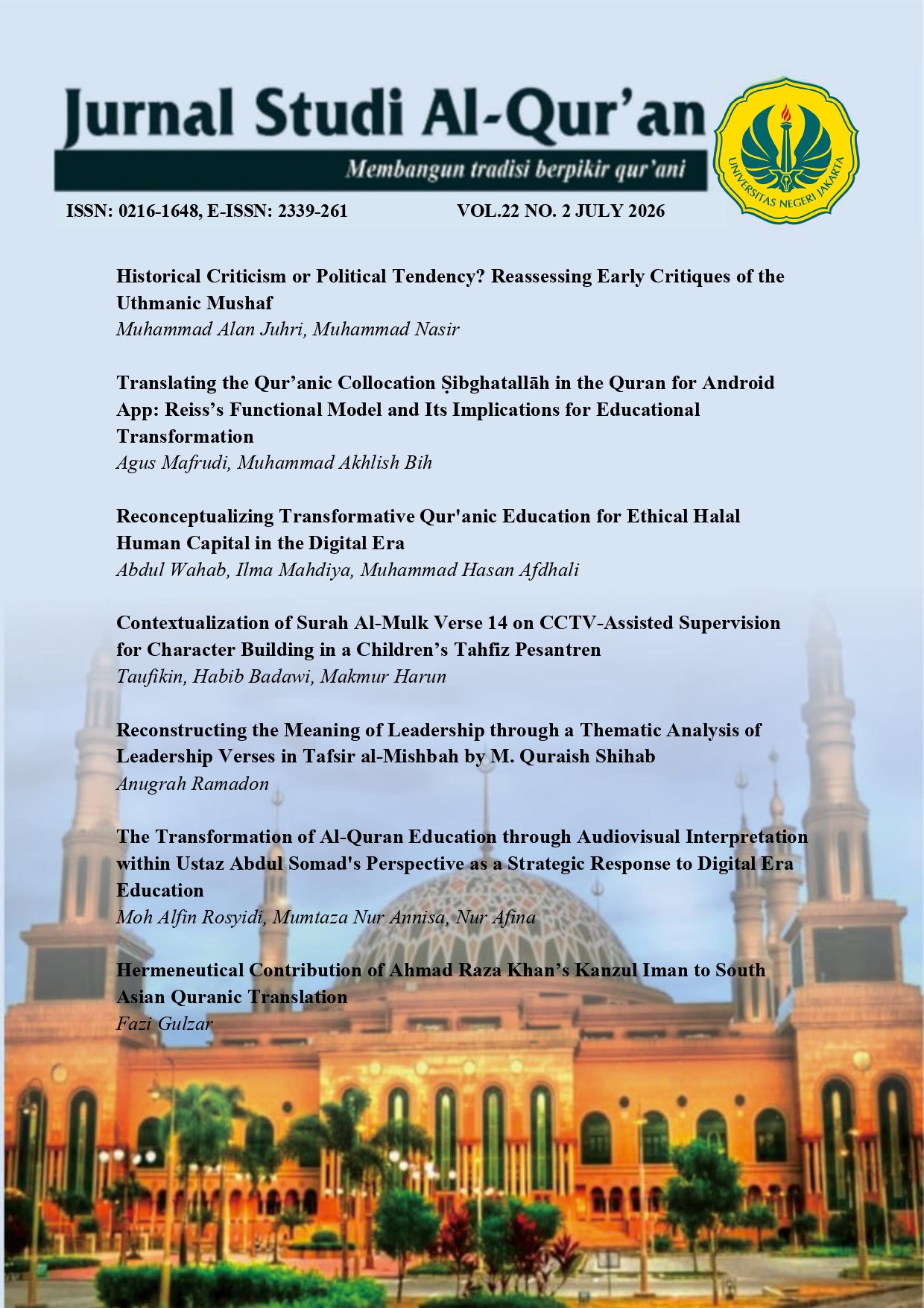
Contextualization of Surah Al-Mulk Verse 14 on CCTV-Assisted Supervision for Character Building in a Children’s Tahfiz Pesantren
DOI:
https://doi.org/10.21009/JSQ.22.2.04Keywords:
Character Building, Children’s Tahfiz Boarding School, Islamic Education, Muraqabah, Surah Al-Mulk Verse 14Abstract
education; however, the dynamics of student life in the digital era present new challenges in maintaining behavioral consistency, whether under direct supervision or otherwise. This study aims to analyze how the use of Closed-Circuit Television (CCTV) is interpreted as a tool for character education by contextualizing Surah Al-Mulk, verse 14, regarding Allah's All-Knowing nature concerning all human actions. A qualitative method with a case study design was employed at a pesantren focused on Quranic memorization (tahfiz) for children. Data were gathered through observation, in-depth interviews with caregivers, teachers, administrators, and students, and analysis of institutional documents. Analysis was conducted using a thematic analysis codebook involving a staged coding process, theme development, and source triangulation. The results indicate that CCTV is not perceived merely as an instrument of control but as a pedagogical medium that helps bridge external surveillance with the cultivation of internal awareness (muraqabah). The findings also reveal that the effectiveness of CCTV relies on the internalization of religious values through guidance, role modeling, and spiritual reflection; consequently, student compliance transcends the mere feeling of being watched and evolves into a sustained moral consciousness. This study contributes to a broader understanding of surveillance technology implementation in Islamic education by demonstrating that the pedagogical function of CCTV becomes more meaningful when positioned as a tool supporting the internalization of Quranic values, rather than as a standalone control mechanism.
References
Abu Bakar, S. B., et al. (2025). Reconstructing Artificial Intelligence Ethics through Qur’anic Values of Ihsan and Amanah Using Thematic Exegesis. Quranica, 17(2 Special Issue), 429–446.
Abubakari, M. S., & Kalinaki, K. (2024). Digital Competence in Islamic Education for Lifelong Learning: Preliminary Analysis Using DigComp 2.1 Framework. In M. M. Hawamdeh & F. Abdelhafid (Eds.), Embracing Technological Advancements for Lifelong Learning. IGI Global. https://doi.org/10.4018/979-8-3693-1410-4.ch001
Achruh, et al. (2024). Challenges and Opportunities of Artificial Intelligence Adoption in Islamic Education in Indonesian Higher Education Institutions. International Journal of Learning, Teaching and Educational Research, 23(11), 423–443. https://doi.org/10.26803/ijlter.23.11.22
Adiwisastra, M. F., et al. (2020). Implementation of the Lab Rotation Model in Blended Learning Based on Student Perspectives. Journal of Physics: Conference Series, 1641(1), 012038. https://doi.org/10.1088/1742-6596/1641/1/012038
Alvarez-Atencio, E., et al. (2022). Use of a Digital Professional Development Tool to Improve Oral Competence in Secondary Education: Experience in Initial Teacher Education in Chile. Revista Iberoamericana de Diagnostico y Evaluacion Psicologica, 5(66), 207–218. https://doi.org/10.21865/RIDEP66.5.15
Arim, S. N., et al. (2024). Navigating Educational Turbulence: A Systematic Literature Review on Challenges Faced by Islamic Education Amid the Pandemic. Studies in Systems, Decision and Control, 537, Springer. https://doi.org/10.1007/978-3-031-62106-2_50
Ashraf, H., et al. (2024). Muraqabah: Meaningful adjuvant therapy for metabolic health. Journal of the Pakistan Medical Association, 74(11), 1920–1921. https://doi.org/10.47391/JPMA.24-88
Azizi, M. A., et al. (2025). Transforming Sharia values through Gurēe communication: Character formation of santri at Dayah MUDI Masjid Raya Samalanga. El-Usrah: Jurnal Hukum Keluarga, 8(1), 536–550. https://doi.org/10.22373/3g9r1113
Bowen, G. A. (2009). Document analysis as a qualitative research method. Qualitative Research Journal, 9(2), 27–40. https://doi.org/10.3316/QRJ0902027
Braun, V., & Clarke, V. (2019). Reflecting on reflexive thematic analysis. Qualitative Research in Sport, Exercise and Health, 11(4), 589–597. https://doi.org/10.1080/2159676X.2019.1628806
Brinck, J., et al. (2023). Open Design Pedagogy: Revealing Openness in Early Childhood Education with Digital Technology. International Journal of Education Through Art, 19(2), 223–240. https://doi.org/10.1386/eta_00128_1
Cai, L., & Lin, M. (2025). Integrating Mental Health Education with Ideological and Moral Teaching. International Journal of Healthcare Information Systems and Informatics, 20(1). https://doi.org/10.4018/IJHISI.384592
Campbell, S., Greenwood, M., Prior, S., Shearer, T., Walkem, K., Young, S., Bywaters, D., & Walker, K. (2020). Purposive sampling: Complex or simple? Research case examples. Journal of Research in Nursing, 25(8), 652–661. https://doi.org/10.1177/1744987120927206
Che Nordin, M. K. N. B., et al. (2025). The development of the educational game “Jejak Anbiya’”: A pedagogical approach to teaching ‘Aqidah to children through the Qur’anic stories of the Prophets. Quranica: International Journal of Quranic Research, 17(1), 142–168.
Cloete, A. L. (2017). Technology and education: Challenges and opportunities. HTS Teologiese Studies / Theological Studies, 73(4), a4589. https://doi.org/10.4102/hts.v73i4.4589
Creswell, J. W., & Creswell, J. D. (2022). Research design: Qualitative, quantitative, and mixed methods approaches (6th ed.). SAGE Publications. https://us.sagepub.com/en-us/nam/research-design/book270550
Darwish, D. (Ed.). (2024). Modern advancements in surveillance systems and technologies. IGI Global. https://doi.org/10.4018/979-8-3693-6996-8
Farid, M., & Masykuri, M. (2023). Management of character education in child-friendly Islamic boarding schools. Journal of Social Studies and Educational Research, 14(2), 112–134.
Firmansyah, et al. (2025). Construction of Islamic Education Based on Islamic Boarding Schools: A Case Study at Al-Manar Muhammadiyah Modern Islamic Boarding School in South Sumatra. Jurnal Pendidikan Agama Islam, 22(1), 195–214. https://doi.org/10.14421/jpai.v22i1.11044
Ghani, A. A., Rahman, N. A., & Zulkifli, H. (2024). Integrating digital technologies in Islamic educational environments: A systematic review of ethics and pedagogy. Computers & Education: X Reality, 4, 100052. https://doi.org/10.1016/j.cexr.2024.100052
Ghimire, S. N., & Rana, K. (2023). CCTV in schools: An examination of perceived value of surveillance. Journal of Education for Students Placed at Risk (JESPAR), 28(4), 351–379. https://doi.org/10.1080/10824669.2022.2092110
Gonçalves, G. S. Q., et al. (2021). Learning evaluation and digital technologies: notes for pedagogical practice. Meta: Avaliacao, 13(40), 491–514. https://doi.org/10.22347/2175-2753v13i40.3437
Hamilton, K., et al. (2024). Ethics and care in qualitative research. In R. W. Belk & C. Otnes (Eds.), Handbook of qualitative research methods in marketing. Yale University Press.
Hanafi, Y., et al. (2021). The new identity of Indonesian Islamic boarding schools in the ‘new normal’: The education leadership response to COVID-19. Heliyon, 7(3), e06549. https://doi.org/10.1016/j.heliyon.2021.e06549
Harianti, W. S., et al. (2022). Muraqabah Intensification Therapy (MIT): An alternative Islamic therapy for social media addiction. International Journal of Public Health Science, 11(1), 38–46. https://doi.org/10.11591/ijphs.v11i1.21137
Hasibuan, A., et al. (2025). Sufistic approach of character education in an Indonesian Islamic boarding school. Miqot: Jurnal Ilmu-Ilmu Keislaman, 49(1), 184–204. https://doi.org/10.30821/miqot.v49i1.1332
Hefner, C.-M. (2022). Morality, Religious Authority, and the Digital Edge: Indonesian Muslim Schoolgirls Online. American Ethnologist, 49(3), 359–373. https://doi.org/10.1111/amet.13088
Hefner, C.-M. (2023). Moral Custodianship between Friends Girlhood, Class, and Islamic Education in Indonesia. HAU: Journal of Ethnographic Theory, 13(3), 557–572. https://doi.org/10.1086/727777
Hidayat, R. (2025). Digital Governance and Transparency: How Open Data Initiatives Enhance Government Accountability. Journal of Governance and Regulation, 14(3), 194–204. https://doi.org/10.22495/jgrv14i3art18
Hirsanudin, H., & Martini, D. (2023). Good corporate governance principles in Islamic banking: A legal perspective on the integration of TARIF values. Journal of Indonesian Legal Studies, 8(2), 935–974. https://doi.org/10.15294/jils.v8i2.70784
Isgandarova, N. (2019). Muraqaba as a mindfulness-based therapy in Islamic psychotherapy. Journal of Religion and Health, 58(4), 1146–1160. https://doi.org/10.1007/s10943-018-0695-y
Isgandarova, N. (2024). Mindfulness techniques and practices in Islamic psychotherapy: The power of Muraqabah. Routledge. https://doi.org/10.4324/9781032631387
Johnson, O., & Jabbari, J. (2022). Infrastructure of Social Control: A Multi-Level Counterfactual Analysis of Surveillance and Black Education. Journal of Criminal Justice, 83. https://doi.org/10.1016/j.jcrimjus.2022.101983
Kamali, M. H. (2017). Reading the signs: A Quranic perspective on thinking. In M. Iqbal (Ed.), Studies in the Islam and science nexus (Vol. 1). Routledge. https://doi.org/10.4324/9781315242187-38
Knott, E., et al. (2022). Interviews in the social sciences. Nature Reviews Methods Primers, 2(1), Article 15. https://doi.org/10.1038/s43586-022-00150-6
Lall, R., et al. (2025). Higher Education Ecosystems in the Global South: Possibilities for Pedagogic Disruption towards Urban Equality. City, 29(3–4), 557–568. https://doi.org/10.1080/13604813.2024.2447686
Leaman, O. (2020). Modern developments in Qur’anic studies. In M. Shah & M. Abdel Haleem (Eds.), The Oxford handbook of Qur’anic studies. Oxford University Press. https://doi.org/10.1093/oxfordhb/9780199698646.013.42
Lee, S. P., et al. (2025). Children’s rights to participate in decision-making: Insights from Islamic teachings. Muslim World Journal of Human Rights. Advance online publication. https://doi.org/10.1515/mwjhr-2025-0011
Maksum, G., et al. (2025). Religious values as foundations of education: Insights from teachers’ perspectives. Research Journal in Advanced Humanities, 6(3). https://doi.org/10.58256/tb06n075
Marlina, E., et al. (2024). Ensuring trustworthiness in qualitative research: The role of triangulation techniques. In R. Throne (Ed.), Qualitative research methods for dissertation research. IGI Global. https://doi.org/10.4018/979-8-3693-3069-2.ch012
Massuh Villavicencio, C. M. (2025). Strategies for the Integration of Technologies in Private Educational Institutions of Guayaquil, Ecuador: A Multidimensional Analysis. Edutec, 207–230. https://doi.org/10.21556/edutec.2025.91.3383
Nasir, K., et al. (2025). Artificial Intelligence Integration in Mobile Applications: Innovation and Challenges in Supporting Quran Memorization and Review. Quranica, 17(2), 612–645.
Nurhayati, S., et al. (2025). Towards Effective Artificial Intelligence-Driven Learning in Indonesian Child Education: Understanding Parental Readiness, Challenges, and Policy Implications. Educational Process: International Journal.
Ott, D. L. (2024). Social learning theory. In A. I. Mockaitis & C. L. Butler (Eds.), Elgar encyclopedia of cross-cultural management. Edward Elgar Publishing. https://doi.org/10.4337/9781803928180.ch33
Pangastuti, R., et al. (2025). Education management strategies for internalizing moderate religious values in learning Quran, Hadith, and Aqeedah Akhlaq in Madrasah Ibtidaiyah. Munaddhomah: Jurnal Manajemen Pendidikan Islam, 6(1), 1–12. https://doi.org/10.31538/munaddhomah.v6i1.1544
Posangi, S. S., et al. (2025). Enhancing Islamic education quality through educational supervision and ICT. Jurnal Ilmiah Peuradeun, 13(2), 1209–1234. https://doi.org/10.26811/peuradeun.v13i2.1955
Prasojo, E., et al. (2025). Infusing indigenous Islamic values into western-style public administration in Indonesia: The role of pesantren institutions. In W. Drechsler et al. (Eds.), Islamic public value: Theory, practice, and administration of indigenous cooperative institutions. Edward Elgar Publishing. https://doi.org/10.4337/9781035333646.00026
Riedel, M. (2022). Studying While Muslim: Anti-Discrimination Law, Countering Violent Extremism, and Suspect Youth. Griffith Law Review, 31(2), 193–216. https://doi.org/10.1080/10383441.2022.2076967
Rifai, A., et al. (2025). An ethical framework for AI in Islamic education: Synthesizing Maqashid al-Sharia and national legal regulations in Indonesia. Revista Electrónica de Ciencia Penal y Criminología, 27.
Romanenko, K., et al. (2025). The Intersection of Spirituality and Artificial Intelligence: Psychological Dimensions of Educational Leadership and Management. International Journal on Culture, History, and Religion, 7(SI1), 372–391. https://doi.org/10.63931/ijchr.v7iSI1.227
Salim, R., & Hossain, M. Z. (2021). Equitable distribution of wealth and resources in Islam. In M. A. Choudhury (Ed.), God-conscious organization and the Islamic social economy. Routledge. https://doi.org/10.4324/9781315585321-13
Sheikh, S., et al. (2024). Investigating Advanced School Surveillance Practices and Disproportionality: A Systematic Review. Urban Education. https://doi.org/10.1177/00420859241279446
Singh, S., & Kaur, J. (2024). Modern advancements in surveillance systems and technologies. In D. Darwish (Ed.), Modern advancements in surveillance systems and technologies. IGI Global. https://doi.org/10.4018/979-8-3693-6996-8.ch002
Srinivasan, K. R., et al. (2024). AI-Driven Decision Making Enhancing Public Sector Efficiency and Effectiveness. In M. D. Lytras et al. (Eds.), Harnessing AI, Blockchain, and Cloud Computing for Enhanced e-Government Services. IGI Global. https://doi.org/10.4018/979-8-3693-7678-2.ch003
Subiyantoro, et al. (2026). Integrating Religious Dimensions and Humanistic Education to Enhance Student Personality: A Case Study in Indonesian Madrasas. Multidisciplinary Science Journal, 8. https://doi.org/10.31893/multiscience.2026208
Suhartono, S., Hidayat, R., & Wibowo, A. (2024). Educational management in modern Pesantren: Balancing spiritual values and digital governance. International Journal of Educational Management, 38(3), 741–758. https://doi.org/10.1108/IJEM-09-2023-0451
Syafe'i, I., Haryanto, H., & Rahmawati, E. (2025). Smart boarding school systems: Security, surveillance, and character building in contemporary Islamic schools. Journal of Islamic Studies and Technology, 12(1), 45–62.
Tanti, et al. (2025). Faith Meets Technology: Navigating Student Satisfaction in Indonesia’s Islamic Higher Education Online Learning. Jurnal Ilmiah Ilmu Terapan Universitas Jambi, 9(2), 695–708. https://doi.org/10.22437/jiituj.v9i2.41513
Tantowi, A., et al. (2025). Optimizing Islamic Boarding School Management in the Digital Era: Analysis of Technology Effectiveness in Administration and Operations. Munaddhomah, 6(2), 295–309. https://doi.org/10.31388/munaddhomah.v6i2.1738
Taufikin, et al. (2024). The Impact of AI on Teacher Roles and Pedagogy in the 21st Century Classroom. 2024 International Conference on Knowledge Engineering and Communication Systems (ICKECS), 1, 1–5. https://doi.org/10.1109/ICKECS61492.2024.10617236
Taufikin. (2021). Sufi Elements in Ki Hadjar Dewantara’s Education Method. Addin, 15(1), 1. https://doi.org/10.21043/addin.v15i1.9096
Thornberg, R. (2008). The lack of professional knowledge in values education. Teaching and Teacher Education, 24(7), 1791–1798. https://doi.org/10.1016/j.tate.2008.04.004
Usman, T., et al. (2025). Exploring Islamic-oriented cooperative learning through faith-driven collaboration among university students in Islamic education courses. International Journal of Learning, Teaching and Educational Research, 24(9), 922–939. https://doi.org/10.26803/ijlter.24.9.44
Vellonen, V., et al. (2025). Pre-service special education teachers’ perceptions of applying technologies in education. Journal of Special Education Technology, 40(4), 505–518. https://doi.org/10.1177/01626434251314044
Walsh, K. (2020). Participant observation. In A. Kobayashi (Ed.), International encyclopedia of human geography (2nd ed., pp. 41–45). Elsevier. https://doi.org/10.1016/B978-0-08-102295-5.10205-7
Ward, J. T., & Brown, C. N. (2015). Social learning theory and crime. In J. D. Wright (Ed.), International encyclopedia of the social & behavioral sciences (2nd ed., pp. 409–414). Elsevier. https://doi.org/10.1016/B978-0-08-097086-8.45066-X
Weinberger, A., & Patry, J.-L. (2016). VAKE (Values and Knowledge Education). In A. Surian (Ed.), Open spaces for interactions and learning diversities. SensePublishers. https://doi.org/10.1007/978-94-6300-340-7_14
Wulan, E. R., et al. (2021). Integration of Science, Technology, and Islamic Values to Enhance Expected Learning Outcomes in French Higher Education. Jurnal Pendidikan Islam, 7(1), 95–108. https://doi.org/10.15575/jpi.v7i1.12765
Zuboff, S. (2015). Big other: Surveillance capitalism and the prospects of an information civilization. Journal of Information Technology, 30(1), 75–89. https://doi.org/10.1057/jit.2015.5
Downloads
Published
How to Cite
Issue
Section
License
Copyright (c) 2026 Taufikin Taufikin, Habib Badawi, Makmur Harun (Author)

This work is licensed under a Creative Commons Attribution 4.0 International License.
Authors who publish with this Journal agree to the following terms:
- Author retain copyright and grant the journal right of first publication with the work simultaneously licensed under a creative commons attribution licensethat allow others to share the work within an acknowledgement of the work’s authorship and initial publication of this journal.
- Authors are able to enter into separate, additional contractual arrangementfor the non-exclusive distribution of the journal’s published version of the work (e.g. acknowledgement of its initial publication in this journal).
- Authors are permitted and encouraged to post their work online(e.g. in institutional repositories or on their websites) prior to and during the submission process, as it can lead to productive exchanges, as well as earlier and greater citation of published works.
Users/public use of this website will be licensed to CC BY