Ownership and Management Information
Ownership and Management Information
JSQ: Jurnal Studi Al-Qur'an
This page explains who owns JSQ, how the journal is governed and managed, and how its editorial independence is protected. It follows the COPE Core Practice on Journal Management and the Principles of Transparency and Best Practice in Scholarly Publishing.
1. Ownership
| Journal title | Jurnal Studi Al-Qur'an (JSQ) |
| Owner and publisher | Universitas Negeri Jakarta (UNJ), Indonesia, through its Institute for Research and Community Service (LPPM) |
| Type of owner | Public, not-for-profit higher education institution |
| Collaboration partners | ADPISI and APPKI |
| First published | 2005 (print); online since 2013; published on the UNJ journal portal under LPPM UNJ since 2017 (see Journal History) |
| ISSN | P-ISSN 0216-1648 (print); E-ISSN 2339-2614 (online) |
| DOI prefix | 10.21009 |
| Frequency | Two issues per year, in January and July |
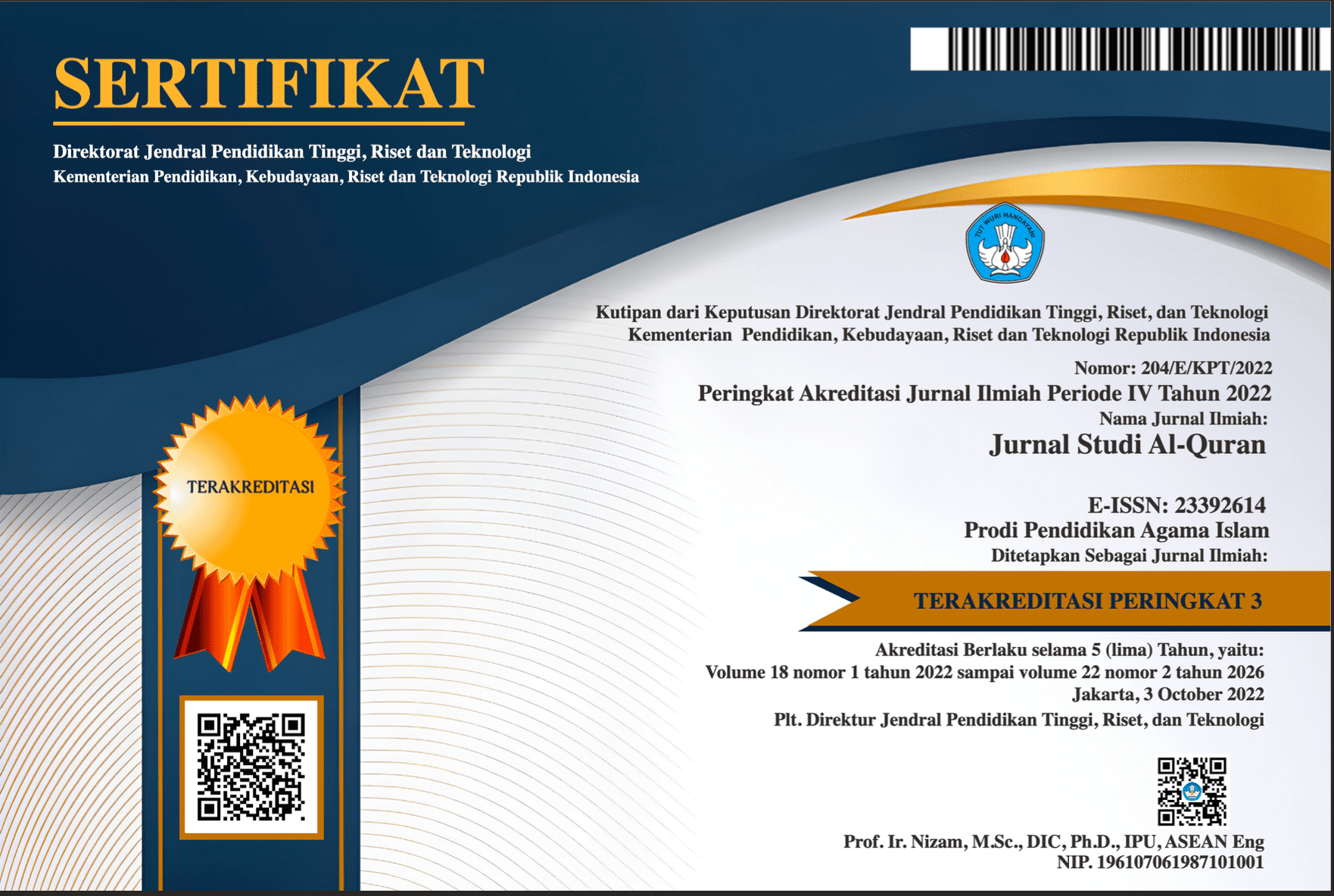
| Accreditation | SINTA 3, Decree No. 204/E/KPT/2022 (3 October 2022) |
| Access model | Full open access under a Creative Commons Attribution 4.0 International (CC BY 4.0) license; authors retain copyright |
| Address | LPPM Universitas Negeri Jakarta, Ki Hajar Dewantara Building, Jl. Rawamangun Muka, East Jakarta, Indonesia |
| Contact | jurnalstudialquran@unj.ac.id · Tel./Fax +62 21 47881925 |
The journal's title, ownership, and ISSN are not changed without public notice on the journal website and notification of the ISSN centre and indexing services.
2. Governance Structure
- Publisher (LPPM UNJ): Appoints the Editor-in-Chief, provides financial, technical, and administrative support, approves journal policies, and guarantees editorial independence.
- Editor-in-Chief: Holds overall responsibility for the journal's content, editorial decisions, policies, and ethical standards, and leads the editorial team.
- Managing Editor: Manages day-to-day operations, the OJS workflow, publication schedules, and communication with authors and reviewers.
- Associate Editors / Handling Editors: Manage manuscripts in their area of expertise, select reviewers, and recommend decisions.
- Editorial Board: Scholars from Indonesia and abroad who advise on scope, policy, and quality, and may handle manuscripts or appeals.
- Assistant Editors and Proofreaders: Support copyediting, layout, proofreading, and production.
The full names, affiliations, and scholarly profiles of all members are published on the Editorial Team page. All members have agreed to serve.
3. Appointment of Editors
- The Editor-in-Chief is appointed by the publisher based on scholarly standing in Qur'anic studies or Islamic education and on editorial experience.
- Editors and editorial board members are appointed by the Editor-in-Chief based on their expertise, publication record in reputable journals, and commitment to the journal.
- The editorial team is reviewed periodically to ensure active participation, international representation, and diversity. Inactive members may be replaced.
- All editorial team members declare their conflicts of interest annually (see Conflict of Interest).
4. Editorial Independence
- Editorial decisions are made solely by the editors, based on scholarly merit, relevance to the journal's scope, and peer review.
- The publisher, university leadership, collaboration partners, and funders do not interfere in decisions on individual manuscripts.
- Manuscripts from UNJ staff, students, or editorial team members receive no preferential treatment and follow the same double-blind review. The journal monitors the share of articles from its own institution to keep authorship diverse.
- Article Processing Charges and fee waivers are handled separately from the editorial process and never influence decisions.
5. Financing
- JSQ is financed by Universitas Negeri Jakarta and by an Article Processing Charge (APC) payable only after acceptance (see Article Processing Charges and Revenue Sources).
- Submission is free of charge, and there is no fee for withdrawals, corrections, or retractions.
- All fees and waiver conditions are published on the journal website before submission.
- Any sponsorship or advertising is governed by the Sponsorship Disclosure and Advertising Policy and has no influence on editorial decisions.
6. Operational Management
- Platform: The journal runs on Open Journal Systems (OJS), hosted by Universitas Negeri Jakarta. All submissions, reviews, and decisions are managed and recorded in the system (see Open Journal Management).
- Workflow: Initial evaluation within 1–2 weeks, first decision within 5–7 weeks, and final decision within 10–16 weeks of submission (see Peer Review Process).
- Quality Assurance: Similarity screening (maximum 20%), a standard manuscript template, copyediting and proofreading, and DOI registration with Crossref.
- Archiving: Published articles are preserved in the Universitas Negeri Jakarta repository so that they remain accessible if the journal ceases publication (see Archiving Policy).
- Indexing: SINTA, DOAJ, Garuda, Dimensions, Google Scholar, Scilit, WorldCat, and Moraref. Indexing information is kept accurate and up to date.
- Records: Editorial and peer review records are kept confidentially for at least five years.
- Policy Review: Journal policies are reviewed regularly to stay aligned with COPE guidance and accreditation requirements.
7. Complaints
- Complaints about the journal's management, processes, or staff should be sent to the Editor-in-Chief at jurnalstudialquran@unj.ac.id.
- Complaints are acknowledged within 7 working days and answered within 30 days.
- Complaints about the Editor-in-Chief are handled by a senior editorial board member or by the publisher.
- If a complainant remains dissatisfied, the matter may be referred to COPE.
Related Policies
The journal's management is guided by its published policies, including the Author Guidelines, Peer Review Process, Publication Ethics, Research Misconduct, Conflict of Interest, Correction and Retraction, and AI Policy.