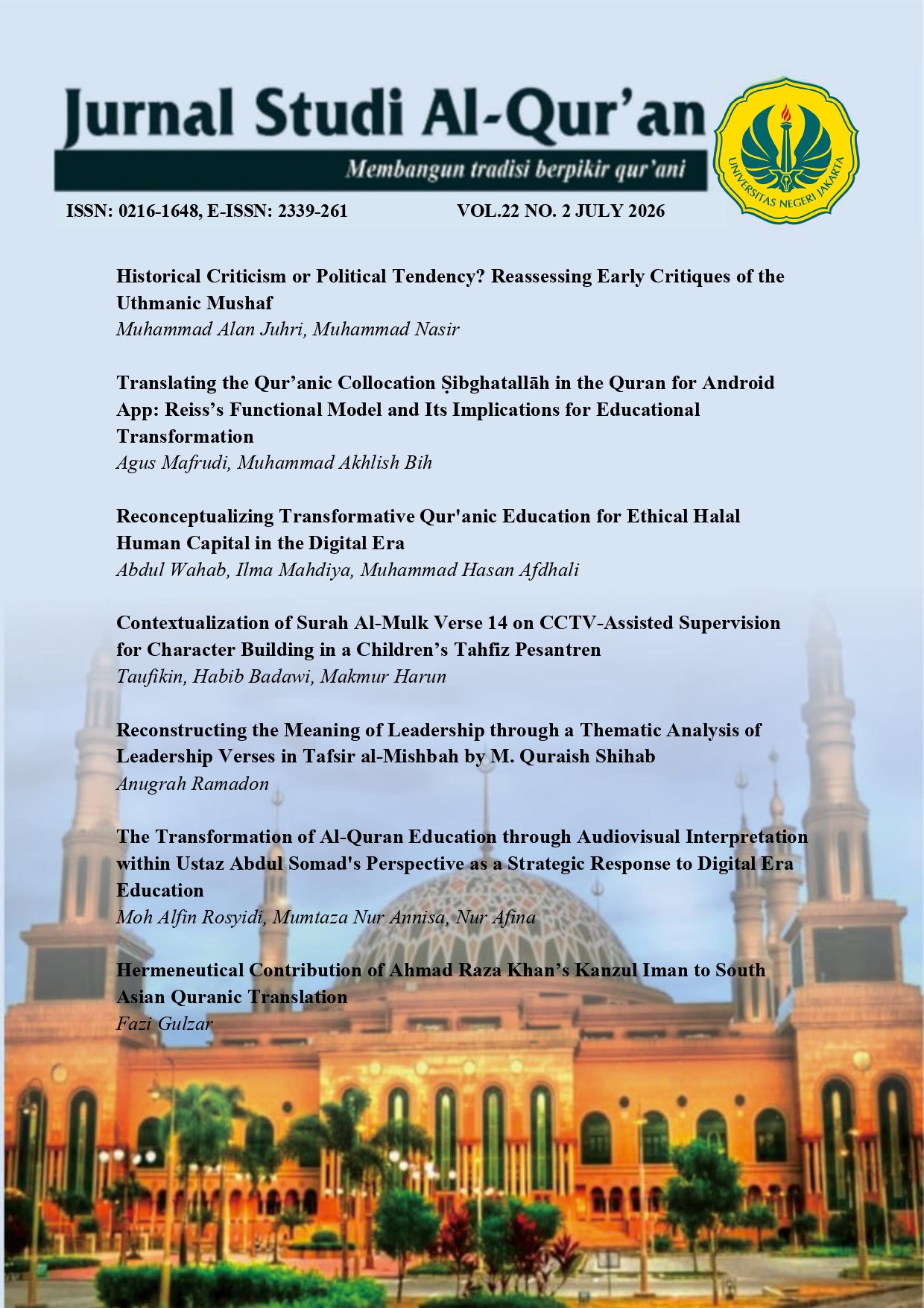
Hermeneutical Contribution of Ahmad Raza Khan’s Kanzul Iman to South Asian Quranic Translation
DOI:
https://doi.org/10.21009/JSQ.22.2.07Keywords:
Ahmad Raza Khan, Kanzul Iman, Quranic Translation, Sunni Orthodoxy, Urdu ExegesisAbstract
This study presents a critical analysis of Kanzul Iman (Treasure of Faith), a 1911 Urdu translation of the Qur'an by Imam Ahmad Raza Khan, which stands as a pivotal pillar of the Islamic scholarly tradition in South Asia. The research aims to evaluate Kanzul Iman based on its linguistic precision, theological coherence, and spiritual sublimity, while examining how the work upholds orthodox Sunni hermeneutics despite its accessibility to Urdu-speaking audiences. Employing qualitative methods including textual analysis, historical contextualization, and a review of academic reception, the study dissects the translation's structural framework and interpretive approach. The findings demonstrate that Kanzul Iman successfully bridges classical Islamic scholarship with accessible local-language expression, safeguarding Sunni orthodoxy against early 20th-century theological shifts without compromising textual clarity or reverence for the Qur'an. These findings derive from qualitative textual analysis and do not reflect a quantitative corpus-linguistic verification of lexical equivalence between the Arabic source and Urdu target texts, nor do they include an empirical study of reader reception. The study’s primary contribution lies in offering profound insights into Qur'anic exegesis and South Asian Islamic thought by affirming the enduring relevance of Kanzul Iman in modern Muslim discourse and serving as a model of how vernacular translations can sustainably preserve the integrity of religious dogma.
References
Al-Madina Al-Ilmiyyah. (2023). Ala Hazrat and services to the Qur'an. Maktaba-tul-Madina / Islamic Research Center.
Almjlad, S. S. A. (2025). Semantic untranslatability in Quranic discourse: Challenges and contextual remedies in English translation. Cogent Arts & Humanities, 12(1), Article 2542336. https://doi.org/10.1080/23311983.2025.2542336
Bauer, K. (2013). Gender hierarchy in the Qur'an: Medieval interpretations, modern responses. Cambridge University Press. https://doi.org/10.1017/CBO9781139048170
Creswell, J. W., & Creswell, J. D. (2018). Research design: Qualitative, quantitative, and mixed methods approaches (5th ed.). SAGE Publications.
Denzin, N. K., & Lincoln, Y. S. (Eds.). (2018). The SAGE handbook of qualitative research (5th ed.). SAGE Publications.
El-Awa, S. M. (2006). Textual relations in the Qur'an: Relevance theory and thematic structure. Routledge. https://doi.org/10.4324/9780203014486
Gadamer, H.-G. (2004). Truth and method (J. Weinsheimer & D. G. Marshall, Trans.; 2nd rev. ed.). Continuum.
Hashas, M. (2021). Pluralism in Islamic contexts: Ethics, politics and modern challenges. Springer Nature. https://doi.org/10.1007/978-3-030-66089-5
Hermansen, M. (2014). Soteriological boundaries and the 'Other' in Muslim translations of the Quran in South Asia. Journal of South Asian Religious History, 2(1), 45–68.
Jahangir, M. (2009). Historical context of Imam Ahmad Raza's Quranic translation. Journal of Islamic Studies and Culture, 14(2), 25–36.
Kidwai, A. R. (2017). Translating the Untranslatable: A critical survey of English translations of the Quran. Quranic Studies Council.
Maarif-e-Raza. (2009). Special issue: Centennial of Kanzul Iman. Quarterly Maarif-e-Raza, 29(4), 108–114.
Nomani Qadri, M. M. A. M. (2009). Publication of Kanzul Iman translation. Raza Book Review (Al-Qalam Foundation), 2(7–8), 71.
Palmer, R. E. (1969). Hermeneutics: Interpretation theory in Schleiermacher, Dilthey, Heidegger, and Gadamer. Northwestern University Press.
Pink, J. (2019). Muslim Quranic interpretation for the modern world. Edinburgh University Press. https://doi.org/10.3366/edinburgh/9781474431200.001.0001
Qadri, A. A. H. S. (2009). Principles of Qur'anic translation. Raza Book Review (Al-Qalam Foundation), 2(7–8), 25–31.
Qadri, M. (2009). Imam Ahmad Raza's Qur'anic translation, Kanzul Iman in the mirror of history. Quarterly Maarif-e-Raza, 29(3), 116–122.
Qasmi, J. A. (2017). Services of subcontinent scholars to Qur'an and Hadith. Jamia Farooqia Research Series, 11(2), 101–125.
Rieker, K. (2021). Vernacularization and authority in South Asian Islam. Modern Asian Studies, 55(3), 890–925. https://doi.org/10.1017/S0026749X2000015X
Rippin, A., & Mojaddedi, J. (Eds.). (2014). The Wiley Blackwell companion to the Qur'an (2nd ed.). Wiley-Blackwell. https://doi.org/10.1002/9781118964804
Rizvi, H. K. (n.d.). Jami al-Ahadith (Vol. 8). Shabbir Brothers.
Saeed, A. (2006). Interpreting the Qur'an: Towards a contemporary approach. Routledge. https://doi.org/10.4324/9780203016770
Saeed, A. (2008). The Quran: An introduction. Routledge. https://doi.org/10.4324/9780203938454
Thaqafi, M. (2022). Distinctive features of Kanzul Iman. My Islamic Information Journal, 5(1), 15–28.
Wilson, M. (2009). Translating scripture in colonial contexts: Linguistic precision and religious authority. Comparative Hermeneutics, 33(4), 210–235.
Downloads
Published
How to Cite
Issue
Section
License
Copyright (c) 2026 Fazi Gulzar (Author)

This work is licensed under a Creative Commons Attribution 4.0 International License.
Authors who publish with this Journal agree to the following terms:
- Author retain copyright and grant the journal right of first publication with the work simultaneously licensed under a creative commons attribution licensethat allow others to share the work within an acknowledgement of the work’s authorship and initial publication of this journal.
- Authors are able to enter into separate, additional contractual arrangementfor the non-exclusive distribution of the journal’s published version of the work (e.g. acknowledgement of its initial publication in this journal).
- Authors are permitted and encouraged to post their work online(e.g. in institutional repositories or on their websites) prior to and during the submission process, as it can lead to productive exchanges, as well as earlier and greater citation of published works.
Users/public use of this website will be licensed to CC BY