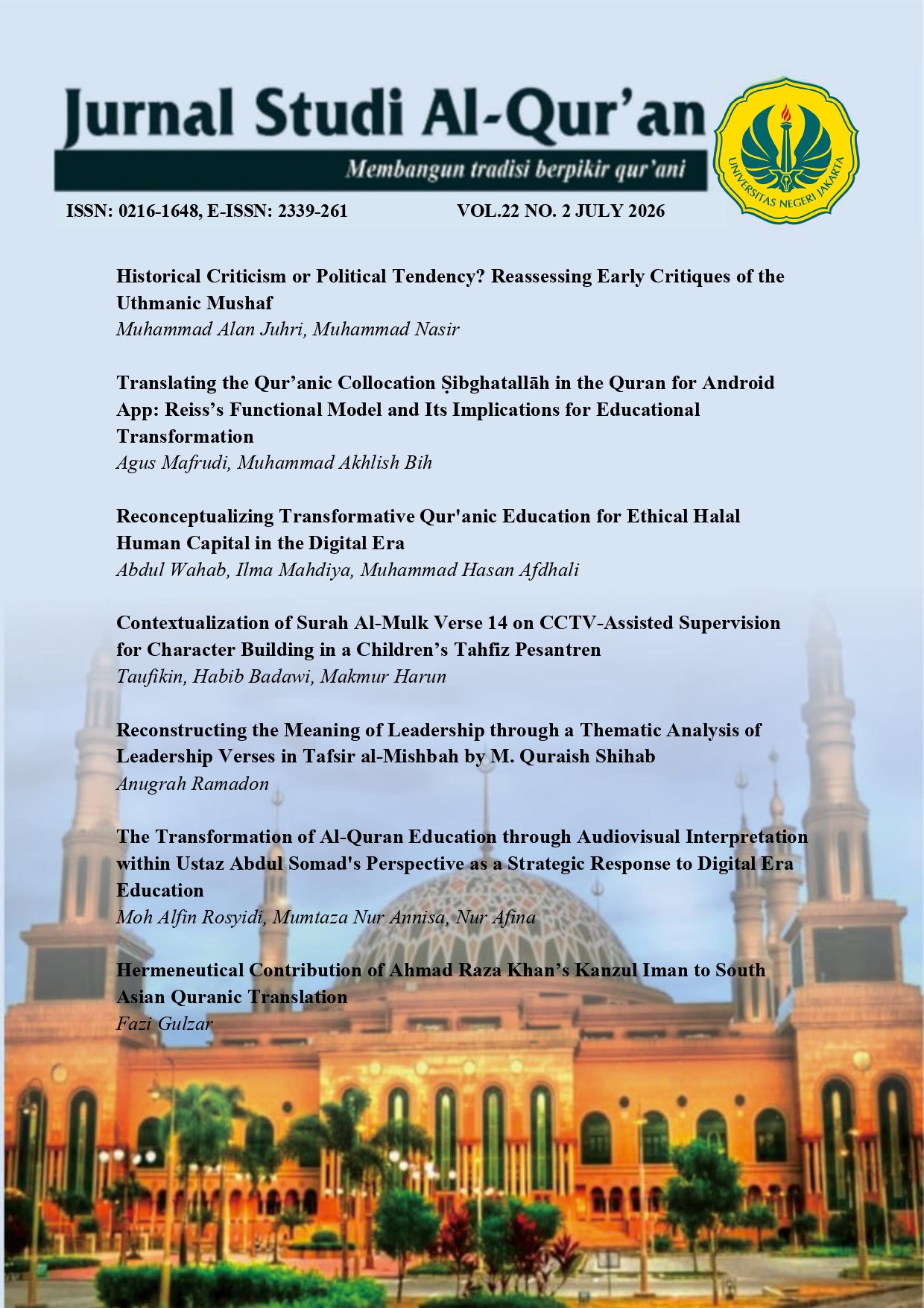
The Transformation of Al-Quran Education through Audiovisual Interpretation within Ustaz Abdul Somad's Perspective as a Strategic Response to Digital Era Education
DOI:
https://doi.org/10.21009/JSQ.22.2.06Keywords:
Ustaz Abdul Somad, Qur'anic Education, Audiovisual Exegesis, Digital Pedagogy, TACP ModelAbstract
The digital era has vastly expanded access to Quranic learning while simultaneously triggering new challenges regarding shifts in interpretive authority, pedagogical sequencing, and the focus of religious attention. In response to these digital-era educational dynamics, this study examines the transformation of Quranic education through audiovisual tafsir (exegesis) pedagogy from the perspective of Ustaz Abdul Somad (UAS). The Method employs qualitative discourse analysis on two full-length YouTube lectures discussing Surah al-Mu'awwidhatayn (al-Falaq and al-Nas). Explanatory segments serve as the units of analysis, with corpus coding based on textual-linguistic, intertextual-authoritative, contextual, and performative dimensions. The findings reveal that UAS’s pedagogy transforms through a synthesis model termed TACP (Text-Authority-Context-Performance). This model operates via four strategic steps: lexical-grammatical scaffolding, authoritative source validation, contextual translation, and audiovisual demonstration. Although this model renders Quranic education more accessible and engaging for audiences, it entails three inherent risks: fragmented consumption, figure-centric authority, and the oversimplification of exegesis. As a contribution, the study formulates strategic guidelines for educators and digital platforms to foster a superior learning ecosystem; these include publishing lectures within their full context, explicitly citing references, creating indexed playlists, and comprehensively strengthening digital tafsir literacy.
References
Abroro, M. (2021). Konstruksi wacana keagamaan digital: Penafsiran Al-Qur'an dan oralitas wacana Gus Baha'. Jurnal Studi Ilmu-Ilmu Al-Qur'an dan Hadis, 22(1), 31–50. https://doi.org/10.14421/qh.2021.2201-02
al Zahrah, F. (2020). Digitalisasi tafsir Al-Qur'an: Studi komparatif metode tafsir M. Quraish Shihab di media cetak dan digital. Jurnal Hermeneutika, 14(2), 155–172.
Azizy, J., Syarifuddin, M. A., & Ubaidah, H. H. (2023). Thematic presentations in Indonesian Qur'ānic commentaries. IJIMS: International Journal of Islam in Southeast Asia, 13(2), 227–252. https://doi.org/10.18326/ijims.v13i2.227-252
Barkah, Q. (2022). Penafsiran Surah Al-Fatihah di era digital: Analisis wacana keagamaan Gus Baha'. Jurnal Komunikasi Islam, 12(1), 45–62.
Bou-Franch, P., & Garcés-Conejos Blitvich, P. (Eds.). (2019). Analyzing digital discourse: New insights and approaches. Palgrave Macmillan. https://doi.org/10.1007/978-3-319-92663-6
Campbell, H. A. (2010). When religion meets new media. Routledge. https://doi.org/10.4324/9780203695371
Campbell, H. A. (2017). Surveying theoretical approaches within digital religion studies. New Media & Society, 19(1), 15–24. https://doi.org/10.1177/1461444816649912
Creswell, J. W., & Creswell, J. D. (2018). Research design: Qualitative, quantitative, and mixed methods approaches (5th ed.). SAGE Publications.
Evolvi, G. (2019). Materializing digital religion: The internet and religious authority in everyday life. Routledge. https://doi.org/10.4324/9780429440380
Ghozali, M. (2022). Metode tafsir thematic (Maudhu'i) Ustaz Adi Hidayat dalam media YouTube. Jurnal Ilmu Al-Qur'an dan Hadis, 5(1), 20–38.
Harahap, I. A. (2024). Analysis of the implementation of Wahdatul Ulum on the influence of the lecture method through social media in strengthening Islamic faith. Jurnal Kajian Agama dan Da'wah, 6(1), 12–28.
Hasan, N. (2022). Islamic preaching and social media in Indonesia. Indonesia and the Malay World, 46(134), 34–52. https://doi.org/10.1080/13639811.2018.1416798
Jones, R. H., Chik, A., & Hafner, C. A. (Eds.). (2015). Discourse and digital practices: Doing discourse analysis in the digital age. Routledge. https://doi.org/10.4324/9781315726465
Lukman, F. (2018). Digital hermeneutics and a new face of the Qur'ān commentary: The Qur'ān in Indonesian's Facebook. Al-Jāmi'ah: Journal of Islamic Studies, 56(1), 95–120. https://doi.org/10.14421/ajis.2018.561.95-120
Miles, M. B., Huberman, A. M., & Saldana, J. (2014). Qualitative data analysis: A methods sourcebook (3rd ed.). SAGE Publications.
Nurjana, I. (2024). Pendekatan Adabi Ijtima'i KH Mustofa Bisri dalam penafsiran Al-Qur'an di media sosial. Jurnal Studi Keislaman, 10(1), 55–72.
Ong, W. J. (2012). Orality and literacy: The technologizing of the word (3rd ed.). Routledge. https://doi.org/10.4324/9780203103708
Prahastiwi, E. D. (2023). Implementation of the Muraja'ah method as an effort to improve short surah memorization skills in elementary schools. Else (Elementary School Education Journal), 7(1), 101–115.
Ramadhani, H. N. (2023). Implementation of Islamic moral development to strengthen Alpha Generation early childhood in the digital era at Sultan Agung Kindergarten, UII Waqf Foundation, Yogyakarta [Unpublished master's thesis]. Universitas Islam Indonesia.
Retnowati, Y. (2019). Methods for learning to memorize short surahs in early childhood full-day education in Bantul Regency. Al-Athfal: Journal of Child Education, 5(1), 4–18.
Rif'ah, A. (2023). Analisis metode tahlili dan muqaran dalam penafsiran Firanda Andirja di YouTube. Jurnal Tafsir dan Media, 4(1), 58–75.
Rohmatulloh, D. M., As'ad, M., & Malayati, R. M. (2022). Gus Baha, Santri Gayeng, and the rise of traditionalist preachers on social media. Journal of Indonesian Islam, 16(2), 303–325. https://doi.org/10.15642/JIIS.2022.16.2.303-325
Rosowulan, T., Hasyim, A. F., Sholikhun, M., Purwanto, Djamil, A., In'amuzzahidin, M., & Wijaya, R. (2025). Pesantren's knowledge identity crisis in the digital era. Jurnal Ilmiah Peuradeun, 13(1), 49–76. https://doi.org/10.26811/peuradeun.v13i1.1287
Salsabila, N. (2023). Visualisasi teks tafsir dalam media digital: Studi kasus channel Firanda Andirja. Jurnal Komunikasi dan Media Keagamaan, 3(2), 50–68.
Sihabuddin, A. (2023). Penafsiran Surah Al-Isra' Ach. Dhofir Zuhry pada kanal NU Online: Pendekatan tahlili. Jurnal Studi Al-Qur'an, 19(1), 28–52.
Slama, M. (2017). A subtle economy of time: Social media and the transformation of Islamic preaching in Indonesia. Journal of the Royal Anthropological Institute, 23(S1), 94–108. https://doi.org/10.1111/1467-9655.12596
Downloads
Published
How to Cite
Issue
Section
License
Copyright (c) 2026 Moh Alfin Rosyidi, Mumtaza Nur Annisa, Nur Afina (Author)

This work is licensed under a Creative Commons Attribution 4.0 International License.
Authors who publish with this Journal agree to the following terms:
- Author retain copyright and grant the journal right of first publication with the work simultaneously licensed under a creative commons attribution licensethat allow others to share the work within an acknowledgement of the work’s authorship and initial publication of this journal.
- Authors are able to enter into separate, additional contractual arrangementfor the non-exclusive distribution of the journal’s published version of the work (e.g. acknowledgement of its initial publication in this journal).
- Authors are permitted and encouraged to post their work online(e.g. in institutional repositories or on their websites) prior to and during the submission process, as it can lead to productive exchanges, as well as earlier and greater citation of published works.
Users/public use of this website will be licensed to CC BY