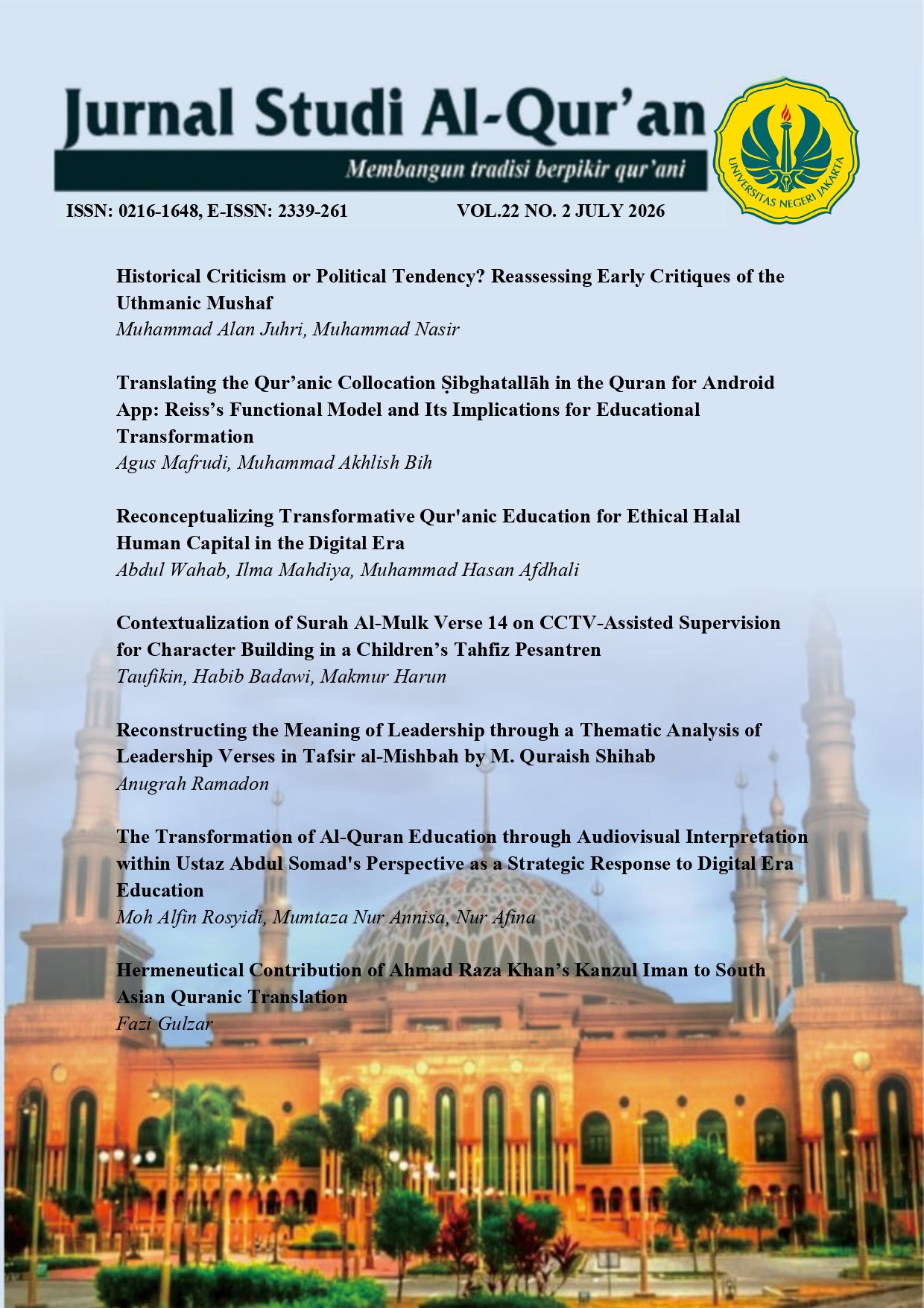
Reconceptualizing Transformative Qur'anic Education for Ethical Halal Human Capital in the Digital Era
DOI:
https://doi.org/10.21009/JSQ.22.2.03Keywords:
Transformative Qur'anic Education, Halal Human Capital, Digital Pedagogy, Ethical Halal Industry, Sustainable Halal EcosystemAbstract
The rapid digitalization of the global halal industry, driven by the integration of artificial intelligence (AI), blockchain, and digital ecosystems, presents critical challenges regarding ethics, spirituality, and professional integrity. Conventional Qur’anic education has yet to fully address these challenges. In response, this study aims tobridge the gap between digital pedagogy and halal industry management, fields that have hitherto operated in isolation. Employing a qualitative conceptual study method based on an integrative literature review, this research reconceptualizes transformative Qur’anic education through a four-pillar framework: Qur’anic ethical values, transformative digital pedagogy, halal professional competence, and a sustainable halal ecosystem. The findingsaffirm that Qur’anic education can serve as a strategic foundation for cultivating halal-sector human resources who are adaptive, highly ethical, and digitally competent. As a contribution, this study offers a new theoretical paradigm that synergizes Islamic educational philosophy with digital ethics, while providing practical guidance for policymakers to support the Sustainable Development Goals (SDGs).
References
Ab Wahab, Mastura. (2024). Building a value-based workforce through Islamic work value-based recruitment: A conceptual review. Asian Academy of Management Journal, 29(1), 255–283. https://doi.org/10.21315/aamj2024.29.1.10
Abubakari, Mussa Saidi. (2025). Digital technologies adoption in Islamic education for fostering lifelong learning culture: Pilot survey preliminary insights. In M. Anshari, M. N. Almunawar, & P. O. de Pablos (Eds.), Multi-Industry Digitalization and Technological Governance in the AI Era. IGI Global. https://doi.org/10.4018/979-8-3373-1681-9.ch005
Akilah, Fahmiah, Abubakar, Achmad, & Mahfuz, Muhsin. (2026). A Qur'anic management framework for sustainable work ethics in the digital era: Operationalizing amānah and integrity for organizational resilience. Banco, 8(1), 27–46. https://doi.org/10.35905/banco.v8i1.15148
Alim, Nik Nurul Akmal, Wahid, Khairussaadah, Zamani, Siti Nor Haliza Abd, & Adenan, Faezy. (2025). Artificial intelligence as a support tool for Quran memorization: An exploratory study on the potential use of AI applications among non-Islamic studies students. Quranica, 17(2), 157–186.
Amin, Husna, Djawas, Mursyid, Nurdin, Abidin, & Akbar, Rhmatul. (2025). Environmental paradigm transformation through integrative interpretation: Perspective of Quranic ecological hermeneutics. International Journal of Islamic Thought, 28, 52–63. https://doi.org/10.24035/ijit.28.2025.334
Amirudin, Iqbal Amar Muzaki, & Nurhayati, Sri. (2026). Reflective digital pedagogy in Islamic religious education and religious character formation in higher education. International Journal of Learning, Teaching and Educational Research, 25(2), 763–782. https://doi.org/10.26803/ijlter.25.2.34
Amran, Najah Nadiah, Daud, Burhan Che, & Hussin, Haziyah. (2025). Transformation of Al-Quran and Al-Sunnah education: Needs and challenges towards dynamic and impactful learning. Global Journal Al-Thaqafah, 256–275. https://doi.org/10.7187/GJATSI122025-17
Arifin, Ah Ali, & Kholis, Nur. (2025). Spiritual values in a digital workplace: The integration of Islamic ethics into human resource development at Bank Syariah Indonesia. Qudus International Journal of Islamic Studies, 13(1), 235–268. https://doi.org/10.21043/qijis.v13i1.33522
Birgün, Mehmet. (2026). Integrating AI into Qur'an learning: Technical advances and pedagogical gaps. Social Sciences and Humanities Open, 13, 102499. https://doi.org/10.1016/j.ssaho.2026.102499
Genç, Hayati, & Yilmaz, Ali. (2025). The teaching of the Quran in the digital age: The role of technology and social media in Quran education. Mutefekkir, 12(23), 239–267. https://doi.org/10.30523/mutefekkir.1733231
Hashim, Yumi Zuhanis Has-Yun, Ahmad, Anis Najiha, Ahmad, Izzah Az-Zahra, Samsudin, Nurhusna, & Abbas, Phirdaous. (2024). Exploring halal science research: Do they meet the Tawhidic paradigm? Do they need Islamization of knowledge? Journal of Fatwa Management and Research, 29(1), 1–22. https://doi.org/10.33102/jfatwa.vol29no1.559
Jaakkola, Elina. (2020). Designing conceptual articles: Four approaches. AMS Review, 10(1), 18–26. https://doi.org/10.1007/s13162-020-00161-0
Kartika, Betania, Razali, M. Afiq, & Bella-Salsa, Aisah. (2024). Toyyiban parameter in halal food industry; A thematic study from Qur'an and Sunnah. In A. Amid, A. A. M. Elgharbawy, & W. A. Abualsunun (Eds.), Solving Halal Industry Issues Through Research in Halal Sciences. Springer Nature. https://doi.org/10.1007/978-981-97-3843-4_7
Kusnadi, Sulaeman Mubaidi, & Zulfikar, Eko. (2025). Systematic literature review (SLR) on Qur'anic learning in Indonesia (2014-2024). Quranica, 17(2), 28–60.
Nasir, Khairulnazrin, Zaman, Rahim Kamarul, Hilmi, Ahmad Bazli Ahmad, Mahadzir, Abdul Hakim, & Mustaffa, Ahmad Mukhlis Bin. (2025). Artificial intelligence integration in mobile applications: Innovation and challenges in supporting Quran memorization and review. Quranica, 17(2), 612–645.
Nusran, Muhammad, Noor, M. Azemi M., Marasabessy, Sitnah Aisyah, & Mel, Maizirwan. (2025). Sustainable development platform for a halal ecosystem: An alternative solution. Industrial Engineering and Management Systems, 24(4), 611–623. https://doi.org/10.7232/iems.2025.24.4.611
Putra, Purniadi, Ilias, Mohd Faeez, Hartono, Rudi, Burhanuddin, Saputra, Nanda, & Barsihanor. (2026). Digital literacy as a transformative framework for character education: A case study in Madrasah Ibtidaiyah. Nazhruna: Jurnal Pendidikan Islam, 9(1), 33–51. https://doi.org/10.31538/nzh.v9i1.429
Rahman, Md. Mahfujur. (2024). Halal industry contributions to sustainable development: Inclusive education and indigenous knowledge systems. In S. K. Behera, A. H. Ibrahim, & F. Romdhani (Eds.), Inclusivity and Indigeneity in Education for Sustainable Development. IGI Global. https://doi.org/10.4018/979-8-3693-2802-6.ch007
Rahman, Md Mahfujur, & Ahmad, Zaki. (2024). Lifelong learning and technologic advancement in the halal industry: Navigating the digital age embracing technological advancements for lifelong learning. In M. M. Kh. Hawamdeh & F. Abdelhafid (Eds.), Embracing Technological Advancements for Lifelong Learning. IGI Global. https://doi.org/10.4018/979-8-3693-1410-4.ch009
Raja Yusof, Raja Jamilah, Norasid, Mohamad Alihanafiah, & Abdullah, Mustaffa. (2025). Digital Al-Qur'an applications and artificial intelligence (AI): An overview. Quranica, 17(2), 646–676.
Rekan, Abd. Aziz, Howell, Hafeezur-Rahman, Salleh, Muhamad Nasir Mohamad, Kassim, Noorafini, & Rokhimawan, M. Agung. (2025). Bridging knowledge and character: Cultivating student development through Islamic educational leadership. Kharisma, 4(2), 125–144. https://doi.org/10.59373/kharisma.v4i2.123
Snyder, Hannah. (2019). Literature review as a research methodology: An overview and guidelines. Journal of Business Research, 104, 333–339. https://doi.org/10.1016/j.jbusres.2019.07.039
Syahir, Aminun Nabil Ahmad, Abidin, Mohd Syukri Zainal, Sa’ari, Che Zarrina, & Rahman, Muhamad Zulfadli Abdul. (2025). Artificial intelligence and digital transformation in Qur'anic studies: A systematic literature review. Quranica, 17(2 Special Issue), 542–585.
Wahab, Abdul, Kuswanjono, Arqom, & Mahdiya, Ilma. (2026). Halal industry and Islamic epistemology: Implications for policy, ethics, and global practices. Journal of Islamic Economic Laws, 9(01), 144–169. https://doi.org/10.23917/jisel.v9i01.13268
Xiao, Yu, & Watson, Maria. (2019). Guidance on conducting a systematic literature review. Journal of Planning Education and Research, 39(1), 93–112. https://doi.org/10.1177/0739456X17723971
Zakariyah, Abdul Muhid, & Arifin, Miftah. (2025). Transformation of Al-Qur'an memorization learning in the digital age through the blended learning flipped classroom approach. Nazhruna: Jurnal Pendidikan Islam, 8(3), 594–606. https://doi.org/10.31538/nzh.v8i3.193
Downloads
Published
How to Cite
Issue
Section
License
Copyright (c) 2026 Abdul Wahab, Ilma Mahdiya, Muhammad Hasan Afdhali (Author)

This work is licensed under a Creative Commons Attribution 4.0 International License.
Authors who publish with this Journal agree to the following terms:
- Author retain copyright and grant the journal right of first publication with the work simultaneously licensed under a creative commons attribution licensethat allow others to share the work within an acknowledgement of the work’s authorship and initial publication of this journal.
- Authors are able to enter into separate, additional contractual arrangementfor the non-exclusive distribution of the journal’s published version of the work (e.g. acknowledgement of its initial publication in this journal).
- Authors are permitted and encouraged to post their work online(e.g. in institutional repositories or on their websites) prior to and during the submission process, as it can lead to productive exchanges, as well as earlier and greater citation of published works.
Users/public use of this website will be licensed to CC BY