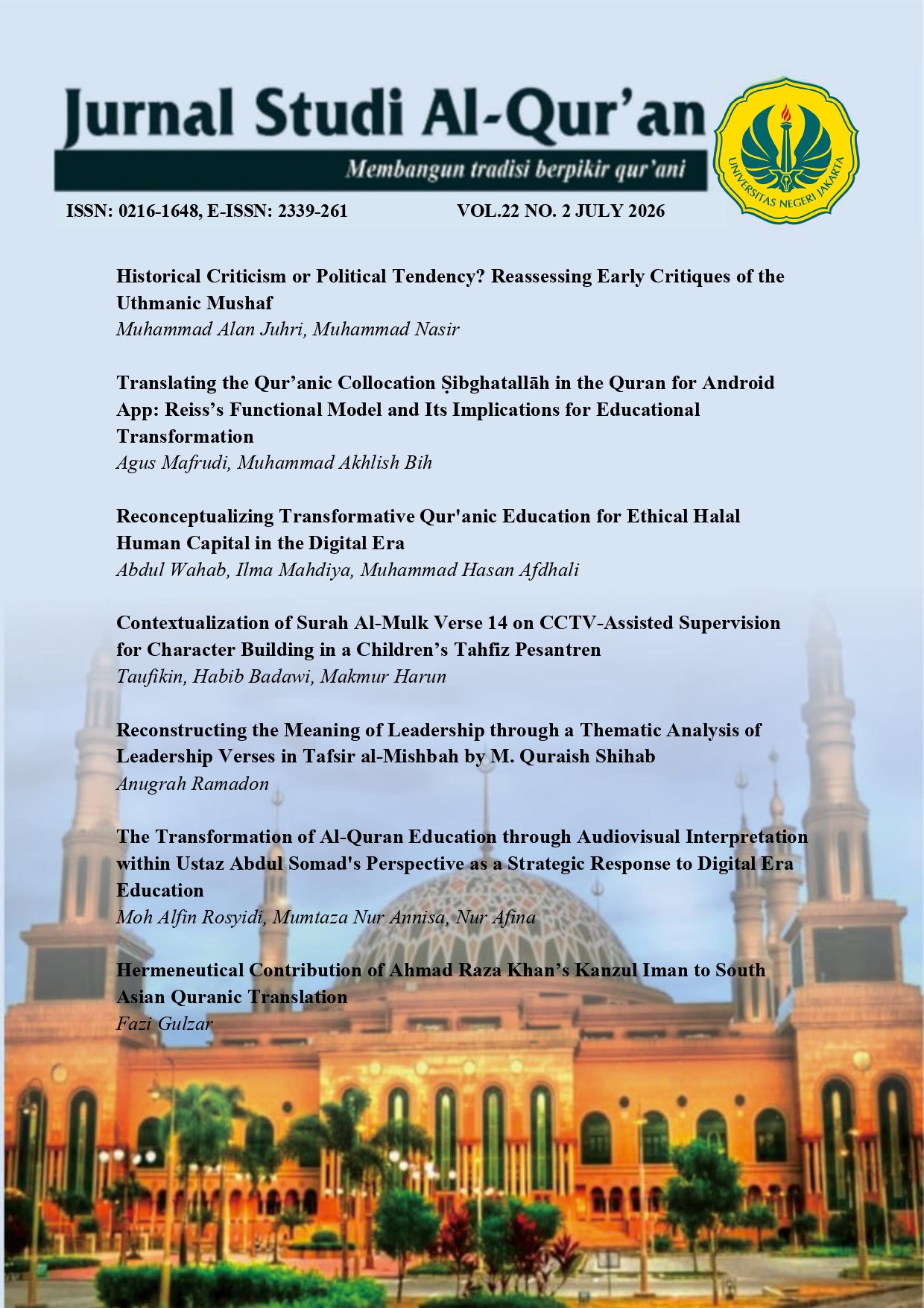
Reconstructing the Meaning of Leadership through a Thematic Analysis of Leadership Verses in Tafsir al-Mishbah by M. Quraish Shihab
DOI:
https://doi.org/10.21009/JSQ.22.2.5Keywords:
Tafsir Al-Misbah, Leadership, Reconstruction of Meaning, M. Quraish Shihab, Bernard M. BassAbstract
Leadership is a mandate given to a person to guide, direct, and serve the community in realizing the common good through moral integrity, justice, deliberation, and responsibility to Allah and fellow humans. This research aims to reconstruct the meaning of leadership in Tafsir Al-Misbah through thematic analysis of leadership verses and identify its contribution to the development of the contemporary Qur'anic leadership paradigm. The research uses a thematic-based qualitative method on Tafsir Al-Misbah as a primary source, supported by classical and modern interpretations, namely Jāmi' al-Bayān, Mafātīḥ al-Ghayb, Al-Taḥrīr wa al-Tanwīr, Tafsīr al-Manār, and Al-Mīzān fī Tafsīr al-Qur'ānas comparative sources. Data were collected through a documentary study of the verses of leadership and their interpretation, then analyzed through thematic coding of the leadership lexicon, including khalīfah, imām, qawwām, ulī al-amr, and shūrā, to reconstruct the principles of leadership that developed in Tafsir Al-Misbah. The results of the study show that Quraish Shihab reconstructs leadership as a mandate that integrates spiritual, moral, social, and humanitarian dimensions through five main principles, namely amānah, uswah, ʿadl, shūrā, and maṣlaḥah. A comparison with the tradition of tafsir shows that Tafsir Al-Misbah does not break the continuity of previous interpretations, but contextualizes them to meet the needs of contemporary Indonesian society. When read through the perspective of transformational leadership by Bernard M. Bass, some of these principles show conceptual suitability in the aspects of ethical and transformational leadership, although they still have different theological foundations. This research contributes to the development of tafsir studies by formulating contextual Qur'anic leadership paradigms and provides a conceptual foundation for leadership development in Islamic educational institutions.
References
‘Asyur, M. al-T. ibn. (1998). Tafsīr al-Tahrīr wa al-Tanwir. Dâr Shuhnûn li alNasyr wa al-Tauzi’.
Adz-Dzahabi, H. (1995). At-Tafsir wal Mufassirun. Maktabah Wahbah.
Al-Farmawi, A. A.-H. (1978). Al-Bidayah Fi Al-Tafsir Al-Mawdhu’i: Dirasat Manhajiyyat Maudhu’iyah. Maktabah al-Jumhuriyyah.
Al-Rāzi. (1995). Fakhr ad-Dīn, Mafātiḥ al-Ghayb. Dār al-Fikr.
Al-Thabari, A. J. M. bin J. (2000). Jami’ al-Bayan ’an Ta’wil Ayi al-Qur’an. Dar al-Kutub al-Ilmiyyah.
As-Sobuni, M. A. (1981). Mukhtasar Tafsir Ibn Katsir (juzuk 1 ce). Darl al-Quran al-Kareem.
Asyibli, B., Syarifudin, E., Lugowi, R. A., Islam, U., Sultan, N., & Hasanuddin, M. (2025). Model Kepemimpinan Partisipatif Vroom-Yetton dalam Meningkatkan Keterlibatan dan Pengambilan Keputusan di Lembaga Pendidikan : Sebuah Kajian Literatur. Nusantara: Jurnal Pendidikan Indonesia, 5(2).
Aulia, S., Badarussyamsi, & Rusydy, M. (2025). PEMIKIRAN QURAISH SHIHAB TENTANG KEPEMIMPINAN PEREMPUAN DALAM TAFSIR AL-MISBAH DAN TAFSIR TEMATIK. QANUN: Journal of Islamic Law and Studies, 3(2), 325–337.
Basyariah, S. (2009). Konsep-konsep Imarah, Kepemimpinan dalam islam dan Imamah (Kajian Kritis Historikal Tentang Sistem Pemerintahan Dalam Islam. Jurnal Ilmiah Sintesa, 8(2).
Bernard, N., Julian, S., Isnaeni, A. N., & Ramadhani, A. D. (2023). IMPLEMENTATION OT THE PROJECT BASED LEARNING MODEL IN. IMPLEMENTASI MODEL PJBL DALAM MATERI GEOMETRI KELAS VI SD BERBASIS TEORI VAN HIELE, 11(1), 1–13.
Bhattacharya, S. Venkatesh, V. G. Chatterjee, S. R. (2024). Responsible corporate leadership towards attainment of sustainable development goals. Routledge Published.
Efendi, Ahmad Fuad Nadjib, M. A. (2021). Mushaf Al-Qur’an Tadabbur Maiyah Padangmbulan. Yayasan Maiyah Al-Manhal.
Federspiel, H. M. (1994). Popular Indonesian Literature of the Qur’an. Cornell Modern Indonesia Project.
Gusmian, I. (2013). Khazanah Tafsir Indonesia: Dari Hermeneutika hingga Ideologi. LKIS.
Gutmann, A., & Thompson, D. (2004). Why Deliberative Democracy? Princeton University Press. Https://Doi.Org/10.1515/9781400826339.
Hanif, M. L. A. (2025). Konsep Kepemimpinan dalam Surah An-Nisa Ayat 58-59 Pada Tafsir Al Kasysyaf Karya Al-Zamakhsyari. Jurnal Studi Islam Indonesia ( JSII ), 3(1), 177–186.
Ichwan, M. N. (2003). Meretas Kesarjanaan Kritis al-Quran: Teori Hermeneutika Nasr Hamd Abu Zayd. Teraju.
Iswanto, A. Z. M. T. M. J. (2022). Konsep Kepemimpinan Pendidikan Islam Perspektif Muhammad Quraish Shihab dalam Tafsir AlMishbah. JIIP:Jurnal Ilmiah Ilmu Pendidikan, 6(11), 9432–9441.
Kaelan. (2012). Metode Penelitian Kualitatif Interdisipliner. Paradigma.
Kaufmann, Daniel and Kraay, A. (n.d.). Growth Without Governance Available at SSRN: https://ssrn.com/abstract=316861. Available at SSRN: Https://Ssrn.Com/Abstract=316861.
Moleong, L. J. (2018). Metodologi Penelitian Kualitatif. Remaja Rosdakarya.
Nuha, U. (2020). Kepemimpinan perempuan menurut Muhammad Tahir Ibnu Asyur dalam kitab al-Tahrir wa al-Tanwir. Universitas Islam Negeri Walisongo Semarang.
Nurtawab, Y. R. E. (2024). Western Qur’anic Studies in Indonesian Islamic Universities: Responses, Contestations, and Curriculum Politics N. Al Jami’ah Journal, 62(2).
Pink, J. (2019). Qur’anic Commentaries on the Internet. Brill.
Quraish Shihab. (2007). Ensiklopedia Al-Qur’an: Kajian Kosakata. Lentera Hati.
Riggio, B. M. B. R. E. (2006). Transformational Leadership, 2nd ed. NJ: Lawrence Erlbaum Associates.
Shihab, M. Q. (2002). Tafsir al-Misbah: Pesan, Kesan, dan Keserasian al-Qur’an. Lentera Hati.
Shihab, M. Q. (2022). Tafsir Al-Mishbah: Pesan, Kesan, dan Keserasian al-Qur’an. Lentera Hati.
Shihab, Q. (2010). Quraish Shihab Menjawab: 101 Soal Perempuan yang Patut Anda Ketahui. Lentera Hati.
van Knippenberg, D., & Sitkin, S. B. (2013). A critical assessment of charismatic—transformational leadership research: Back to the drawing board? The Academy of Management Annals, 7(1), 1–60. https://doi.org/10.1080/19416520.2013.759433
Downloads
Published
How to Cite
Issue
Section
License
Copyright (c) 2026 Anugrah Ramadon (Author); Abu Sari

This work is licensed under a Creative Commons Attribution 4.0 International License.
Authors who publish with this Journal agree to the following terms:
- Author retain copyright and grant the journal right of first publication with the work simultaneously licensed under a creative commons attribution licensethat allow others to share the work within an acknowledgement of the work’s authorship and initial publication of this journal.
- Authors are able to enter into separate, additional contractual arrangementfor the non-exclusive distribution of the journal’s published version of the work (e.g. acknowledgement of its initial publication in this journal).
- Authors are permitted and encouraged to post their work online(e.g. in institutional repositories or on their websites) prior to and during the submission process, as it can lead to productive exchanges, as well as earlier and greater citation of published works.
Users/public use of this website will be licensed to CC BY